


How a Little Girl’s Hacking Matrix Explains the Future of the AAA Single-Player Shooter

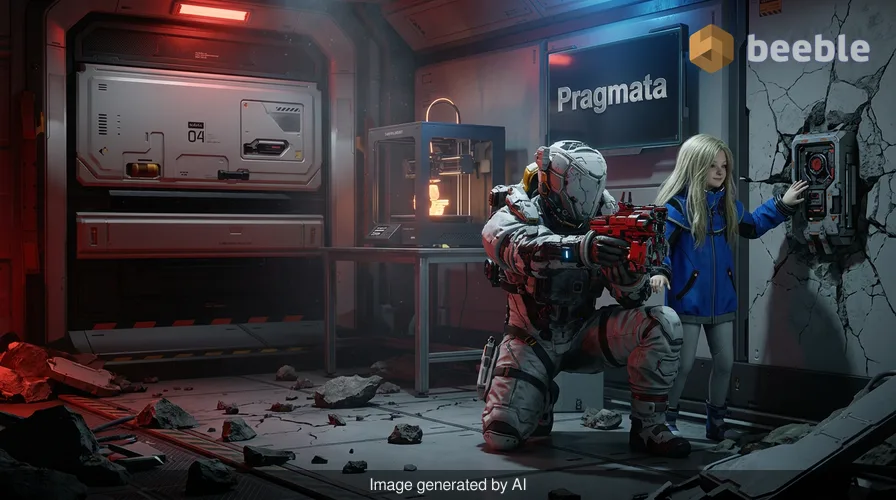
There is a specific, cold prickle of sweat that forms at the base of your neck when you realize you aren’t looking at the thing trying to kill you. In Capcom’s Pragmata, this happens every few minutes. You are Hugh Williams, an astronaut whose bulky, NASA-chic suit feels heavy and vulnerable, and you are staring intently at a floating geometric grid—a hacking matrix—while a three-story-tall security automaton thunders toward you. Your thumb dances across the face buttons to navigate a path to a green node, while your peripheral vision catches the metallic glint of a raised fist. It is a moment of profound vulnerability, a mechanical forced-distraction that creates a tension most modern shooters have long since traded for power fantasies.
This feeling isn't accidental; it is a clinical dissection of player psychology. Behind the scenes, Capcom is utilizing a high-stakes cognitive load to bridge the gap between the player’s anxiety and the character’s desperation. In an industry that has spent the last decade streamlining every friction point out of the user experience to ensure 'player retention,' Pragmata paradoxically finds its soul by forcing you to look away from the action. It is a bold, disruptive move for a big-budget new IP in 2026, a year where the 'safe bet' of a sequel or a live-service treadmill usually wins the boardroom debate.
The Architecture of Scarcity on the Moon
We often treat world-building as a decorative layer, but in Pragmata, the setting functions as the architectural foundation of the entire experience. The lunar medical base is a graveyard of near-future ambition, grounded by the concept of 'lunafilament.' This isn't the 'magic space dust' of lesser sci-fi; it is presented as a ubiquitous industrial raw material, the ink for the base’s massive 3D printing infrastructure. This groundedness matters because it makes the high-tech elements feel earned rather than conjured. When Hugh 3D prints a new tool, it doesn't feel like a menu selection; it feels like a survivalist using the only remaining lung of a dying facility.
This sense of place is essential for a game that spends so much time in silence. The eerie stillness of the base suggests a narrative weight that many AAA titles try to fill with constant chatter or waypoint markers. Instead, Pragmata trusts the player to sit with the emptiness. Zooming out to the industry level, this reflects a shift away from the bloated 'map-filler' design philosophy that dominated the early 2020s. We are seeing a return to the 'contained' blockbuster—games that value the density of an environment over its sheer square footage.
The Hacking Matrix as a Conversation
At its core, the combat in Pragmata is a rhythmic exchange between Hugh’s conventional ballistics and Diana’s digital interventions. Diana, the mysterious android girl who becomes your shadow, is the lens through which the world becomes manageable. When you aim down sights, you aren't just looking for a headshot; you are looking through Diana’s eyes. The hacking matrix that appears next to enemies is a literal visualization of her processing power.
This mechanic functions as a conversation between the player and the developer. The developer asks, 'How much risk are you willing to take for a clean kill?' Conventional weapons are mostly ineffective, clunky tools against the moon base’s robotic sentries. They are the 'noise' used to buy time for the 'signal'—the hack. This creates a multifaceted combat loop where you are constantly hot-swapping between weapons to manage ammo scarcity while waiting for the perfect window to engage with the hacking UI.
| Combat Element | Function | Strategic Trade-off |
|---|---|---|
| Basic Sidearm | Regenerative ammo; low damage | Forces frequent weapon switching during cooldown |
| Hacking Matrix | Bypasses armor; 'cracks' enemies | Leaves player blind to immediate physical threats |
| Strike Mode | High-damage burst via nodes | Requires pre-damaging enemies with conventional fire |
| Sticky Bombs | Shrinks enemy hacking grids | Limited resource; requires precision aiming |
| Lunafilament | 3D prints consumables/tools | Requires exploration to find 'raw' material nodes |
The Wolf, the Cub, and the Emotional Autopsy
Narratively speaking, Pragmata walks a path cleared by The Last of Us and God of War, utilizing the 'wolf-and-cub' trope to anchor its stakes. Hugh is the weary, pragmatic father figure; Diana is the gifted, naive ward. It is a familiar structure, perhaps even derivative to those who have played through the 'Dad-ification' of games over the last fifteen years. However, Pragmata avoids the trap of making Diana a mere escort mission burden. She is the source of your power, the literal UI through which you survive.
This creates a resonant bond that is reinforced in the Shelter, the game’s mission hub. Here, the game slows down to a crawl, allowing you to gift Diana keepsakes from Earth—holographic records of a world she has never seen. Through this audience lens, we see Hugh’s own nostalgia for Earth reflected in his attempts to explain childhood to an android. It is an emotional autopsy of what it means to be human in a post-human environment. The 'bingo board' mini-game with a friendly robot might seem like a frivolous addition, but it serves as a necessary psychological breather, a moment of levity that makes the subsequent terrors of the 'red rooms' feel more impactful.
Breaking the Content Walled Garden
Historically, Capcom has been a company that thrives when it balances its massive franchises (Resident Evil, Monster Hunter) with weird, singular experiments. Pragmata feels like the culmination of that experimental spirit. In everyday terms, it’s the difference between a franchise restaurant that delivers a predictable meal and a boutique bistro that surprises you with a flavor profile you didn’t know you wanted.
Paradoxically, the game’s biggest strength is its refusal to be 'infinite.' In an era of fragmented attention spans and algorithmic curation designed to keep us playing forever, Pragmata is a finite, authored experience. It has a beginning, a middle, and a thrilling conclusion that doesn't feel like it’s being stretched thin to satisfy a ten-year roadmap. It reminds us that the most profound media experiences are often the ones that know when to let go.
Reclaiming the Human Scale
Ultimately, Pragmata is a reminder of why we fell in love with single-player games in the first place. It isn't just about the 'newness' of the tech or the seamlessness of the RE Engine’s latest iteration; it’s about the specific, human connection formed between two characters in an impossible situation. From a creator's standpoint, it is a masterclass in how to introduce a new IP without falling into the 'ubiquitous open-world' trap.
As you finish the game and watch the credits roll, you’re left with a sense of completion that is increasingly rare in our digital buffet of endless content. Pragmata urges us to look away from the 'hacking matrix' of our own daily digital distractions and focus on the resonant, tangible relationships in front of us. It is a game about survival, yes, but more importantly, it is a game about what is worth surviving for. If this is the future of Capcom’s output, then the AAA industry might just be finding its way out of the dark.
Sources:
- Capcom Integrated Report 2025: Strategic Pivot Toward New IP Development.
- Developer Interview: 'The Psychology of Hacking in Pragmata,' Game Informer (March 2026).
- Industry Analysis: 'The Decline of the Live-Service Model and the Return of the Authored Experience,' Media Research Group (2025).
- Technical Deep Dive: 'RE Engine Evolution: Ray-Tracing and Physics in Lunar Environments,' Digital Foundry (April 2026).



See you on the other side.
Our end-to-end encrypted email and cloud storage solution provides the most powerful means of secure data exchange, ensuring the safety and privacy of your data.
/ Create a free account
