


How a Mock Documentation Page Infiltrated the Modern Developer Workflow

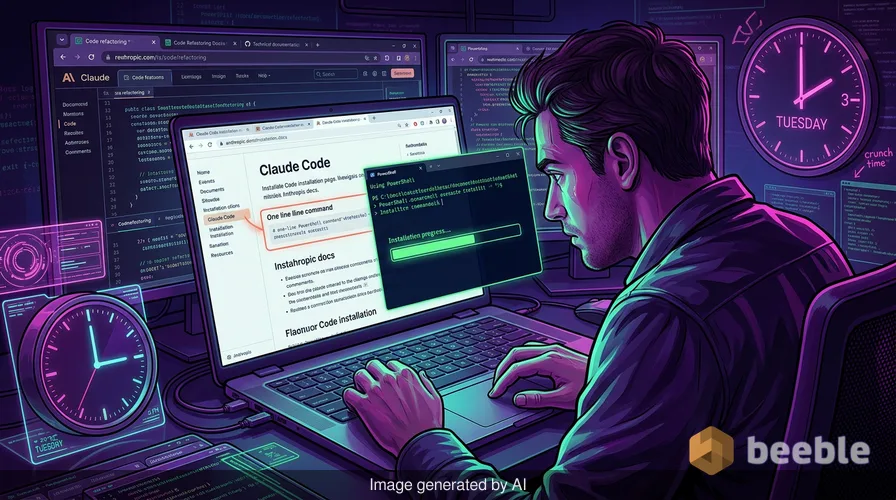
Imagine a mid-level software engineer named Alex. It is 3:00 PM on a Tuesday, and Alex is looking to shave twenty minutes off a tedious refactoring task. They have heard great things about Claude Code, Anthropic's command-line interface for agentic coding. A quick search for "install claude code" brings up a sponsored result that looks indistinguishable from official documentation. The page is clean, the typography matches Anthropic’s aesthetic perfectly, and there is a simple, one-line PowerShell command ready to be copied and pasted into a terminal.
Alex, like thousands of other developers under pressure to deliver, trusts the search engine’s ranking. They copy the command, paste it into their administrative shell, and hit enter. For Alex, the installation seems to proceed normally. Behind the scenes, however, their workstation has just become the initial access point for a sophisticated campaign designed to strip the credentials from their browser and pivot into the heart of their organization’s infrastructure.
From a risk perspective, this is not just another phishing attack. It is a precision-guided strike against the gatekeepers of the digital kingdom. This campaign, first detailed on 11 May 2026 by Ontinue’s Cyber Defense Center, highlights a shift in threat actor focus. By targeting the tools developers use to build, attackers are effectively bypassing the front door and walking straight into the server room.
The Illusion of Canonical Documentation
The brilliance of this campaign lies in its simplicity. The attackers didn't just build a fake site; they built a mirror. The lure page mimicked the layout of legitimate Claude Code documentation, but with a critical deviation: the installation command rendered in HTML was altered. While the genuine Anthropic command pulls from a trusted repository, the malicious version pointed to one of three operator-controlled domains registered in a flurry of activity in April 2026.
When I first looked at the network traffic associated with this campaign, I noticed a clever bit of tradecraft designed to defeat automated URL scanners. If a security tool like a sandbox or a crawler requested the /install.ps1 file directly, the server returned a verbatim, clean copy of the genuine Claude Code installer. It only served the malicious payload when specific headers or browser-like behaviors were detected. It is the digital equivalent of a Trojan horse that only opens its trapdoor once it is safely inside the city walls.
Decoupling the Attack: The PowerShell-Native Split
Once executed, the victim's terminal doesn't just install a coding tool; it fetches a 600 KB PowerShell loader. This script is heavily obfuscated—a common tactic, but the way it handles the actual theft is what caught my attention. Proactively speaking, most behavioral detection rules look for suspicious activity in a single process. If a native binary starts making network connections and reading browser databases, flags go up.
To circumvent this, the attackers used a split-architecture design. The PowerShell loader does the heavy lifting for the environment: it enumerates Chromium-family browsers like Chrome, Edge, Brave, Vivaldi, and the newer Arc or Perplexity Comet. It then reflectively injects a tiny, 4608-byte native helper into a live, legitimate browser process.
This helper is a masterclass in minimalism. It contains no network, file, or cryptographic imports. In a forensic isolation, the binary looks almost inert. Its sole purpose is to act as a bridge, invoking the browser’s internal interfaces to retrieve encryption keys. By the time the PowerShell script uses those keys to read the SQLite databases containing cookies and passwords, the "malicious" act has been distributed across different layers of the operating system, making it nearly invisible to traditional endpoint detection and response (EDR) tools.
Bypassing the Digital Vault: The IElevator2 Exploit
The architectural core of the attack targets a specific security feature in modern browsers: App-Bound Encryption. Introduced to stop exactly this kind of theft, App-Bound Encryption binds sensitive data to the identity of the application, theoretically preventing a third-party script from simply grabbing the cookie folder and running.
However, the threat actors behind this campaign have been tracking upstream Chromium changes with predatory focus. Within 60 days of the Chrome 144 release in January 2026, they had already adapted their loader to target the IElevator2 COM interface. In terms of data integrity, this interface is meant to be a high-privilege service that allows the browser to perform specific tasks. The malware tricks this service into handing over the master key, effectively turning the browser's own security mechanisms against it.
In my experience analyzing APT-level loaders, this level of agility is rare. It suggests an operator who is not just a script kiddie using leaked kits, but a development team with a dedicated focus on defeating the Chromium security roadmap. Interestingly, they left behind a signature of their own fallibility: a transcription error in the embedded Edge IElevator2 identifier. Two nibbles were transposed in the Data3 field. This causes the initial high-tech call to fail, forcing the malware to fall back to an older, noisier interface. For a defender, that malformed identifier is a gift—a high-confidence detection signature that can be used to hunt for this specific family across the network.
The Developer as a High-Value Pivot Point
We often talk about the human firewall in the context of administrative assistants or finance teams, but developers represent a unique and pervasive risk. As Vineeta Sangaraju, an AI research engineer at Black Duck, noted, a compromised developer workstation is rarely an end-state for an attacker. It is a pivot.
Developers typically have broad access to mission-critical assets. Their machines hold the session cookies for GitHub, AWS, and internal CI/CD pipelines. They have SSH keys to production servers and API tokens that bypass multi-factor authentication. One compromised workstation does not stay contained; it cascades. It pivots into source code repositories where attackers can inject backdoors into downstream software, a move we’ve seen in systemic supply-chain attacks like SolarWinds.
Furthermore, the malware includes a "regional exclusion" list. If the loader detects the host is in Russia, Iran, or other CIS nations, it exits silently. This is a common hallmark of actors operating out of those regions who wish to avoid local law enforcement scrutiny, adding a layer of geopolitical context to the technical analysis.
Building a Resilient Defense Against Tooling Attacks
So, how do we defend against an attack that looks like a legitimate part of a developer's workflow? Patching aside—since this malware exploits valid interfaces rather than unpatched vulnerabilities—we must look at architectural controls.
Proactively speaking, the most effective countermeasure is enforcing PowerShell Constrained Language Mode (CLM). This limits the ability of scripts to invoke the kind of complex COM and Win32 API calls required for reflective injection. When combined with robust script block logging, it allows SOC analysts to see the "how" of an attack even if the "what" is obfuscated.
Additionally, we need to treat the developer workstation as a high-trust, high-risk environment. This means:
- Implementing web content filtering that blocks newly registered domains (less than 30 days old), which would have neutralized this specific campaign.
- Moving away from long-lived session cookies and toward short-lived, hardware-bound tokens for access to cloud infrastructure.
- Educating engineering teams on the risks of "copy-paste" installations from non-canonical sources, even when they appear in search results.
At the end of the day, security is a cat-and-mouse game played at the speed of the Chrome release cycle. This campaign proves that threat actors are no longer waiting for zero-days; they are simply waiting for us to copy the wrong line of code.
Key Takeaways for IT and Security Leaders
- Verify the Source: Ensure developers only pull CLI tools and packages from official, verified repositories (e.g., direct GitHub releases or official npm/pip registries) rather than third-party documentation mirrors.
- Monitor COM Activity: Use EDR tools to monitor for unusual processes calling the
IElevatorandIElevator2interfaces, specifically looking for the malformed Edge IID signature. - Implement Persistence Hunting: Audit scheduled tasks for unusual polling intervals (e.g., once per minute) that point to external, non-corporate C2 domains.
- Enforce Least Privilege: Use Windows AppLocker or similar technologies to prevent unauthorized PowerShell loaders from executing in a high-privilege context.
Sources:
- Ontinue Cyber Defense Center: Threat Intelligence Report (May 2026)
- Chromium Project: App-Bound Encryption Technical Documentation
- MITRE ATT&CK: T1059.001 (Command and Scripting Interpreter: PowerShell)
- NIST SP 800-207: Zero Trust Architecture
Disclaimer: This article is for informational and educational purposes only. It does not replace a professional cybersecurity audit, forensic analysis, or incident response service. Always consult with a qualified security professional before making significant changes to your organization's security posture.



See you on the other side.
Our end-to-end encrypted email and cloud storage solution provides the most powerful means of secure data exchange, ensuring the safety and privacy of your data.
/ Create a free account
