


How a Poisoned Dependency Compromised the OpenAI Build Pipeline

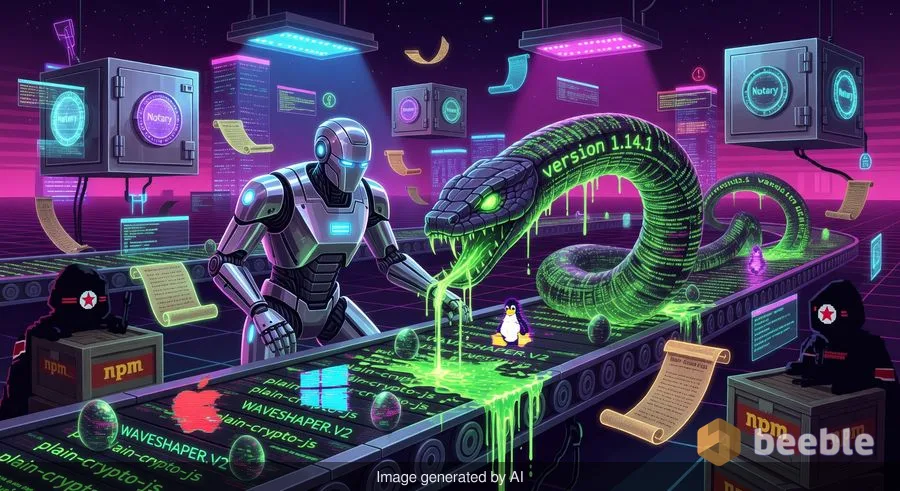
The modern software development lifecycle is a marvel of efficiency, yet it remains precariously balanced on a house of cards built from third-party code. We saw this reality manifest in late March when OpenAI, a company at the absolute vanguard of artificial intelligence, revealed that its macOS application signing process had been ensnared in a sophisticated supply chain attack. The culprit wasn't a zero-day exploit in their proprietary LLMs, but rather a malicious version of Axios, one of the most ubiquitous JavaScript libraries in existence.
From a risk perspective, this incident highlights the architectural paradox of modern DevOps. We build massive, resilient fortresses around our production data, yet we often leave the back door to the construction site wide open. In this case, the construction site was a GitHub Actions workflow—an automated pipeline designed to sign and notarize OpenAI’s macOS applications. By design, these workflows often reach out to the public internet to pull down dependencies. On March 31, that routine pull brought back a Trojan horse.
The Anatomy of the Axios Hijack
Behind the scenes, the compromise began not at OpenAI, but within the npm registry. The threat actor, identified by Google Threat Intelligence Group (GTIG) as the North Korean-linked group UNC1069, managed to hijack the account of a maintainer for the Axios package. This allowed them to push two poisoned versions: 1.14.1 and 0.30.4.
These versions were not merely broken; they were weaponized. They included a malicious dependency named plain-crypto-js. When OpenAI’s automated workflow executed its build process, it downloaded Axios 1.14.1, which in turn triggered the execution of the malicious payload. This is a classic example of a nested supply chain attack, where the primary target is reached through a web of trust that extends several layers deep.
Assessing the attack surface, we see that the malicious payload was designed to deploy a cross-platform backdoor known as WAVESHAPER.V2. This malware is a versatile tool capable of infecting Windows, macOS, and Linux systems, providing the attackers with a persistent foothold to exfiltrate data or move laterally through a network.
The Race Against the Payload
In the event of a breach, timing is everything. OpenAI’s forensic analysis suggests they may have narrowly avoided a catastrophe. The company stated that while the GitHub Actions workflow had access to the highly sensitive certificates and notarization materials used for ChatGPT Desktop, Codex, and Atlas, the malicious payload likely failed to exfiltrate them.
This stroke of luck—if we can call it that—was attributed to the specific sequencing of the job. The certificate injection and the timing of the payload execution didn't align in the attacker's favor. However, as any seasoned incident responder will tell you, hope is not a strategy. Proactively speaking, OpenAI has chosen to treat the signing certificate as compromised, regardless of whether evidence of exfiltration exists.
This is the correct move. In the world of high-stakes security, integrity is binary. Once the environment is touched by a known malicious actor, the trust is broken. Consequently, OpenAI is revoking and rotating the affected certificates, a move that effectively kills the trust chain for any application signed during the window of risk.
The Ripple Effect for macOS Users
From an end-user perspective, the fallout of this certificate revocation is significant. Starting May 8, 2026, older versions of OpenAI’s macOS applications—including the ChatGPT desktop app—will no longer receive updates or support. Because the underlying certificate is being invalidated, the operating system will eventually refuse to run or update these apps, viewing them as potentially illegitimate.
This creates a forced migration path. Users must update to the latest versions to ensure their software remains functional and, more importantly, secure. It is a stark reminder that software is never truly a finished product; it is a living entity that requires constant maintenance to remain resilient against an evolving threat landscape.
Lessons from the Human Firewall
Looking at the threat landscape, the UNC1069 incident isn't an isolated event; it's a symptom of a systemic vulnerability in how we manage dependencies. We often treat package managers like npm as a trusted utility, similar to a water line or an electrical grid. But unlike a utility, the code we pull down is authored by humans whose accounts can be phished, coerced, or compromised.
To mitigate these risks, organizations must move toward a model of granular verification. This involves more than just patching; it requires a fundamental shift in how we handle the build pipeline.
| Mitigation Strategy | Technical Implementation | Impact on Security |
|---|---|---|
| Dependency Pinning | Use lockfiles (package-lock.json) to ensure exact versions are used. | Prevents automatic updates to malicious versions. |
| SBOM Generation | Generate a Software Bill of Materials for every build. | Provides a clear inventory for vulnerability tracking. |
| Isolated Build Environments | Run CI/CD jobs in ephemeral, network-restricted containers. | Limits the ability of malware to exfiltrate secrets. |
| SCA Tools | Implement Software Composition Analysis to scan for known malware. | Detects poisoned packages before they reach production. |
The Path Forward
OpenAI’s transparency in this matter is commendable, but the incident serves as a warning shot for the entire industry. If a company with the resources and technical depth of OpenAI can be touched by a supply chain compromise, smaller organizations are essentially sitting ducks unless they adopt a more stringent posture.
We must stop viewing the network perimeter as a castle moat and start treating our internal build processes with the same skepticism we reserve for the open web. Zero trust isn't just for user access; it must be applied to the very code that builds our tools.
Actionable Takeaway: Conduct a thorough audit of your CI/CD pipelines. Ensure that all secrets—especially code-signing certificates—are stored in dedicated hardware security modules (HSMs) or encrypted secret managers with strictly scoped access. Furthermore, implement mandatory manual approvals or automated security gates for any dependency updates in mission-critical workflows.
Sources:
- NIST SP 800-161r1: Cybersecurity Supply Chain Risk Management Practices for Systems and Organizations.
- MITRE ATT&CK Framework: Software Supply Chain Compromise (T1195).
- Google Threat Intelligence Group (GTIG) Technical Report on UNC1069.
- OpenAI Security Disclosure (April 2026).
Disclaimer: This article is for informational and educational purposes only and does not replace a professional cybersecurity audit or incident response service.



See you on the other side.
Our end-to-end encrypted email and cloud storage solution provides the most powerful means of secure data exchange, ensuring the safety and privacy of your data.
/ Create a free account
