


How a Single Leaked Token Exposed the Core of the World's Favorite Dashboard

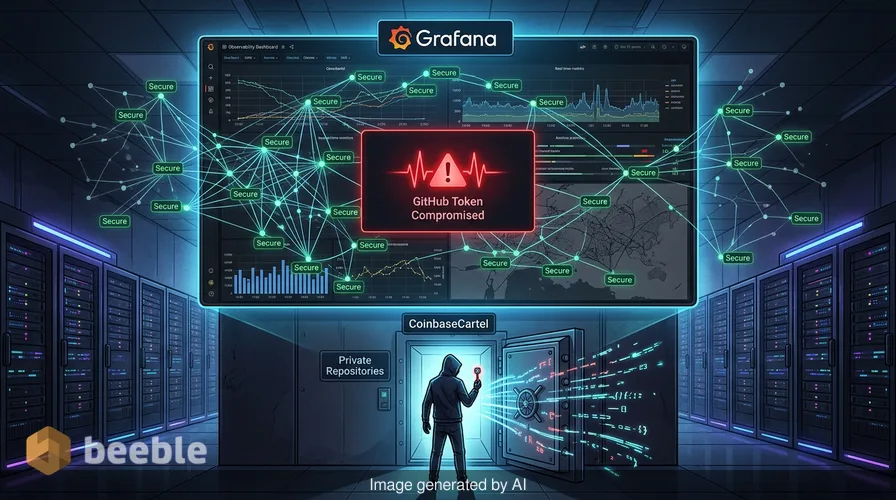
For a company that has built its reputation on observability, the irony of being blindsided is rarely lost on the security community. Grafana Labs, the steward of the ubiquitous AI-powered visualization platform, recently found itself under the very microscope it usually provides to others. While Grafana’s infrastructure is designed to provide granular visibility into the world’s most complex networks, a solitary, mismanaged credential rendered that perimeter irrelevant.
Behind the scenes, the incident began not with a sophisticated zero-day exploit or a complex social engineering campaign, but with the quiet acquisition of a GitHub token. This token acted as a master key, granting an unauthorized party access to the firm’s private repositories. Consequently, what was intended to be a secure, mission-critical development environment became an open library for a relatively new threat actor group known as CoinbaseCartel.
As someone who regularly communicates with white-hat researchers over PGP-encrypted channels, I’ve seen this script play out before. The architectural paradox here is striking: a multi-million dollar defense strategy, likely involving advanced endpoint detection and rigorous network segmentation, was bypassed by a simple string of characters that shouldn’t have been accessible.
The Anatomy of the GitHub Token Leak
In the modern DevOps pipeline, tokens are the lifeblood of automation. They allow services to talk to each other without human intervention. However, from a risk perspective, they are also a significant liability. In this specific instance, the threat actor leveraged a compromised token to clone Grafana’s source code. Assessing the attack surface in hindsight reveals a common truth in InfoSec: we often spend so much time hardening the front door that we forget to secure the keys left under the digital doormat.
Grafana Labs confirmed that the "unauthorized party" managed to download its codebase and subsequently attempted to extort the firm. This is a classic shift in the threat landscape. Instead of deploying malicious ransomware to lock systems—which would trigger immediate availability alarms—the attackers focused on confidentiality. By stealing the source code, they aimed to create a digital hostage situation, threatening to release the proprietary logic that powers Grafana’s most advanced features.
From an end-user perspective, the immediate concern is always data integrity. If hackers have the source code, can they find vulnerabilities to attack the 7,000+ customers who rely on Grafana? While the threat of a downstream supply chain attack is real, Grafana Labs has stated that no customer data or personal information was accessed during the breach. Their forensic analysis suggests the leak was contained to the GitHub environment, rather than the production systems where customer data resides.
Refusing the Ransom: A Case Study in Resilience
When the extortion demand arrived, Grafana Labs faced a choice that defines a company’s character. Many firms, fearing the reputational damage of a public code leak, might have considered paying. Proactively speaking, however, Grafana chose the more resilient path: total transparency and a refusal to negotiate.
This decision aligns with the published stance of the FBI, which argues that paying a ransom only offers an incentive for others to get involved in illegal activity. In my experience, paying a ransom is like trying to put out a fire with gasoline; it might provide a temporary reprieve, but it ultimately fuels the ecosystem of cybercrime. By design, there is no guarantee that a threat actor will delete stolen data once paid. In fact, many groups keep a copy for future leverage or sell it anyway on the dark web.
Grafana’s proactive disclosure on X (formerly Twitter) is a textbook example of reactive transparency done right. Instead of waiting for the story to leak through backchannels, they owned the narrative. This approach minimizes the "fear, uncertainty, and doubt" (FUD) that often follows a breach involving high-profile tech giants like NVIDIA, Microsoft, and Salesforce.
The Human Element and the Architectural Paradox
We often speak of the human firewall as the first line of defense, but in the world of automated CI/CD pipelines, that firewall is frequently bypassed by automated processes. The paradox at play here is that the more scalable and automated our development becomes, the more centralized the risk becomes. A single token, if improperly scoped or stored in a way that is exploitable, can negate every other security measure.
Think of zero trust as a VIP club bouncer at every internal door. In an ideal zero-trust architecture, even if an attacker gains a token for GitHub, they shouldn't automatically be able to export an entire codebase without additional verification. However, many organizations still treat the internal network or the development environment as a "trusted zone." Once you’re in, you’re in. This incident reminds us that the network perimeter is an obsolete concept; the identity of the user—or the token—is the new perimeter.
Assessing the Threat: Who is CoinbaseCartel?
While the industry is still piecing together the profile of CoinbaseCartel, they appear to follow the "extortion-only" model popularized by groups like Lapsus$. They don't want to encrypt your servers; they want your intellectual property. Looking at the threat landscape, this is a pervasive trend. Source code is high-value because it can be audited for vulnerabilities, cloned by competitors, or used to build more effective malware.
By treating data as a toxic asset—something that is dangerous to hold and must be protected with the utmost care—companies can better prepare for these scenarios. Grafana’s response shows they understood the value of their asset but also realized that the integrity of their brand was worth more than the secrecy of their code.
Strategic Takeaways for Business and IT Leaders
This breach serves as a stark reminder that even the most technically proficient organizations are vulnerable to credential mismanagement. To avoid a similar fate, consider the following mission-critical steps:
- Audit Token Permissions (Least Privilege): Ensure that GitHub Personal Access Tokens (PATs) and OAuth tokens are granular. A token used for a specific CI/CD task should not have the permission to clone every repository in the organization.
- Implement Secrets Scanning: Use tools to proactively scan all repositories for hardcoded secrets, API keys, and tokens. This should be a mandatory part of the commit process, not a reactive measure.
- Enforce Token Expiration: Tokens should never be permanent. Implement a policy of frequent rotation to minimize the window of opportunity for an attacker if a credential is compromised.
- Harden the Developer Workflow: Move away from long-lived tokens toward short-lived, identity-based access. If an attacker steals a token that expires in 15 minutes, the damage they can do is significantly limited.
- Refine Your Incident Response Playbook: Grafana’s ability to quickly invalidate credentials and launch a forensic investigation suggests they had a robust plan in place. Test your plan with tabletop exercises that specifically simulate source code theft.
The Path Forward for Grafana Users
For the thousands of organizations using Grafana to monitor their mission-critical systems, the immediate risk appears low. Patching aside, the focus should be on internal credential hygiene. If you use Grafana plugins or integrations that require their own tokens, now is the time to audit those permissions.
Grafana Labs has promised to share a more detailed post-mortem once their forensic analysis is complete. In the meantime, their refusal to pay the CoinbaseCartel is a win for the industry. It signals that while source code is valuable, it is not more valuable than the principles of transparency and security.
As we move further into 2026, the battle for our digital infrastructure will continue to be fought over small, seemingly insignificant details—like a single leaked token. In this case, the bouncer at the door might have looked the other way for a moment, but the response in the aftermath has shown that the house is still in order.
Sources:
- NIST Special Publication 800-204D (Strategies for Microservices Security)
- MITRE ATT&CK Framework: T1528 (Steal Application Access Token)
- FBI Internet Crime Complaint Center (IC3) Ransomware Guidance
- GitHub Security Best Practices for Enterprise
Disclaimer: This article is for informational and educational purposes only and does not replace a professional cybersecurity audit or incident response service.



See you on the other side.
Our end-to-end encrypted email and cloud storage solution provides the most powerful means of secure data exchange, ensuring the safety and privacy of your data.
/ Create a free account
