


How a Single VS Code Extension Opened the Gates to GitHub's Internal Codebase

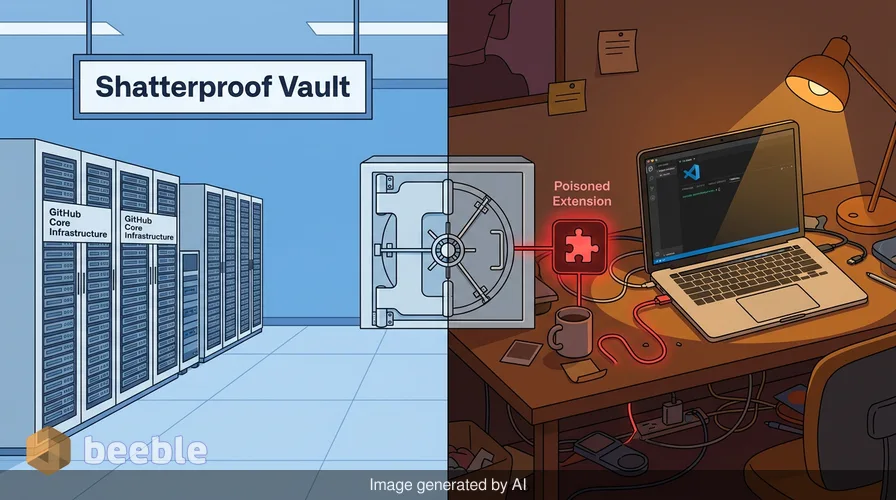
The architectural paradox of modern software development is that our most secure fortresses often rely on the most fragile tools. We build high-availability, globally distributed platforms with layers of encryption and multi-factor authentication, yet the entire edifice frequently rests on the integrity of a single developer's workstation. Last Tuesday, this reality hit home for GitHub, a Microsoft-owned subsidiary that serves as the de facto vault for the world's source code. While GitHub's primary infrastructure remains robust, a compromise of a single employee device allowed the threat actor known as TeamPCP to exfiltrate approximately 3,800 internal repositories.
From a risk perspective, this incident is a textbook example of how a mission-critical environment can be bypassed not through a zero-day in the core platform, but through the peripheral tools developers use to interact with it. Assessing the attack surface of a developer today means looking beyond the cloud console and into the local IDE (Integrated Development Environment). In this case, the gateway was a poisoned Microsoft Visual Studio Code extension. It is a sobering reminder that while we treat encryption as a shatterproof digital vault, that vault is only as secure as the person holding the keys—and the tools they use to turn them.
The Marketplace for Stolen Secrets
The story broke when TeamPCP, a threat actor already notorious for a string of supply chain attacks, listed GitHub’s internal source code for sale on a well-known cybercrime forum. The asking price was $50,000, which the group cheekily described as their retirement fund. Unlike traditional ransomware groups that thrive on digital hostage situations, TeamPCP explicitly stated this was not an extortion attempt. They intended to sell the data to a single buyer and then "shred" their copy, or leak it for free if no buyer emerged.
When I first saw the screenshots shared by Dark Web Informer, I reached out to a few incident responders via Signal to verify the claims. While forum bravado is common, the technical details TeamPCP provided—specifically the count and naming conventions of the repositories—were too granular to ignore. GitHub eventually confirmed that the attacker's claim of roughly 3,800 repositories was directionally consistent with their internal forensic investigation. This exfiltration represents a significant breach of confidentiality, even if the integrity of customer data stored on the platform remains, according to GitHub, currently unaffected.
The IDE as a Stealthy Entry Point
GitHub’s investigation traced the compromise back to a poisoned VS Code extension. While they did not officially name the specific plugin, the timing aligns perfectly with a known compromise of the Nx Console extension. This is where the architectural paradox becomes most visible: GitHub expected their stringent internal access controls to mitigate risk, but the exploitability of a trusted developer tool rendered those perimeters obsolete.
Behind the scenes, the attacker likely used a multi-stage credential stealer embedded within the extension. Because developers often grant their IDEs broad permissions to interact with local files, environment variables, and SSH keys, a compromised extension is effectively a VIP club bouncer who has decided to let the wrong crowd in through the back door. Once the extension was active on the employee's device, it was trivial for the attacker to scrape the tokens and credentials necessary to clone internal repositories. Consequently, GitHub was forced to initiate a massive secret rotation exercise, prioritizing the highest-impact credentials to prevent follow-on activity.
The Mini Shai-Hulud Worm and PyPI Poisoning
The breach of GitHub's internal repositories was not an isolated event; it was a pivot point for a much larger, pervasive campaign. TeamPCP used the stolen credentials to compromise a GitHub account with access to the durabletask PyPI package—an official Microsoft Python client. By publishing malicious versions (1.4.1, 1.4.2, and 1.4.3), the attackers turned a localized breach into a global supply chain threat.
This malware, dubbed "Mini Shai-Hulud" by researchers, is particularly stealthy. It is a self-replicating dropper that executes the moment the package is imported. Looking at the threat landscape, we rarely see this level of sophistication in Python packages. The payload, a second-stage script named rope.pyz, is a full-featured infostealer designed specifically for Linux systems. It doesn't just look for passwords; it actively attempts to unlock and dump 1Password and Bitwarden vaults, harvest HashiCorp Vault KV secrets, and scrape Docker and VPN configurations.
| Feature | Description of Mini Shai-Hulud |
|---|---|
| Target OS | Specifically optimized for Linux environments. |
| Persistence | Uses stolen tokens to propagate across cloud instances. |
| Stealth | Executes silently upon import with no visible error messages. |
| Exfiltration | Targets SSH keys, cloud provider credentials, and password managers. |
| Geofencing | Includes logic to execute destructive commands on specific regional settings. |
Lateral Movement via Cloud Infrastructure
What makes this campaign truly dangerous is how it leverages modern infrastructure for propagation. If the malware detects it is running inside an AWS environment, it attempts to use the AWS Systems Manager (SSM) to jump to other EC2 instances. Proactively speaking, this turns a single infected developer machine or CI/CD pipeline into a launchpad for an internal worm. If it finds itself in a Kubernetes cluster, it uses kubectl exec to spread.
As a countermeasure, organizations often rely on network segmentation, but this malware bypasses the network perimeter entirely by using legitimate management protocols. It even employs a fascinating backup C2 (Command and Control) mechanism called FIRESCALE. If the primary domain is blocked, the malware searches public GitHub commit messages for specific base64-encoded strings to find a new address. This decentralized approach to C2 makes the threat exceptionally resilient to standard domain-blocking techniques.
Assessing the Human and Technical Fallout
In my years of analyzing APTs (Advanced Persistent Threats), I have found that we often spend too much time on the "what" and not enough on the "how." The "what" here is 3,800 repositories, but the "how" is the systematic failure of the human firewall combined with an over-reliance on third-party extension integrity. We treat our IDEs as private workspaces, but in reality, they are part of the corporate attack surface.
There is also a darker, more erratic side to this specific threat actor. Analysts at Aikido Security discovered that the malware contains a "1-in-6 chance" of playing audio and executing rm -rf /* if it detects Israeli or Iranian system settings. This injects an element of digital nihilism into what is otherwise a very professional credential-harvesting operation. It suggests that while TeamPCP is motivated by profit, they are not above causing systemic chaos for the sake of it.
Proactive Defense: Lessons from the GitHub Breach
Patching aside, the lesson here is that we must apply Zero Trust principles not just to our networks, but to our development environments. Every machine or pipeline that installed the affected versions of durabletask should be treated as fully compromised. The fact that the package is downloaded over 400,000 times a month means the shadow of this breach will loom over the industry for some time.
To secure your digital footprint before the next major breach, I recommend the following actionable steps:
- Audit IDE Extensions: Treat VS Code extensions with the same level of scrutiny as third-party libraries. Use internal marketplaces or allow-lists to prevent developers from installing unverified plugins.
- Enforce Short-Lived Tokens: Use OIDC (OpenID Connect) for CI/CD pipelines and avoid long-lived PATs (Personal Access Tokens) that can be easily exfiltrated and reused.
- Monitor SSM and K8s Activity: Set up alerts for unusual
SendCommandorkubectl execpatterns, especially those originating from unexpected service accounts. - Secret Management Audit: Move away from storing secrets in environment variables or local files. Use a centralized, hardened secret manager that requires hardware-based MFA for access.
- Review PyPI Dependencies: If your organization uses
durabletask, verify that you are not running versions 1.4.1 through 1.4.3. Pin your dependencies to known-good versions and use a private repository manager to proxy public packages.
The network perimeter is an obsolete castle moat; the new battleground is the developer's laptop. Until we treat every plugin and package as a potential Trojan horse, we will continue to see even the most resilient organizations lose their crown jewels to a single, poisoned line of code.
Sources:
- GitHub Incident Response and Security Blog (May 2026 update)
- MITRE ATT&CK Framework: T1195 (Supply Chain Compromise), T1552 (Unsecured Credentials)
- Wiz Research: Analysis of PyPI Package Poisoning
- StepSecurity: Investigation into FIRESCALE C2 Mechanisms
- NIST Special Publication 800-204: Security Strategies for Microservices-based Applications
Disclaimer: This article is for informational and educational purposes only and does not replace a professional cybersecurity audit or incident response service. The author and publisher are not responsible for any actions taken based on the information provided herein.



See you on the other side.
Our end-to-end encrypted email and cloud storage solution provides the most powerful means of secure data exchange, ensuring the safety and privacy of your data.
/ Create a free account
