


How a Tuesday night email in New York explains the end of the corporate habit

A phone sits on a bedside table in a small apartment in New York City. The blue light from the screen is the only illumination in the room at 6:00 a.m. Moyan Chen reached for this phone every Wednesday morning for a month. She was 24 years old and worked as a data scientist at Meta. The ritual was a response to a leak. Rumors suggested that layoffs were coming. There was no specific timeline, only a recurring fear that Wednesdays were the designated days for professional expiration. Every Tuesday night, she left the office wondering if the badge in her bag would function the next morning. This is the microscopic reality of modern employment. A single notification determines if a person is a contributor or a line item.
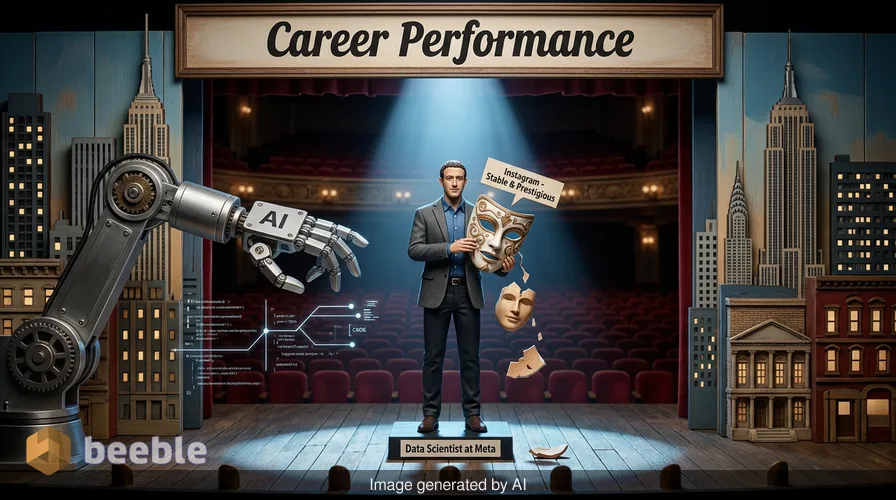
When the email finally arrived on May 20, the sensation was relief. The wait was over. The period of hyper-vigilance ended with a clean severance. In the context of New York, a city that functions as a theater stage for career performance, being cast out of a leading role is usually a tragedy. For Chen, it was a moment of clarity. She was a data scientist on Instagram, a role that appeared stable and prestigious. However, the internal logic of the work had already shifted. She felt she lost her job to artificial intelligence. The tasks that defined her daily life were no longer exclusive to human intelligence. This personal realization mirrors a broader structural shift in the global labor market.
The metaphor of the fast ship and the storm
Chen describes Meta as a huge ship moving at high speed. The employees are passengers or crew members who believe the size of the vessel provides safety. Then the AI storm arrives. This metaphor is resonant because it describes the systemic vulnerability of the modern professional. When the storm hits, the natural instinct is to find a different ship. Some of her colleagues looked toward finance. They believed the traditional structures of banks would adopt AI more slowly. This is a common coping mechanism. Individuals seek shelter in slower-moving institutions to delay the inevitable friction of technological displacement.
Zooming out, this behavior is a symptom of what sociologist Zygmunt Bauman calls liquid modernity. In a solid world, a job at a company like Meta was a destination. It was an anchor. In a liquid world, institutions are transient. They change shape or dissolve without warning. The ship is not a permanent home; it is a temporary platform. Chen realized that jumping to a smaller, slower ship might not be a solution. The storm is pervasive. It covers the entire ocean. The risk of staying in a traditional role that focuses on repetitive data analytics is high. In the long term, that path leads to a specialized form of obsolescence.
The clinical language of corporate severance
Linguistically speaking, the word severance is an archaeological site of corporate history. It implies a clean, surgical cut. In practice, the experience is more like atomization. The individual is separated from the collective infrastructure of the office. They are left alone in the city with their severance pay and their digital trail. Chen noticed that her colleagues immediately began the work of professional reconstruction. They posted on LinkedIn. They asked for referrals. They attempted to re-enter the same cycle that just ejected them. This is the corporate habitus in action. It is the deeply ingrained set of dispositions that tells us we are only valid if we are part of a large organization.
Chen chose a different discourse. She stopped looking for the next ladder to climb. The idea of the corporate ladder is a structural relic of a previous era. It assumes a linear progression and a stable foundation. AI has removed the bottom rungs of that ladder. Chen worked on specific tasks like writing SQL queries and creating visualizations. These are the mundane building blocks of data science. At Meta, she saw AI perform these tasks with higher accuracy than she could manage. For specific, well-defined queries, the machine was a talented individual contributor. If the core of a job is a series of repetitive, accurate executions, that job is already an artifact.
The transition from specialist to generalist
Historically, the economy rewarded the specialist. The more narrow and deep your knowledge, the higher your value. The rise of pervasive AI reverses this trend. If a machine can handle the narrow depths, the human must navigate the broad surface. Chen observes that a data scientist now needs to understand other functions. Coding alone is not a promising career. This shift requires a change in how we view our skills. We are moving from a model of fixed expertise to a model of constant adaptation.
On an individual level, this is a profound psychological burden. It requires a person to be in a permanent state of transition. Chen is currently in this period. She is creating content and exploring career coaching. She is using her experience to help others navigate the same technological shift. This is an example of a fragmented career path. Instead of one long narrative at a single company, she is building a patchwork of roles. She is a creator, an analyst, and a coach. This is the new reality of the atomized worker. We are no longer parts of a machine; we are independent operators trying to align our values with our labor.
Urban alienation and the safety of the institution
New York City is a collection of people living densely packed but often isolated. It is a social archipelago. For many young professionals, the office provides the primary sense of community. It is the place where social identities are forged. When the layoff happens, the individual is not just losing a paycheck. They are losing their social coordinate. Chen is single and has no family in the US. Her parents suggested she return to China. This is the ultimate fallback, but she finds the energy of New York resonant. She wants to stay, but she no longer wants to stay within the traditional boundaries of the corporate world.
Paradoxically, the generosity of the severance package provides the space for this reflection. It is a financial cushion that allows her to question the necessity of the corporate life. She used to wonder how she would feed herself without a big company. This fear is a powerful tool for institutional retention. It keeps people working hard at jobs that may be stripping them of their agency. The layoff broke that cycle of dependency. It made her see that life could be different. The risk of an AI startup or a freelance career is visible and immediate. The risk of a traditional job is invisible and systemic. Staying in a role that AI can do better is the true long-term danger.
The architecture of a different life
Chen is now looking at AI as a tool for change rather than a threat to her existence. She is interested in how it changes how people work and build products. This is a shift in perspective. Instead of being the subject of the technology, she is becoming an observer and an orchestrator of it. She is documenting her journey online. This documentation is a form of digital habitus. She is building a public record of her learning and her adaptation. This is how the modern worker creates security in a liquid market. Your value is not in your title; it is in your ability to synthesize information and share it with a community.
Ultimately, the story of a 24-year-old leaving Meta is not just about a tech company downsizing. It is about the breakdown of a specific social contract. The old contract promised that if you worked hard and entered a prestigious institution, you were safe. That contract is void. The new reality is more fragmented and more demanding. It requires a visceral understanding of technological trends and a resilient sense of self. Chen is not sure what comes next, but she is no longer waiting for a Wednesday morning email to tell her who she is. She is defining herself through her own curiosity and her own projects.
We should look at our own routines with the same critical eye. The tools we use every day are changing the nature of our contributions. If we find ourselves performing repetitive tasks with robotic precision, we are already in the path of the storm. The goal is not to find a slower ship. The goal is to learn how to swim in the new environment. This requires us to reclaim the human experiences that machines cannot replicate: complex empathy, strategic ambiguity, and the ability to find profound meaning in the mundane acts of daily life.
Sources
- Bauman, Z. (2000). Liquid Modernity. This text examines the shift from a "solid" society of stable institutions to a "liquid" one of constant change.
- Bourdieu, P. (1977). Outline of a Theory of Practice. This work introduces the concept of "habitus," the ingrained habits and dispositions shaped by our social environment.
- Layoffs.fyi. (2024-2026). This database tracks the systemic trends in technology sector employment and the impact of the "Year of Efficiency."
- Bureau of Labor Statistics. (2026). Reports on the evolving role of data scientists and the integration of automated analytics in the workforce.



See you on the other side.
Our end-to-end encrypted email and cloud storage solution provides the most powerful means of secure data exchange, ensuring the safety and privacy of your data.
/ Create a free account
