


How fake Minecraft clients outranked official sources to deliver Weedhack

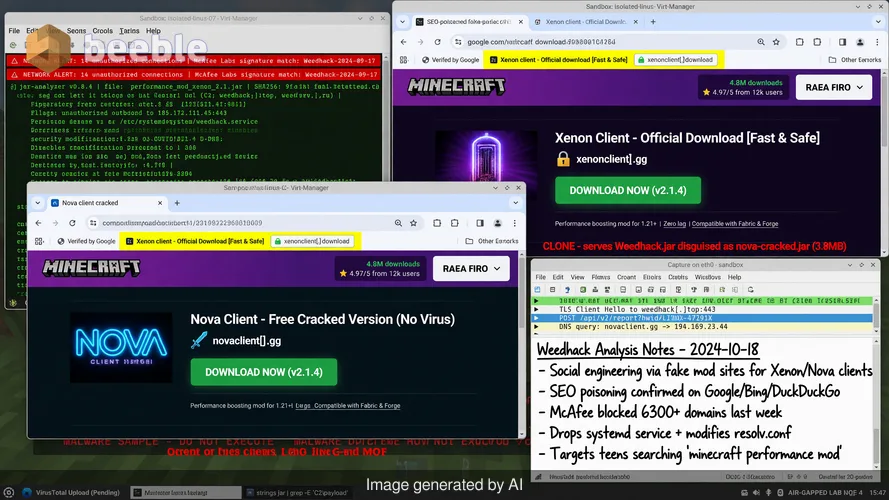
I spent a few hours yesterday afternoon analyzing a suspicious JAR file in a sandboxed environment on one of my isolated Linux machines. The file claimed to be a performance-enhancing mod for Minecraft, a category of software that millions of teenagers download every week without a second thought. My analysis environment immediately flagged a series of unauthorized network connections and attempts to modify system security settings. This was not a mod. It was a fresh sample of the Weedhack malware family, and it is currently one of the most effective social engineering campaigns targeting the gaming community.
McAfee Labs recently reported that their systems blocked over 6,300 attempts to access malicious domains associated with this campaign. The attackers are not just relying on simple phishing emails. They are using SEO poisoning to ensure that their malicious websites appear at the top of search results on Google, Bing, and DuckDuckGo. When a user searches for popular tools like the Xenon or Nova clients, the top result is often a clone site that looks identical to the real project but serves malware instead.
The mechanics of search result manipulation
Search engine optimization poisoning is a technique where threat actors manipulate the algorithms of search engines to place their malicious links above legitimate ones. In this campaign, the attackers have created a network of spoofed websites that replicate the branding, feature lists, and even the FAQ sections of well-known Minecraft projects. From a risk perspective, this creates a situation where the most visible source of a tool is the most dangerous one.
McAfee identified several high-traffic domains that currently outrank the official sources. For instance, meteorclients[.]com impersonates the legitimate meteorclient[.]com, while radium-client[.]com mimics the paid Radium client. Even community tools like SeedCrackerX have been targeted, with a fake GitHub Pages site (seedcrackerx.github[.]io) competing for traffic against the original seedcrackerx[.]com. Because search engines prioritize site structure and keyword density, these attackers are able to push the real GitHub and Modrinth repositories further down the page.
Behind the scenes, the attackers are also using YouTube to drive traffic. They upload videos that demonstrate the features of these clients and provide direct links to the malicious domains in the descriptions. This creates a multi-layered trap that starts with a video and ends with a compromised host machine.
AI builders and the lowering barrier of entry
One of the most concerning aspects of this campaign is the use of Lovable, an artificial intelligence-powered website builder. One detected site, kryptonclientcrack.lovable[.]app, was built using this tool. By design, AI website builders allow anyone to create a professional-looking site in minutes by simply describing what they want. This lowers the barrier for cybercriminals who might not have the web development skills to create convincing clones from scratch.
In the past, malicious websites often had tell-tale signs of fraud, such as broken links, poor grammar, or low-quality graphics. Today, an attacker can use AI to scrape a legitimate site and generate a perfect mirror. This makes the job of the human firewall much harder. When a site looks exactly like the official tool and features links to genuine GitHub repositories for its developer credits, most users have no reason to doubt its integrity. The AI does the heavy lifting, allowing the attacker to focus on the infection chain.
Anatomy of a multi-stage JAR attack
The Weedhack malware uses a multi-stage sequence to evade detection. When a user downloads a fake client, they usually receive a JAR file. Because Minecraft itself runs on Java, these files are a natural choice for mod distribution. However, JAR files are essentially executable archives that can run code on any operating system that has a Java Runtime Environment installed.
Once the user executes the file, the first stage begins. The malware does not immediately steal data. Instead, it performs a series of environment checks to see if it is running in a virtual machine or a sandbox. If the environment looks like a real user's PC, it moves to the next stage. One of its first actions is to set up Microsoft Defender exclusions. By telling the operating system to ignore certain folders, the malware ensures that future stages of the attack can run without being blocked by local antivirus signatures.
Consequently, the malware is able to deploy its final payloads. These payloads are designed to collect sensitive system information and steal data from the host. This includes browser cookies, stored passwords, and session tokens for platforms like Discord. In many cases, the malware is a digital Trojan horse that provides the attacker with a persistent foothold in the victim's digital life.
Abusing trusted distribution infrastructure
The attackers are not just hosting files on their own domains. They are leveraging familiar platforms to increase the perceived legitimacy of their downloads. McAfee Labs found that nearly half of the malicious URLs (49.6%) were Discord links. Another 23.4% were hosted on MediaFire, and 8.2% were on GitHub. By using these services, attackers bypass some basic network filters that might block unknown or newly registered domains.
Discord is particularly useful for malware distribution in the gaming community. Many mod developers use Discord as their primary support and update channel. Attackers create fake Discord servers or compromise existing ones to spread their links. When a user sees a link on a platform they use every day, their guard drops. This is a systemic issue where the infrastructure of the community is turned against its members.
Beyond file hosting, the attackers have uploaded malicious JAR files to Planet Minecraft and EndMods. These are legitimate hubs for Minecraft content. While these platforms have their own scanning procedures, the multi-stage nature of Weedhack sometimes allows it to bypass basic automated checks. The malware remains dormant until it is executed on a local machine, making it difficult for static scanners to identify the malicious intent.
Comparing malicious domains and their targets
The table below shows how closely the malicious domains mimic their legitimate counterparts. This tactic relies on the fact that most users do not look closely at the URL once they reach a site that looks correct.
| Target Software | Legitimate Domain | Malicious Spoof Domain |
|---|---|---|
| Glazed Client | glazedclient[.]com | glazed-client[.]com |
| Radium Client | radiumclient[.]com | radium-client[.]com |
| SeedCrackerX | seedcrackerx[.]com | seedcrackerx.github[.]io |
| Meteor Client | meteorclient[.]com | meteorclients[.]com |
| Xenon Client | GitHub / Modrinth | xenonclient[.]com / xenoclient[.]lol |
| Nova Client | GitHub / Modrinth | nova-client[.]com |
The broader context of SEO poisoning
This Minecraft-focused campaign is part of a larger trend in the threat landscape. In June 2026, Check Point Research identified a similar large-scale operation that impersonated a variety of open-source and freeware projects. That campaign used a Traffic Distribution System (TDS) to funnel users through different stages depending on their location and browser. The end result was the delivery of malware like Remus Stealer and the SessionGate framework.
These operations show that search engines are a mission-critical vulnerability in the way most people navigate the internet. We treat search results as a curated list of safe options, but the reality is that the top spots are often occupied by the highest bidder or the most skilled manipulator. From an end-user perspective, the network perimeter has truly become an obsolete castle moat. The threat is not trying to break into your network; it is waiting for you to invite it in via a Google search.
Practical defense for modders and gamers
Protecting yourself against Weedhack requires a move toward a zero-trust mindset, even when you are just playing games. You cannot trust a website based on its appearance or its position in search results. Every download is a potential risk that needs verification.
As a countermeasure, always verify the source of a download by checking multiple independent channels. If a mod claims to be open-source, find the official GitHub repository and check the commit history and the number of stars. Legitimate developers usually link to their official websites from their GitHub profiles, not the other way around. If you find a site that links to a GitHub page that does not link back to that specific site, that is a major red flag.
Proactively speaking, you should never disable security protections to install a mod. If an installation guide or a README file tells you to add an exclusion to Microsoft Defender or turn off your firewall, the software is likely malicious. Legitimate software does not need to hide from your security tools to function. Furthermore, scanning every downloaded JAR file with a tool like VirusTotal can provide a quick sanity check, though it is not a perfect defense against zero-day variants.
Lastly, ensure that your Java installation and your operating system are up-to-date. Many JAR-based attacks rely on vulnerabilities in older versions of the Java Runtime Environment to gain higher privileges on the system. By keeping your software patched, you reduce the attack surface available to the malware once it is executed.
Sources
- McAfee Labs: Threat Report on Weedhack and SEO Poisoning (2026)
- Check Point Research: Traffic Distribution Systems and Freeware Malware (2026)
- MITRE ATT&CK: T1566 (Phishing) and T1583.001 (DNS Server/SEO Poisoning)
- NIST SP 800-63: Digital Identity Guidelines for Secure Authentication
Disclaimer: This article is for informational and educational purposes only. The information provided does not replace a professional cybersecurity audit, forensic analysis, or incident response service. Always consult with a qualified professional before making significant changes to your security posture.



See you on the other side.
Our end-to-end encrypted email and cloud storage solution provides the most powerful means of secure data exchange, ensuring the safety and privacy of your data.
/ Create a free account
