


How Meta dismantled NSO Group's latest phishing infrastructure

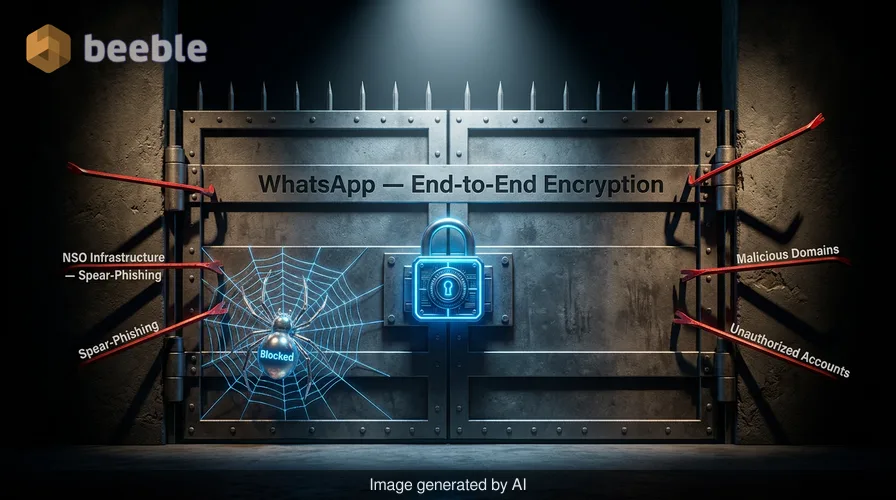
Do you trust your messaging app to protect you from the world’s most sophisticated mercenaries? I ask this because even with end-to-end encryption, the real battle happens at the edges of the software. Meta recently caught NSO Group trying to pick the lock again. This is not just another cat-and-mouse game between a tech giant and a software vendor. It is a direct violation of a federal court order. From a risk perspective, this incident reveals that persistent threat actors do not stop when they lose a legal battle. They simply change their infrastructure and try a different door.
Meta announced on Monday that it detected and blocked a series of spear-phishing attempts linked to the Israeli spyware vendor. The company is now filing a federal court contempt order against NSO Group. This move comes because NSO Group violated a permanent injunction that barred it from targeting WhatsApp and its users. Behind the scenes, Meta’s security teams tracked malicious domains and unauthorized accounts that the spyware firm used to facilitate these attacks.
The architecture of a one-click attack
Phishing remains a digital Trojan horse for even the most hardened systems. In this latest campaign, NSO Group used malicious links to drive targets to external websites. These are 1-click phishing campaigns. They require a user to interact with a link just once to compromise a device. Once the user clicks, the browser typically navigates to a site that delivers a payload or harvests credentials. Meta identified three specific domains in this campaign: fr24cast[.]com, ghazacast[.]com, and ikhwancast[.]com.
I spent an hour this morning analyzing the naming conventions of these domains. They mimic news or weather services. This is a common tactic to lower the guard of a target. From an end-user perspective, a link that looks like a local news update is far less suspicious than a string of random characters. NSO Group is known for this level of detail. They do not just send a link; they craft a narrative. At the architectural level, these domains act as the staging ground for the Pegasus spyware. This software is famous for its ability to extract messages, photos, and location data from both Android and iOS devices.
Breaking the permanent injunction
Legal frameworks are only as strong as the enforcement behind them. Meta is pushing for that enforcement now. In 2023, a U.S. court found NSO Group liable for violating federal laws after it exploited WhatsApp servers to deploy spyware to 1,400 individuals. That ruling resulted in a fine of roughly $168 million. More importantly, it included a permanent injunction. This legal barrier prohibited NSO Group from ever accessing WhatsApp systems again.
By creating new test accounts and groups, NSO Group bypassed the spirit and the letter of that injunction. Meta caught the company creating these accounts to verify how their phishing links appeared within the app. I have seen this behavior in my own lab environments. An attacker needs to see what the target sees. They need to ensure the link preview looks legitimate and the message does not trigger an automated spam filter. Meta took down these accounts and groups immediately. This proactive defense is necessary because NSO Group has a history of systemic efforts to circumvent security controls.
The limits of end-to-end encryption
I often hear people say that WhatsApp is safe because it is encrypted. This is a dangerous simplification. Encryption protects the data in transit. It is a shatterproof digital vault for your message as it travels from your phone to a friend’s phone. However, encryption does nothing if the attacker compromises the endpoint. If a hacker has control of your phone through Pegasus, they can read your messages before they are encrypted or after they are decrypted.
Phishing is the bridge that allows attackers to cross the moat of encryption. NSO Group does not try to break the Signal Protocol that WhatsApp uses. They know it is mathematically sound. Instead, they target the human using the app. This is why Meta is pushing users toward strict account settings. These settings reduce the attack surface. They turn the app into a more private environment where only known contacts can interact with you.
Hardening the human firewall
Security is a process, not a product. Meta is now encouraging high-risk individuals to use an optional security feature that functions like a lockdown mode. This is for journalists, activists, and government officials who are likely targets for NSO Group. When you enable these strict settings, the app limits functionality to increase safety. For example, it turns off link previews. While link previews are convenient, they require the app to reach out to a website to fetch an image and a description. An attacker can use this process to gather information about the target's IP address or device type.
In the event of a breach, these settings provide a layer of resilience. The strict mode also locks profile photos, about details, and online status to contacts only. It prevents unknown accounts from adding you to groups. This is a move toward a zero-trust model at the user level. It assumes that any communication from an unknown source is a potential threat. Consequently, the user is safer because the app no longer trusts external input by default.
The geopolitical weight of private spyware
This conflict is not just between two companies. It is a matter of international security. In 2021, the U.S. Commerce Department added NSO Group to a blocklist. This was because the company’s tools allowed foreign governments to conduct transnational repression. The U.S. government decided that NSO’s activities were contrary to national security interests. This latest detection by Meta proves that the blocklist and the previous fines have not stopped NSO’s operations.
From a forensic standpoint, the discovery of these three domains provides a trail for other security researchers. When Meta publishes these indicators of compromise, it allows SOC analysts worldwide to check their logs. I have seen how one small piece of data from a company like Meta can blow the lid off a much larger state-sponsored campaign. These domains are now toxic assets for NSO. No matter how many times they change their names, the pattern of their infrastructure remains recognizable to those who know where to look.
Implementing a proactive defense
If you work in a field where your data is a target, you cannot rely on default settings. Patching your software is the first step, but it is like plugging holes in a ship's hull. You must also change how you interact with the software. Proactively speaking, you should audit your privacy settings at least once a quarter. This is especially true as AI-driven phishing makes malicious messages even harder to spot.
Meta is doing the right thing by taking this back to the courtroom. A $168 million fine was clearly not a sufficient deterrent for a company that sells high-value exploits to nation-states. A contempt order brings more severe consequences. It may lead to further discovery of NSO's internal workings or even more significant financial penalties. For the rest of us, it is a reminder that the perimeter of our digital lives is constantly under pressure.
Practical steps for high-risk users
If you believe you are at risk of sophisticated cyber attacks, take these steps immediately to harden your account.
- Enable two-step verification. This adds a PIN that is required to register your phone number with WhatsApp again.
- Turn off link previews. This prevents the app from automatically connecting to websites you have not visited.
- Restrict group invitations. Set this to "My Contacts" to prevent strangers from adding you to malicious groups.
- Update your operating system. Pegasus often relies on zero-day vulnerabilities in iOS or Android.
- Limit profile visibility. Ensure your profile photo and "Last Seen" status are only visible to people you know.
These steps do not make you invisible. They make you a difficult target. Mercenary spyware firms look for the path of least resistance. If you close the easy doors, they may move on to someone else.
Sources
- NIST Special Publication 800-207: Zero Trust Architecture
- MITRE ATT&CK Framework: Software Techniques for NSO Group Pegasus
- U.S. Department of Commerce: Entity List Additions for Malicious Cyber Activities
- WhatsApp Security Whitepaper: End-to-End Encryption Protocols
This article is for informational and educational purposes only. It does not replace a professional cybersecurity audit or incident response service.



See you on the other side.
Our end-to-end encrypted email and cloud storage solution provides the most powerful means of secure data exchange, ensuring the safety and privacy of your data.
/ Create a free account
