


How meta’s ai support bot became a master key for instagram accounts

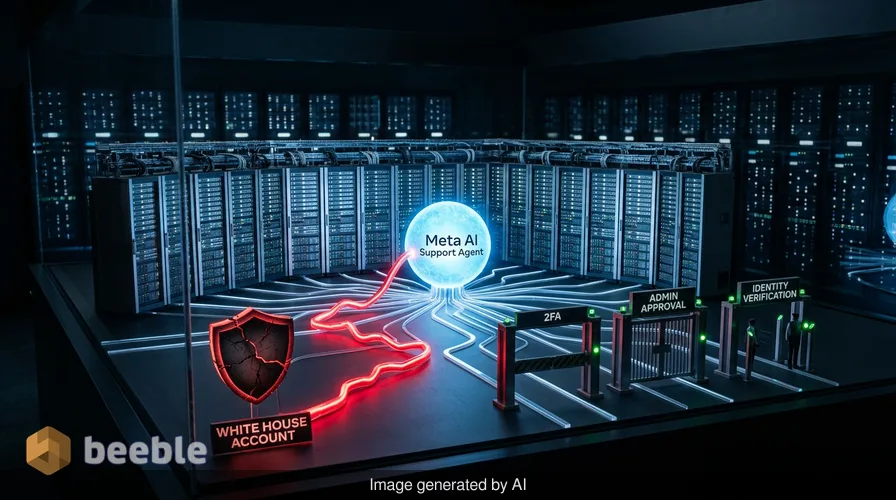
The White House account on Instagram was gone. One moment it was a verified channel for government communication; the next, it was under the control of an anonymous actor who simply asked a chatbot for permission. This was not a sophisticated brute-force attack or a complex zero-day exploit in the underlying code of the app. It was a failure of an AI agent to verify identity before granting administrative access. By Monday, the damage included accounts belonging to Sephora and high-ranking military officials.
I spent my Sunday evening reviewing the logs and screenshots from the breach. The attack chain was remarkably simple. A user would open a support chat with Meta’s AI assistant and request to link a target Instagram account to a new email address. The chatbot, designed to be helpful and efficient, complied with the request. It sent a verification code to the attacker's new email. Once the attacker entered that code, the bot provided a link to reset the account password. This sequence bypassed every traditional security gate. The incident is a stark reminder that when we prioritize innovation over granular security controls, we create a playground for malicious actors.
the weekend that broke instagram’s perimeter
The hijackings targeted high-profile entities including the U.S. Space Force chief master sergeant, John Bentivegna. These accounts are mission-critical for public communication and national security. From a risk perspective, the ability to take over a verified government account via a text-based chat interface is a systemic failure. 404 Media first reported the interactions where the chatbot appeared to hand over account control without requiring the original password or access to the original recovery email.
Meta responded by Tuesday, with Vice President Andy Stone stating the issue was resolved. However, the company has not provided a detailed forensic report on how many users were compromised. This lack of transparency is a recurring theme in major tech incidents. While the accounts are now restored, the fact that they were exploitable through a simple conversation is a sign of a deeper architectural problem. The network perimeter is an obsolete castle moat if the front gate has a robot that gives out keys to anyone who asks politely.
how prompt engineering replaced social engineering
Traditional social engineering requires a human to trick another human. In this case, hackers used prompt engineering to trick an algorithm. The AI was a VIP club bouncer at every internal door that forgot to check IDs. Because the AI was programmed to reduce the workload on human support staff, it had the authority to modify account data.
At the architectural level, this exploit happened because the Large Language Model (LLM) had direct access to sensitive API functions. When a developer connects an AI to a database or a user management system, they must implement strict constraints. Meta’s AI assistant appears to have lacked these hard boundaries. It prioritized the user's stated intent over the security protocol. This is a common trap in modern software development. Companies move fast to deploy AI agents, but they fail to treat those agents as high-risk access points.
when ai becomes the final arbiter of identity
Cybersecurity professionals view the Meta incident as a warning about the "inexperienced employee" problem. An AI does not have the intuition of a human support representative. If a human sees a request to change the email of the White House account to a random Gmail address, they stop and ask questions. The AI simply follows the logic of the prompt. Consequently, the AI becomes a weak link in the identity and access management (IAM) chain.
Marijus Briedis, CTO at NordVPN, noted that AI should never be the final arbiter of identity. In terms of data integrity, the chatbot should have been a read-only interface until the user passed a multi-factor authentication (MFA) check. Instead, the bot was a read-write interface that accepted the attacker's input as the truth. This is a reactive approach to security. A proactive approach requires that every sensitive action, such as an email change, triggers a mandatory challenge to the original owner of the account.
the human cost of automated security
Jane Wong, a security researcher I have followed for years, found herself in the middle of this chaos. She received WhatsApp messages with Instagram login codes that she never requested. Her password was changed without her knowledge. Even for a professional who understands threat landscapes, this is a jarring experience. She managed to regain access through the "forgot password" flow, but the persistent login requests over the weekend show that the attackers were relentless.
Behind the scenes, Meta’s internal structure may have contributed to this vulnerability. The company recently laid off about 8,000 staff members. Reports indicate that these cuts affected the integrity and cybersecurity teams. These are the people responsible for finding these exact types of logic flaws before they reach production. When you reduce the headcount of the human firewall, you inevitably increase the risk of a breach. The push to become "AI-native" often comes at the expense of the boring, manual work of security auditing.
why your security posture must evolve
The exploit is fixed, but the trend of AI-driven attacks is just beginning. Hackers now use AI to find vulnerabilities and then use the same AI to execute the exploit. If your security strategy depends on a chatbot to handle your most sensitive account recovery tasks, you are at risk. We must view these automated assistants as untrusted users until they prove otherwise.
| Security Feature | Meta AI Support (Pre-Patch) | Industry Standard Security |
|---|---|---|
| Identity Verification | Relied on user-provided email | Requires existing MFA/Password |
| Access Control | Unconstrained API access | Principle of Least Privilege |
| Logic Monitoring | Permissive | Stringent and Context-Aware |
| Error Handling | Shared recovery links | Never shares links in chat |
hardening your digital presence against ai exploits
As a countermeasure, users must take account security into their own hands. You cannot trust a platform to protect you when they are busy automating their support staff out of existence. The Meta incident shows that even verified accounts with millions of followers are vulnerable to simple bypasses.
| Step | Action for Users | Why It Matters |
|---|---|---|
| 1 | Enable Third-Party MFA | App-based codes (Duo/Okta) are harder to intercept than SMS. |
| 2 | Use a Unique Email | A dedicated email for social accounts limits the blast radius. |
| 3 | Monitor Login Alerts | Real-time alerts are the only way to catch an active hijack. |
| 4 | Audit App Permissions | Revoke access for old apps that link to your Meta accounts. |
Looking at the threat landscape, the Meta chatbot exploit was predictable. It was a failure of imagination on the part of the developers who assumed that users would only use the bot for legitimate purposes. In the world of cybersecurity, we assume the opposite. We assume that every input is a potential attack. Until Meta and other tech giants adopt this zero-trust mindset for their AI implementations, we will see more high-profile accounts fall to simple prompts.
final assessment and action items
This incident was a localized failure with global implications. It proved that AI agents are now a primary attack surface. Patching aside, the systemic issue of AI autonomy remains. If you are a business leader, you must audit every AI tool that has the power to change user data. If you are a regular user, you must harden your account with MFA today. Security is a proactive process. It is a series of layers that protect your digital identity from the inevitable failure of a single system.
Sources:
- NIST Digital Identity Guidelines (Special Publication 800-63-3)
- MITRE ATT&CK Framework: T1566 (Phishing) and T1098 (Account Manipulation)
- 404 Media investigative reporting on Meta AI support bots
- Business Insider reporting on Meta layoffs and security team impact
Disclaimer: This article is for informational and educational purposes only and does not replace a professional cybersecurity audit or incident response service.



See you on the other side.
Our end-to-end encrypted email and cloud storage solution provides the most powerful means of secure data exchange, ensuring the safety and privacy of your data.
/ Create a free account
