


Inside the Oversight Void That Lets AI Facial Recognition Erase Public Anonymity

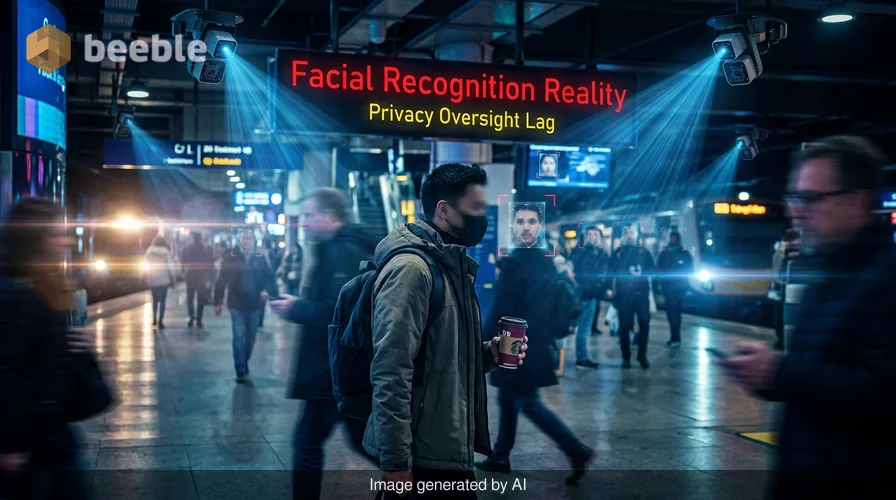
You step off the train at a busy commuter station, grab a coffee from a high-street kiosk, and head toward a stadium for an evening concert. You haven't spoken to a single person, logged into any app, or handed over an identification card. Yet, by the time you reach your seat, your precise movements, estimated age, and biometric signature have been captured, analyzed, and quietly cross-referenced against a dozen invisible databases.
If our digital footprints used to be a trail of breadcrumbs we left intentionally, then modern AI facial recognition has transformed our physical bodies into permanent broadcast beacons. If a system can instantly map the geometry of your face from a blurry ceiling camera, then the centuries-old concept of moving through a crowd unnoticed vanishes entirely.
As privacy watchdogs issued stark warnings in May 2026, a systemic reality became impossible to ignore: the oversight of artificial intelligence and facial recognition technology is lagging drastically behind its deployment.
The Anatomy of an Invisible Scan
I recently audited the technical documentation and privacy policies of several high-profile biometric vendors providing services to retail chains. As a rule, I apply privacy by design to my own investigations—removing the names of the specific retail clients and mid-level developers to focus strictly on the structural flaws of the technology. Reputation matters, but my focus is always on the architecture.
When I dissect these systems, I don't believe the obligatory "we care about your security" marketing banners. I wait until I can verify the data flows. What I found in these recent audits was startlingly opaque.
In practice, when you walk into a store equipped with Live Facial Recognition (LFR), the camera instantly converts the unique mathematical distances between your eyes, nose, and jawline into a biometric template. From a compliance standpoint, the store acts as a "Data Controller"—a legal term simply meaning the organization deciding why and how your face is scanned.
They often justify this invisible scan by claiming a "Legitimate Interest" to prevent theft. Translated from heavy legal jargon, Legitimate Interest is a fallback mechanism companies use to process your data without explicitly asking for your permission, arguing that their business needs outweigh your privacy rights.
A Patchwork Quilt of Regulations
Why are global privacy watchdogs sounding the alarm now? Because the technology has become profoundly sophisticated, while the rules governing it remain a patchwork quilt of outdated interpretations.
Ten years ago, facial recognition required immense computing power and ideal lighting. Today, AI models are so advanced they can identify individuals wearing medical masks, in low light, from a remarkable distance. The cost of running these algorithms has plummeted, making it accessible not just to state intelligence agencies, but to local shopping malls, private landlords, and concert promoters.
Ultimately, the law moves at the speed of paper, while artificial intelligence moves at the speed of silicon. While broad privacy frameworks require data collection to be proportionate—meaning companies shouldn't use a sledgehammer to crack a nut—the definition of "proportionate" is being stretched to its absolute breaking point.
Watchdogs warn that we are sliding into a reality where granular consent is bypassed entirely. Consent is a key, but facial recognition removes the locks entirely. You cannot reasonably opt out of a surveillance camera at a grocery store if the only alternative is starvation.
The Toxic Asset on Your Forehead
There is a fundamental difference between a compromised credit card and a compromised face. If a bank suffers a data breach—an event I regularly analyze to trace the fallout—the bank can issue you a new card number. The damage is contained.
Biometric data, however, is essentially an unchangeable password written on your forehead. If a private company's facial recognition database is breached, that mathematical map of your face is permanently compromised. You cannot reset your jawline. You cannot generate a new pupil distance.
Despite this, companies continue to hoard biometric data, treating it as a valuable commodity rather than the toxic asset it becomes when stored insecurely. Watchdogs in 2026 are pointing out that without robust, statutory boundaries specifically tailored to AI-driven biometrics, citizens are being left vulnerable to persistent profiling.
The Blur Between Public and Private
Perhaps the most pressing concern raised by oversight bodies is the increasingly blurred line between law enforcement and corporate surveillance. Police forces frequently partner with private vendors to deploy Live Facial Recognition vans in crowded areas.
When state actors rely on private, closed-source algorithms to determine who looks "suspicious," accountability evaporates. How was the AI trained? Does it suffer from demographic bias? If the system flags an innocent person, who is legally responsible—the police officer, the retail store, or the software developer? The current regulatory void leaves these questions precariously unanswered.
Reclaiming Your Anonymity
We cannot wait for the legislative machinery to catch up with machine learning. While watchdogs continue to push for stringent oversight, protecting your digital and physical privacy requires immediate, actionable steps.
Take control of the data you actually can govern. Start by systematically auditing the apps on your phone. Revoke camera and microphone permissions for any application that does not strictly need them to function. If a retailer or service provider requires a facial scan to verify your identity for an account, ask for an alternative, non-biometric verification method.
Furthermore, exercise your right to deletion. If you live in a jurisdiction with strong data protection laws, send formal requests to data brokers and retail loyalty programs demanding they erase any biometric categorizations they hold on you. Your face belongs to you, not to a server rack in a secondary data center. Demand that the digital world respects the physical boundaries of your identity.
Sources:
- General Data Protection Regulation (GDPR) Article 4 & 9 (Definitions and Processing of Special Categories of Personal Data)
- European Data Protection Board (EDPB) Guidelines on the use of facial recognition technology
- UK Information Commissioner's Office (ICO) Opinions on Live Facial Recognition in public places
- EU AI Act (Biometric Categorisation and High-Risk AI Systems frameworks)
Disclaimer: This article is strictly for informational and journalistic purposes. It explores technological and regulatory trends and does not constitute formal legal advice. If you require assistance with compliance or legal data protection strategies, please consult a qualified legal professional in your jurisdiction.



See you on the other side.
Our end-to-end encrypted email and cloud storage solution provides the most powerful means of secure data exchange, ensuring the safety and privacy of your data.
/ Create a free account
