


Meta’s 2026 Layoffs Aren't About Financial Trouble—They’re About Building an Invisible Workforce

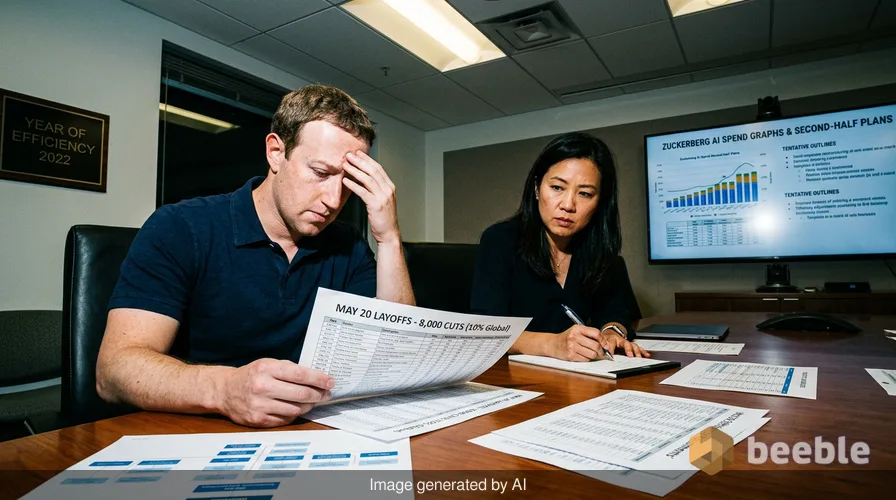
Conventional wisdom suggests that when a company announces sweeping job cuts, the ship must be taking on water. We are taught to look for falling stock prices, vanishing margins, or a desperate pivot to save a failing product. However, Meta’s recent announcement that it will lay off roughly 8,000 employees on May 20—nearly 10% of its global workforce—challenges this narrative entirely. While a 10% cut usually signals a crisis, looking at the big picture reveals a company that is actually flush with cash and growing. This isn't a retreat; it is a disruptive reimagining of what a tech giant looks like in the age of automation.
Behind the jargon of 'efficiency' and 'restructuring,' Meta is currently sitting on a $60 billion profit and generated over $200 billion in revenue last year. Unlike the desperate 'Year of Efficiency' in 2023, when the company was reeling from a post-pandemic slump, the Meta of 2026 is robust and resilient. So, why the pink slips? The answer lies in a systemic shift toward artificial intelligence that is currently rippling through the entire Silicon Valley ecosystem. To put it another way, Meta isn't firing people because it can’t afford them; it’s firing them because it has found a tireless intern that doesn't need a desk, a salary, or a lunch break.
The May 20 Wave: Breaking Down the Numbers
According to internal sources, the May 20 layoffs represent only the first phase of a broader plan. While the initial 8,000 roles represent a significant portion of the company’s 79,000-person headcount, a second wave is already slated for the latter half of 2026. Some insiders suggest the total reduction could eventually exceed 20% of the workforce.
Historically, Meta has used these moments to thin out middle management—the layers of coordinators and directors who sit between the people writing the code and the executives making the decisions. This time, however, the cuts appear deeper and more foundational. The company is pivoting away from the massive, human-heavy experimental projects of the past and toward a streamlined, AI-first architecture.
| Feature | 2023 Layoffs (The Correction) | 2026 Layoffs (The Transformation) |
|---|---|---|
| Primary Driver | Post-COVID over-hiring & falling stock | AI integration & efficiency gains |
| Financial Health | Volatile; stock in freefall | Robust; record profits and revenue |
| Target Roles | Middle management & recruiting | Coding, operations, & Reality Labs |
| Long-term Goal | Survival and cost-cutting | Building autonomous AI agents |
The Tireless Intern: AI Under the Hood
For the average user, the term 'Artificial Intelligence' often brings to mind chatbots or generated images. But within the walls of Meta’s Menlo Park headquarters, AI is being treated as a foundational tool to replace routine white-collar labor. The company recently formed a new 'Applied AI' organization, pulling engineers from various departments to build agents capable of writing code and managing complex tasks autonomously.
Essentially, Meta is betting that one engineer equipped with a specialized AI agent can do the work of three engineers without one. This is the 'So What?' of the current tech landscape: the labor required to maintain a global social network is shrinking. Practically speaking, tasks that once required a team of human supervisors—such as content moderation, ad placement optimization, and even basic software debugging—are being handed over to these digital systems. This allows the company to remain scalable without the massive overhead of thousands of additional employees.
A Broader Pattern in Big Tech
Meta is far from alone in this strategy. Earlier this year, Amazon trimmed 30,000 corporate employees, and the fintech firm Block cut nearly half its staff. In every instance, the justification was the same: AI-driven efficiency. Looking at the big picture, we are witnessing a decoupling of corporate profit from human headcount. In the past, a company making $200 billion would be expected to grow its staff to meet demand. Today, the goal is to grow the revenue while keeping the staff count as lean as possible.
Curiously, the stock market has acted as a global mood ring for this trend, rewarding companies that cut costs in favor of AI investment. Meta’s shares have remained resilient, up over 3% this year, because investors prefer a streamlined machine over a sprawling bureaucracy. For the market, these layoffs aren't a sign of weakness; they are a signal that Meta is evolving into a more profitable, automated entity.
Reality Labs and the Shift to Small Business
One of the more tangible shifts in this restructuring involves the Reality Labs division—the arm responsible for Meta’s VR and Metaverse ambitions. While CEO Mark Zuckerberg spent years pouring billions into a virtual world that has yet to see mainstream adoption, the 2026 strategy appears much more grounded in immediate utility.
Engineers are being moved out of experimental VR roles and into the 'Applied AI' unit or a new 'Meta Small Business' division. This suggests that Meta is focusing less on building a digital universe and more on creating AI tools that help everyday merchants sell products on Instagram and Facebook. From a consumer standpoint, this means you’ll likely see more AI-generated ads and interact with more sophisticated chatbots when you try to buy something through these platforms.
What This Means for You
If you aren't a Meta employee, you might think these layoffs don't impact your daily life. However, this shift changes the digital environment for everyone. Here is the practical breakdown for the everyday user:
- User Experience: As human teams shrink, expect more of your interactions with Facebook and Instagram to be managed by algorithms. If you have an issue with your account or a fraudulent ad, you will likely be dealing with an autonomous AI agent rather than a human customer support representative.
- The Job Market: Meta’s move is a blueprint for other industries. If you work in a role that involves processing data, basic coding, or administrative coordination, the 'Applied AI' model is a preview of the competitive pressure you may face from automated tools in the near future.
- Privacy and Accuracy: With fewer humans in the loop, the responsibility for catching misinformation or privacy breaches falls more heavily on AI. This can be a double-edged sword; while AI is faster, it can also lack the nuanced judgment required to handle complex social issues.
Perspective Shift
Ultimately, Meta’s May 20 layoffs serve as a stark reminder that the tech industry has entered a new era. We are moving past the 'move fast and break things' phase of human-led growth and into a period of 'automate and optimize.' The company’s financial success, paired with its decision to let go of thousands of talented workers, suggests that the value of human labor in the digital sector is being recalibrated.
Instead of viewing this as a standard corporate downsizing, we should observe it as a systemic shift in how the world’s most powerful companies operate. The next time you open an app or see a perfectly targeted ad, remember that it is increasingly the work of an invisible, digital workforce. The challenge for the rest of us is to find the skills that an AI agent—no matter how robust—cannot yet replicate: empathy, creative strategy, and the ability to navigate the messy, unoptimized reality of human life.
Sources
- Reuters Market Reports: Meta Workforce Restructuring Plans.
- Meta Investor Relations: Full Year 2025 Financial Results and 2026 Outlook.
- Layoffs.fyi: Global Tech Sector Employment Tracking Data.
- Bureau of Labor Statistics: Tech Sector Occupational Outlook 2026.



See you on the other side.
Our end-to-end encrypted email and cloud storage solution provides the most powerful means of secure data exchange, ensuring the safety and privacy of your data.
/ Create a free account
