
Meta's new AI model is free to download but costs thirty thousand dollars to run

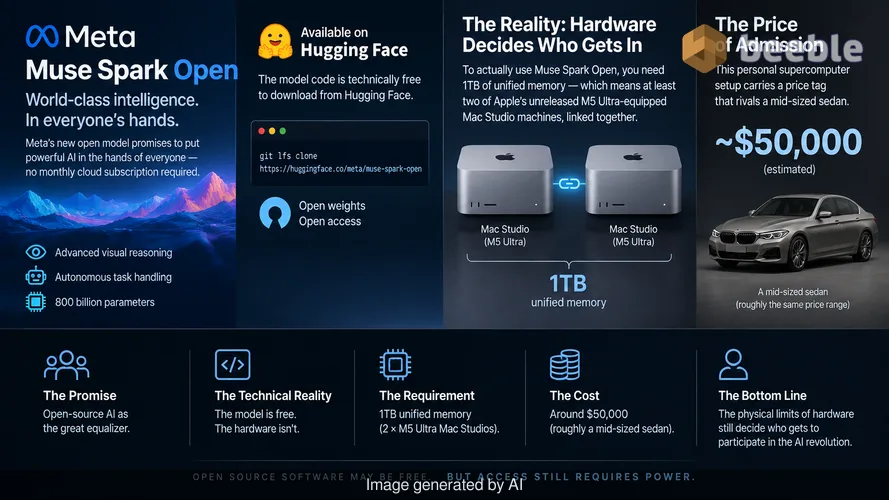
We are often told that open-source software is the great equalizer of the digital age. Mark Zuckerberg wants the public to believe that Meta's new Muse Spark Open model puts world-class intelligence in the hands of everyone without the monthly tax of a cloud subscription. While the model code is technically free to download from Hugging Face, the hardware required to actually use it tells a different story. For the average user, this latest release is less of a gift and more of a reminder that the physical limits of hardware still dictate who gets to participate in the AI revolution.
Meta recently released Muse Spark Open, an 800-billion parameter model that the company describes as the most capable US open-weight model to date. It is a massive piece of software designed to handle complex visual reasoning and autonomous tasks. It is also the first major model optimized specifically for Apple's high-end silicon. However, the price of admission is a staggering 1TB of unified memory. To reach that number, a user needs at least two of Apple's unreleased M5 Ultra-equipped Mac Studio machines linked together. The result is a setup that functions like a personal supercomputer but carries a price tag that rivals a mid-sized sedan.
The weight of eight hundred billion parameters
To understand why this model requires such extreme hardware, it helps to view the AI as a tireless intern with a very large reference library. An 800-billion parameter model is essentially a massive collection of weights or connections. Every time you ask the AI a question, it must consult these billions of points to determine the most likely answer. If the library is too big to fit on the intern's desk, they have to walk to a basement storage room for every single word they write. In computing, that desk is the Random Access Memory (RAM).
Most consumer laptops today ship with 8GB or 16GB of RAM. High-end professional machines might have 64GB or 128GB. Meta's Muse Spark Open needs 1,000GB. When a model is this large, it cannot sit on a standard hard drive or a typical graphics card. It needs to live entirely within the fast-access memory of the computer to function at a usable speed. If the memory is insufficient, the system slows to a crawl or simply crashes. Meta has built a digital brain that is simply too large for almost any desk currently in existence.
Historically, running models of this scale was the exclusive domain of massive data centers filled with Nvidia H100 clusters. These setups cost millions of dollars and consume enough electricity to power a small neighborhood. By optimizing for Apple Silicon, Meta is attempting to move that capability into the office. But even with Apple’s efficiency, the sheer volume of data involved makes this a niche tool for the wealthy or the institutional.
Why Apple Silicon is the chosen platform
Apple has a unique advantage in this high-end race thanks to its unified memory architecture. In a traditional PC, the processor and the graphics card have separate pools of memory. This creates a bottleneck when a massive AI model needs to move data between the two. Apple’s M-series chips allow the CPU and the GPU to share one large pool of very fast memory. This allows a Mac Studio to handle data-heavy tasks that would normally require multiple expensive enterprise graphics cards.
Meta explained that two Mac Studio machines equipped with M5 Ultra chips can act as a single unit. Each machine can hold up to 512GB of memory. When connected, they behave like one computer with 1TB of unified memory. This setup is the only way a consumer-grade device can hold the entire Muse Spark Open model at once. It is a clever engineering workaround for a problem that usually requires a server rack.
Looking at the big picture, this optimization is a strategic move for both companies. Meta gets to prove that its open-source models can run without relying on Nvidia's near-monopoly on AI chips. Apple gets to market its most expensive hardware to a new crowd of developers and researchers. For the consumer, however, it creates a new tier of "pro" hardware that is further out of reach than ever before. The gap between a standard Mac and the hardware needed for top-tier AI is now a canyon.
The real cost of local AI sovereignty
Practically speaking, the investment required to run Muse Spark Open is significant. Based on current pricing structures and Meta’s own estimates, a setup capable of running the model at full speed will cost roughly $38,000. This configuration uses four Mac Studios with 256GB of memory each. While this is cheaper than buying a dedicated AI server from a vendor like Dell or Hewlett Packard, it is still an astronomical sum for a single developer.
| Configuration | Total Memory | Estimated Cost | Target Use Case |
|---|---|---|---|
| 2x Mac Studio (M5 Ultra 512GB) | 1TB | $40,000+ | Research & Enterprise |
| 4x Mac Studio (M5 Ultra 256GB) | 1TB | $38,000 | Distributed Local AI |
| Single Mac Studio (M5 Ultra 128GB) | 128GB | $6,000 | Small Model Testing |
For a large organization, this math actually makes sense. Many companies currently spend thousands of dollars every month on "tokens," which are the units used to pay for AI services like GPT-4 or Claude. These costs add up over time and offer no ownership of the underlying technology. By spending $38,000 on a cluster of Mac Studios, a company can run Meta’s model for free for years. They own the hardware and the data stays within their own walls. On the market side, this is a capital expenditure that eventually pays for itself by eliminating recurring subscription fees.
For the individual "vibe coder" or hobbyist, this is a different reality. The dream of running a frontier-class AI on a personal laptop remains just that—a dream. We are entering an era where the software is open and free, but the hardware acts as a new kind of gatekeeper. The decentralized future of AI is arriving, but it is currently reserved for those with corporate budgets.
Benchmarks and the battle with China
Meta is not just releasing this model for the sake of hardware sales. There is a geopolitical element to this launch. The company explicitly stated that the US should not allow Chinese labs to lead the way in open-source AI. Benchmarks released by Meta show that Muse Spark Open outperforms leading Chinese models like GLM 5.3 and Kimi K3. These comparisons focus on agentic tasks, which involve the AI taking actions on behalf of a user, and visual reasoning.
In everyday life, a model with these capabilities could act as a sophisticated personal assistant that can see what is on your screen and interact with your apps. It could analyze complex architectural blueprints or help a doctor interpret medical imaging. Because it is an open-weight model, developers can inspect its code and ensure it is not sending private data to a central server. This transparency is the primary selling point for organizations that handle sensitive information.
Curiously, the performance lead Meta claims is slim in some areas. The Chinese models are becoming increasingly efficient, often requiring less memory for similar results. Meta’s approach is one of brute force. By building an 800-billion parameter giant, they are betting that scale will beat efficiency. This puts the burden on the user to provide the necessary power. It is a bet that the hardware will eventually catch up to the software's demands.
What this means for the everyday consumer
Under the hood, Muse Spark Open represents a shift in how we think about computer power. For the last decade, we have moved toward the cloud for everything. We stream movies, store photos in the cloud, and use AI through a web browser. Meta is attempting to reverse this trend. They want the most powerful tools to live on your desk, not in a data center owned by a competitor like Google or Microsoft.
From a consumer standpoint, you should not feel the need to go out and buy a Mac Studio today. You will likely interact with Muse Spark Open through third-party apps and services that host the model for you. However, the existence of this model will influence the features that eventually trickle down to your phone and laptop. As Meta learns how to make this massive model work on Apple Silicon, they will find ways to shrink it. The techniques developed for the 1TB version will eventually make the 10GB version on your next iPhone much smarter.
Ultimately, Muse Spark Open is a foundational piece of technology that sets a new ceiling for what is possible outside of a massive server farm. It is a robust tool that favors privacy and local control over convenience. While the price of admission is high, it provides a blueprint for a future where high-end intelligence is a private utility rather than a rented service. As memory prices fluctuate and new chips emerge, the cost of this intelligence will fall. For now, it remains a powerful signal of where the industry is headed.
Observe your own digital habits and notice how much of your data currently lives in the cloud. The arrival of massive local models suggests a future where your most important tasks might once again happen entirely on your own device. The hardware may be expensive today, but the shift toward digital sovereignty is officially underway.
Sources:
Meta Newsroom Official Release Statement
Apple Machine Learning Research Documentation
Hugging Face Model Repository for Muse Spark Open
Market Analysis on M-Series Silicon Pricing for 2026
Comparative Benchmark Reports for GLM 5.3 and Kimi K3



See you on the other side.
Our end-to-end encrypted email and cloud storage solution provides the most powerful means of secure data exchange, ensuring the safety and privacy of your data.
/ Create a free account