


Mistral AI is not the European OpenAI and that is its biggest advantage

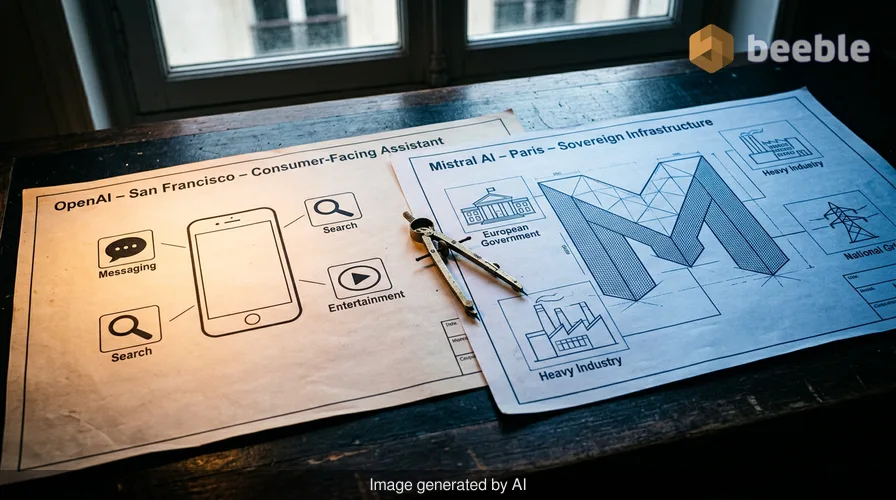
While observers often label Mistral AI as the OpenAI of Europe, this comparison is largely incorrect. The Paris-based company has spent the last three years building a business model that looks nothing like the consumer-facing chatbot giant from San Francisco. OpenAI wants to be the primary assistant on your smartphone. Mistral wants to be the invisible backbone of European government, heavy industry, and sovereign infrastructure.
This distinction is becoming more relevant as global tech lines harden. Following recent directives from the U.S. government that led rival Anthropic to pull its latest models offline, the demand for technology that exists outside of American or Chinese control has skyrocketed. Mistral has positioned itself as the answer to this demand, offering a supply of artificial intelligence that does not depend on a foreign kill switch.
The research heavyweights behind the brand
Mistral started with a pedigree that immediately caught the attention of the global tech community. The company has three founders who previously worked at the highest levels of U.S. tech research hubs in Paris. CEO Arthur Mensch is a former researcher at Google’s DeepMind, while CTO Timothée Lacroix and Chief Scientist Guillaume Lample both came from Meta’s AI research division.
These founders did not just bring technical skill; they brought a specific philosophy regarding how software is shared. They launched the company in May 2023 and quickly raised 113 million dollars in seed funding, which was the largest seed round in European history at the time. Unlike their American counterparts who kept their recipes secret, the Mistral team gained early fame by releasing their first models under open licenses. This allowed developers to see the inner workings of the system, a move that built instant trust within the European startup ecosystem at Station F and beyond.
Following the Palantir playbook
To understand why Mistral is thriving despite having less cash than OpenAI, look at its strategy for customer acquisition. The company is following what industry analysts call the Palantir playbook. Instead of just selling a monthly subscription for a chatbot, Mistral sends forward-deployed engineers to work directly inside large corporations and government agencies.
These engineers help organizations adopt AI and tailor it for specific, high-stakes use cases. This is why you see Mistral partnering with the French army, shipping giant CMA CGM, and German defense tech startup Helsing. These are not companies looking for a creative writing tool; they are organizations that need secure, local processing of sensitive data. By embedding itself into the operational fabric of these industries, Mistral makes its technology hard to replace.
This approach also shows in the company’s financial growth. In early 2024, Mistral reported an annual recurring revenue of 20 million dollars. By February 2025, that number jumped to 400 million dollars. Current estimates place the company on track to surpass 1 billion dollars in revenue this year. This growth happened while the company maintained a relatively lean workforce, especially when compared to the thousands of employees at Google or Meta.
Building the sovereign AI cloud
The most significant shift in Mistral’s strategy is its move toward hardware and infrastructure. Sovereignty is not just about who writes the code; it is about where the data lives and what chips process the information. Mistral is currently investing 4 billion euros into a strategy to build dedicated data centers in France and Sweden.
Earlier this year, the company acquired an infrastructure startup named Koyeb to accelerate this transition. The goal is to build a true AI cloud that allows European companies to run advanced models without their data ever leaving the continent. This is a direct response to the anxiety felt by European leaders like Emmanuel Macron, who has championed Mistral as a tool for industrial independence.
Behind the scenes, Mistral is even exploring the possibility of designing its own chips. While it currently relies on a partnership with Nvidia, Arthur Mensch has stated that owning the silicon is a logical next step. This would complete the vertical integration of the company, moving from the mathematical research to the physical hardware.
A broad family of specialized models
Mistral does not believe in a one-size-fits-all model. The company has developed a diverse portfolio that ranges from massive reasoning systems to tiny models that run on local devices.
| Model Name | Primary Use Case | Accessibility |
|---|---|---|
| Mistral Large 2 | High-end reasoning and complex coding | Proprietary API |
| Mistral Small 4 | Cost-efficient enterprise tasks | Open weights |
| Les Ministraux | Optimized for phones and edge devices | Open weights |
| Leanstral | Specialized coding assistant | Open source |
| Codestral | High-performance programming | Proprietary API |
The upcoming model scheduled for release this summer continues the trend of reducing the performance gap between European and American AI. This new model is expected to be open-weight, meaning developers can download the model and run it on their own servers. For many businesses, this is the ultimate security feature because it ensures that their proprietary data never touches Mistral’s servers or the public internet.
The shift from debt to strategic partnerships
Mistral’s funding history reads like a map of the global power structure. While the company started with traditional venture capital from firms like Andreessen Horowitz and Lightspeed, its recent rounds are more strategic. The Series C round in September 2025 was led by ASML, the Dutch company that produces the machines required to make advanced microchips.
This partnership with ASML is particularly telling. It moves AI out of the realm of internet search and into the realm of industrial manufacturing. ASML is using Mistral’s models to optimize its own production and research operations. By aligning with the companies that literally build the hardware of the modern world, Mistral secures its place in the global supply chain.
Despite this massive influx of cash and a valuation reaching toward 23 billion dollars, the company remains focused on an eventual initial public offering rather than a sale. Arthur Mensch has been vocal about staying independent, even as rumors of interest from companies like Apple continue to circulate. A sale to a U.S. company would likely trigger regulatory intervention in France, given Mistral’s status as a national champion for tech sovereignty.
What this means for your digital life
For the average consumer, Mistral’s success might not be visible in a new app icon on their home screen. Instead, you will feel the impact of this technology through the services you use every day. When your bank uses a more secure, local AI to detect fraud, or when your local government streamlines public services through the AI for Citizens initiative, Mistral is likely the engine behind those improvements.
Practically speaking, Mistral represents a choice. It offers an alternative to the centralized control of a few Silicon Valley corporations. If you care about where your data is processed or how much influence a single country has over the tools you use for work, Mistral’s growth is a positive development for digital diversity.
Ultimately, Mistral is proving that AI is becoming a commodity. Just as every country needs a reliable supply of electricity or clean water, every modern economy now needs a secured and affordable supply of intelligence. By focusing on the infrastructure and the industrial application of this technology, the French startup is ensuring that it remains a necessary utility rather than just another trendy chatbot.
Sources: Mistral AI official announcements, CNBC, Bloomberg Market Data, Crunchbase, Arthur Mensch LinkedIn public statements.



See you on the other side.
Our end-to-end encrypted email and cloud storage solution provides the most powerful means of secure data exchange, ensuring the safety and privacy of your data.
/ Create a free account
