


National bank charters and the verified domain threat: What fintech leaders must reconsider before a public listing

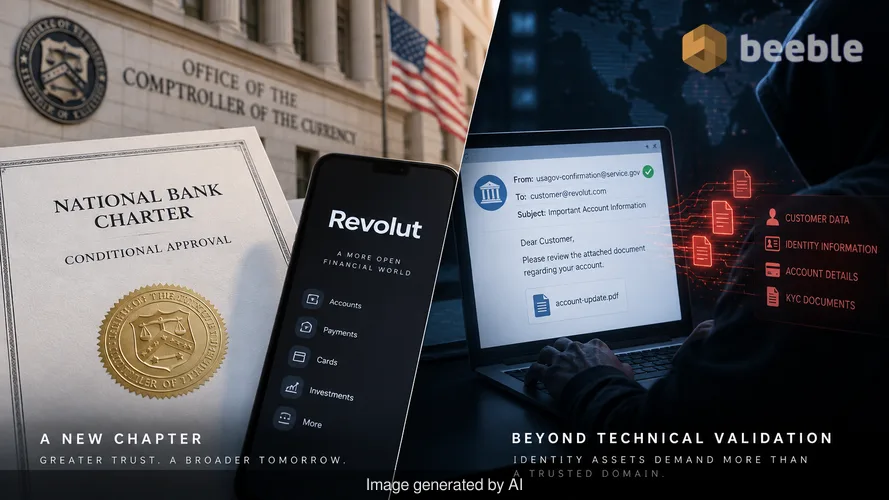
The U.S. Office of the Comptroller of the Currency issued a conditional national bank charter to Revolut this month. This regulatory advancement signals the firm's transition from a digital wallet provider to a systemically important financial institution. Simultaneously, Revolut confirmed that an unauthorized third party exfiltrated sensitive customer data by impersonating a government agency via a legitimate domain. The incident demonstrates that technical validation of an email source is insufficient for the protection of high-value identity assets.
The collapse of domain legitimacy as a trust proxy
The breach at Revolut is a demonstration of access asymmetry. An attacker utilized a legitimate government agency email domain to submit fraudulent information requests. Because the domain was authentic, the emails passed standard authentication checks including SPF, DKIM, and DMARC. This allowed the attacker to bypass the automated filters that usually block phishing attempts. The trust was placed in the infrastructure rather than the intent of the request.
For a fintech firm aiming for a $200 billion valuation, this incident is a stark reminder that the perimeter is not a wall but a permeable membrane. Traditional security models assume that a verified sender is a safe sender. This assumption is now a liability. What this means in practice is that the verification of the sender's identity is separate from the verification of the sender's authority to access specific data. Revolut confirmed that the exposed data included passports, driver’s licenses, and verification selfies. These are the crown jewels of identity theft.
Targeting the high net worth ecosystem
Security researcher ZachXBT noted that the incident appeared to target high net worth individuals. This suggests a shift from broad, automated attacks to high-precision social engineering. The attackers were not looking for volume; they were looking for value. When an attacker targets a specific class of users, the threat model changes from a generic defense to a targeted counter-intelligence operation.
The exfiltration of account statements and transaction histories provides attackers with a roadmap for future exploitation. This data allows for the creation of highly convincing follow-on scams. If an attacker knows a customer's exact balance and recent transactions, they can pose as a bank official with absolute credibility. The blast radius of this breach extends far beyond the initial data loss. It creates a persistent risk for the most valuable segment of the customer base.
The architectural failure of administrative trust
The core of the shift in modern cyber defense is the realization that internal processes are as vulnerable as external ports. In this case, the breakdown occurred at the intersection of regulatory compliance and data privacy. Revolut employees or automated systems responded to what appeared to be a lawful request for information. The failure was not in the encryption of the data, but in the logic of the disclosure process.
A government domain is not a master key, but a requested invitation. Organizations often grant an implicit trust to government entities that they would never grant to a commercial partner. This creates a blind spot in the Zero Trust architecture. If a system does not verify the specific legal mandate behind a request, the legitimacy of the email domain is irrelevant. The data was handed over because the process lacked a secondary, out-of-band verification step for high-stakes data requests.
From perimeter defense to granular authorization
For clarity, the current threat environment requires a total decoupling of communication and authorization. Microsegmentation is usually discussed in terms of network traffic, but it must also apply to human workflows. A request for a passport copy should trigger a different security protocol than a request for a mailing address change. Revolut has blocked the specific email address, but the underlying vulnerability—the reliance on domain-based trust—remains until the workflow is re-engineered.
Legacy systems often treat regulatory requests as a fast-track process to avoid legal friction. This efficiency is the expertise deficit that attackers exploit. They know that compliance teams are under pressure to respond quickly to government inquiries. The logic shifts to a model where every external request for sensitive PII is treated as a potential breach attempt. Verification must occur through a pre-established, secure portal or a secondary confirmation with a known human contact at the agency in question.
Regulatory implications and IPO readiness
Revolut is currently under intense scrutiny as it prepares for a public listing and expands its banking footprint in the UK, France, and the US. Regulators view data protection as a proxy for operational stability. A firm that can be deceived by a spoofed or compromised government domain faces questions about its internal controls. The OCC's conditional approval will likely come with increased demands for architectural resilience.
The fintech sector is a prime target for state-sponsored and sophisticated criminal actors because it sits at the intersection of traditional finance and rapid software iteration. The friction between fast development and security is constant. However, as a bank, Revolut is now a piece of critical infrastructure. The standard for security is no longer "best effort," but "failsafe." A single compromise of a high-net-worth account can result in regulatory fines and a loss of market confidence that outweighs years of growth.
Action plan for C-level leadership
CISOs and CTOs must move beyond basic hygiene and implement a defense-in-depth strategy for administrative functions. The goal is to ensure that a compromise of a single trust signal does not lead to a total data breach. The following steps are required for organizations handling sensitive PII and identity documents.
- Audit Regulatory Response Workflows: Map every path through which customer data leaves the organization. Identify every instance where a verified email domain is the sole requirement for data disclosure.
- Implement Out-of-Band (OOB) Verification: Establish a mandatory secondary verification process for all third-party data requests. This must involve a different communication channel, such as a phone call to a verified agency number or a secure government portal.
- Enforce Data Minimization and Ephemeral Storage: Do not store identity documents longer than legally required for KYC purposes. Use tokenization to represent sensitive documents in downstream systems, reducing the volume of raw data available for exfiltration.
- Deploy AI-Driven Behavioral Analysis: Use frontier models to analyze the language and patterns of inbound requests. Sophisticated impersonation scams often follow specific linguistic templates that can be identified by machine learning before a human ever sees the email.
- Microsegment the Compliance DMZ: Treat the compliance department as a high-risk zone. Limit the ability of compliance personnel to bulk-export sensitive data without multi-party authorization.
Survival through architectural resilience
The new reality of cybersecurity is that identity is the primary attack vector. Whether it is a compromised user account or a compromised government domain, the attacker's goal is to wear the mask of a trusted entity. Survival depends on an architecture that assumes the mask is already in place. The goal is to prevent a single point of failure in the trust chain from becoming a catastrophe. As Revolut moves toward its IPO, its ability to prove that it has solved the problem of trusted impersonation will be its most important asset.
Sources:
- U.S. Office of the Comptroller of the Currency (OCC) official filings.
- Revolut Corporate Press Office and customer notifications.
- ZachXBT crypto-security research reports.
- Financial Conduct Authority (FCA) data protection guidelines.
Disclaimer: This article is for informational and educational purposes only. It does not replace a professional cybersecurity audit, legal advice, or a dedicated incident response service. The strategies described should be evaluated in the context of your specific organizational architecture and regulatory environment.



See you on the other side.
Our end-to-end encrypted email and cloud storage solution provides the most powerful means of secure data exchange, ensuring the safety and privacy of your data.
/ Create a free account
