


Securing your AI infrastructure before NadMesh empties your cloud accounts

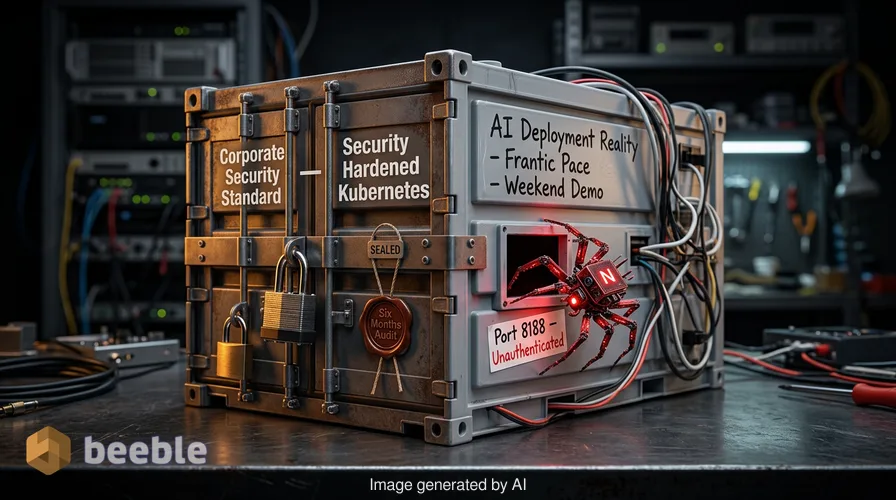
A multi-million dollar enterprise defense strategy often collapses under the weight of a single unauthenticated container. I saw this firsthand last quarter while auditing a research lab that had spent six months hardening its Kubernetes clusters but left a ComfyUI instance open for a weekend demo. That single exposed port on 8188 was enough to bypass every network policy they had in place. The NadMesh botnet, discovered in early July 2026, lives exactly in that gap between corporate security standards and the frantic pace of AI deployment.
NadMesh is a Go-based malware family that prioritizes identity over raw compute. While previous botnets focused on hijacking GPUs for Monero mining, the operators behind NadMesh understand that a stolen AWS secret is more valuable than a few thousand hashes per second. QiAnXin’s XLab published a report on Friday detailing how this botnet hunts for the image generators, local model runners, and workflow builders that engineering teams stand up fast and firewall late.
The architectural cost of the AI gold rush
There is a fundamental paradox in modern AI deployment. Organizations invest heavily in cloud IAM roles and encrypted storage, yet they allow developers to run unauthenticated tools like Ollama or n8n directly on the public internet. NadMesh exploits this lack of friction. The botnet uses a Shodan harvester to keep its scan queue stocked with targets running ComfyUI, Open WebUI, Langflow, and Gradio. These are the tools of the modern AI stack, and they are rarely hardened out of the box.
I recently analyzed a capture where a developer deployed a Marimo notebook to test a new model. They ignored the security warnings because they only needed it for an hour. Within twenty minutes, a NadMesh bot had scanned the IP, identified the service, and attempted an exploit. This speed is possible because the botnet treats the internet like a searchable database rather than a vast territory to wander. Subnets that produce successful hits are resampled every five minutes. If a target is flagged as dangerous, the botnet returns every fifteen minutes to run a high-priority scan of AI-specific ports first.
How the harvester feeds the queue
The scanning logic is persistent. A full sweep drags every IP marked dangerous in the last seven days back to the top of the queue. The author clearly knows that researchers and honeypots are watching. If a target absorbs ten deployment attempts without returning a result, the botnet blacklists it automatically. This prevents the fleet from wasting resources on decoys. When the queue runs dry, the bots generate a random /24 subnet and continue the hunt.
By the second week of July, distinct source IPs pushing NadMesh went vertical. XLab recorded the count jumping from near zero to around 139 a day. The operator’s own dashboard, captured on July 10, claims a haul of 3,811 unique AWS keys. This discrepancy between the small number of active bots and the massive volume of stolen credentials suggests a highly efficient automation engine. The operator does not need a massive botnet if every infection yields a master key to a cloud environment.
The vulnerability inside the model context protocol
The Model Context Protocol (MCP) is the primary vector on the controller's priority list. MCP is a standard that allows AI models to call external tools and access data sources. By design, the first specification of MCP put authentication outside the core protocol. An authorization flow exists as of March 2025, but the specification describes it as optional. Many developers skip it to save time during configuration.
Censys counted over 21,000 reachable MCP services by May 2026. Roughly 90 of those advertised a tool named execute_command. This tool is the exact call at the top of the NadMesh exploit table. The botnet uses a JSON-RPC tools/call to trigger this command. No CVE is associated with this activity because the software is performing exactly as configured. The problem is not a bug in the code. The problem is a protocol that allows unauthenticated command execution by default.
Inventorying the model and the identity
When a bot successfuly compromises a host, it does not just install a miner. It catalogues the environment. The intel feed behind the NadMesh dashboard shows inventories of DeepSeek, GLM, and Kimi models. These inventories are often tagged with a ":cloud" identifier. This indicates that the bot is looking past the local machine and identifying which remote AI services the host can access.
What a bot ships home is the identity of the organization. It pulls cloud keys out of environment variables, extracts Kubernetes service account tokens, and scrapes the contents of ~/.aws/config. It also targets .env files and ~/.docker/config.json. The researchers are plain about the motive. The operator is after the cloud credentials and cluster privileges rather than the host itself. In a modern architecture, the host is a disposable commodity, but the credentials provide persistent access to the data plane.
Persistence through triple redundancy
Removing NadMesh from a compromised system is difficult because of its redundant persistence mechanisms. The agent maintains three separate ways to survive a reboot. If an administrator finds and deletes one entry, the other two remain to pull a fresh copy of the malware. This is like trying to put out a fire that has three independent fuel sources. Every build of the malware also goes through Garble obfuscation and UPX packing with random padding. This means every agent has a unique file hash. A security team cannot rely on a single hash to find infections across their network.
Five build versions of the botnet currently run in the wild. The most common is 33.8-GO-TITAN. The operator uses a canary endpoint to stage new builds to a small slice of the fleet before a wide release. This is a level of DevOps maturity that mirrors the legitimate software companies they target. Success for the operator is scored on an outcome allowlist that excludes the Ollama and AWS harvest. This suggests the scoreboard on the dashboard is only showing a fraction of the total operation.
Defensive actions for the exposed perimeter
Most of what NadMesh throws is aimed at admin functionality left callable on the public internet. This includes open Docker APIs on port 2375, Jenkins script consoles, and unauthenticated Redis instances. No patch closes these holes because they are configuration choices. To secure your environment, you must move these services behind authentication or off the public internet entirely. Prioritize the four ports the NadMesh rescan job puts first: 8188 (ComfyUI), 11434 (Ollama), 7860 (Gradio), and 5678 (n8n).
There is also a short list of vulnerabilities that require immediate patching. CVE-2026-39987 is a pre-authentication remote code execution flaw in Marimo notebooks. CISA added it to the Known Exploited Vulnerabilities catalog in April. CVE-2026-41176 is also critical, as it allows unauthenticated callers to flip the authentication switch on rclone RC servers. Since rclone configurations often contain cloud credentials, this is a high-priority target for NadMesh.
If you find indicators of compromise, isolate the host immediately. Look for persistence files in /etc/cron.d/.sys_monitor and hidden files in /dev/shm/.a or /tmp/.a. Revoking credentials is the only safe path forward. If a host is compromised, assume every AWS key, cluster token, and .env file it touched is now in the hands of the operator. Rotating keys is not enough if the malware is still present to steal the new ones. You must pull the persistence before you issue replacements. Audit your logs for activity from the IP 209.99.186[.]235 or connections to the domain cdnorigin[.]net. The goal is to verify where the stolen identities were used while they were live.
Sources: NIST Cybersecurity Framework, MITRE ATT&CK (Resource Development, Initial Access), QiAnXin XLab NadMesh Report, Censys MCP Census 2026.
Disclaimer: This article is for informational and educational purposes only and does not replace a professional cybersecurity audit or incident response service.



See you on the other side.
Our end-to-end encrypted email and cloud storage solution provides the most powerful means of secure data exchange, ensuring the safety and privacy of your data.
/ Create a free account
