


The AI Revolution is Finally Swapping Wall Street’s Suits for Software Templates

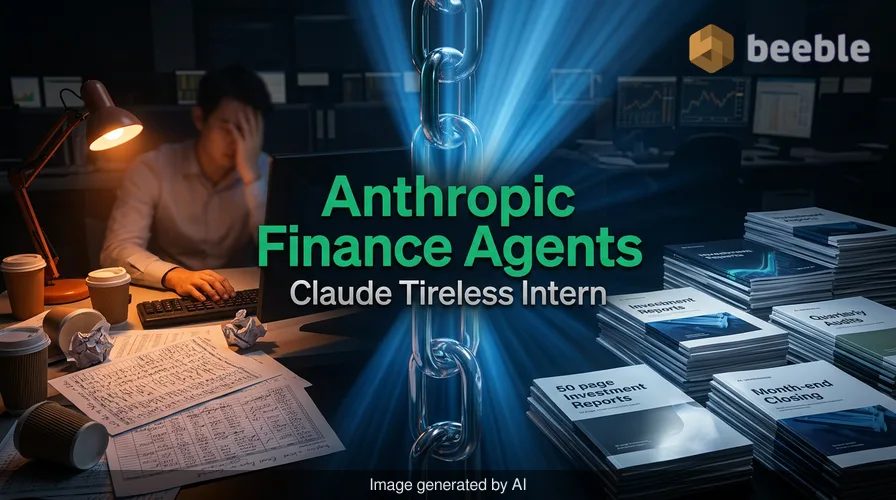
When you see a gleaming 50-page investment report or a finalized quarterly audit, you are looking at the final link in a long, expensive chain. This chain begins with raw, messy data scattered across global databases and usually ends with a junior analyst staring at an Excel sheet at 3:00 AM. For decades, the foundational machinery of global finance has relied on this human-powered processing. However, that chain is being fundamentally rebuilt.
Anthropic recently signaled a major shift in how this work gets done, releasing 10 ready-to-run AI agent templates specifically designed to handle the heavy lifting of the financial world. From building the pitchbooks that drive multi-billion dollar mergers to closing the books at month-end, the company is positioning its Claude AI models not just as a chatbot, but as a specialized, tireless intern that never needs sleep or a coffee break.
Breaking Down the Digital Assembly Line
To understand what is happening under the hood, we have to look at how these tasks were traditionally performed. A "pitchbook"—the document a bank uses to convince a company to hire them—requires gathering company histories, financial comparables, and market trends. Historically, this meant an analyst would manually pull data from various subscriptions, copy-paste it into Excel, and then format it into PowerPoint.
Anthropic’s new templates attempt to turn this manual labor into a streamlined, automated workflow. They have organized these tools into two distinct categories that reflect the front and back offices of a bank. On the research side, the AI acts as a scout, drafting target lists and reviewing earnings transcripts to flag changes in a company’s strategy. On the operations side, the agents act as a meticulous bookkeeper, handling general ledger reconciliation and the complex "Know Your Customer" (KYC) screenings required to prevent money laundering.
What makes this disruptive is not just the AI’s ability to read text, but its systemic integration. Each template uses a three-part structure:
- Skills: The domain-specific knowledge required for the task (e.g., knowing how to calculate a debt-to-equity ratio).
- Connectors: The digital bridges that allow the AI to reach into secure databases like Moody’s or Dun & Bradstreet.
- Subagents: Smaller, specialized AI models that Claude calls upon to double-check math or verify a specific methodology.
The Spreadsheet Survival Guide
For the average user, the most tangible update is likely the deeper integration with Microsoft Office. For years, AI tools felt like they lived in a separate tab in your browser—you had to copy data out of your spreadsheet and paste it into the AI window. Behind the jargon of "cross-application context," Anthropic is essentially erasing those walls.
Claude can now work directly across Excel, PowerPoint, Word, and Outlook. In simple terms, this means if an analyst builds a financial model in Excel, the AI remembers the logic of that model when the user switches to PowerPoint to write the summary. It’s an interconnected ecosystem where the AI doesn't just see a single document; it sees the entire project.
| Feature | Traditional Manual Process | Anthropic Agent Process |
|---|---|---|
| Data Gathering | Hours spent searching disparate databases | Seconds via integrated data connectors |
| Context Transfer | Manual copy-pasting between Excel and PPT | Automatic context sharing across Office |
| Verification | Peer review by another human analyst | Automated "Subagents" check for errors |
| Timeline | Weeks to months for full deployment | Ready to run in days |
The Speed of Trust and the Human Factor
Curiously, even as Anthropic pushes for more automation, they are being very careful about how they market the "human in the loop." The launch of Claude Opus 4.7—which currently sits at the top of industry benchmarks for financial tasks—comes with a disclaimer: humans must still review and approve the work.
Looking at the big picture, this is a calculated move to maintain trust in a volatile industry. Finance is a world where a single misplaced decimal point can trigger a systemic crisis or a massive regulatory fine. By framing the AI as a robust assistant rather than a total replacement, Anthropic is trying to lower the barrier to entry for cautious firms.
However, the performance numbers are hard to ignore. Anthropic claims their models lead the industry on Vals AI’s Finance Agent benchmark, scoring over 64%. While that might sound low compared to a human expert, in the world of raw data processing, it represents an unprecedented level of accuracy for an automated system.
The Shadow Side: Security and Shifting Jobs
It wouldn’t be a major tech rollout in 2026 without a sobering reality check. Alongside the productivity gains, Anthropic’s CEO Dario Amodei recently warned of a "moment of danger." This refers to the dual-use nature of the technology. The same AI that can find a discrepancy in a financial audit can also be used to find vulnerabilities in software code.
Anthropic’s "Claude Mythos" model has already been used by organizations like Mozilla to find and patch hundreds of bugs in the Firefox browser. While this is great for defense, the concern is that if this level of intelligence becomes decentralized or falls into the hands of bad actors, the very financial systems these agents are meant to manage could become targets.
Beyond cybersecurity, there is the overarching question of employment. We are already seeing the cyclical nature of the tech industry play out, with companies like Meta and Coinbase citing AI efficiency as a reason for recent layoffs. For the average user working in a corporate environment, the message is clear: the "drudgery" being automated today is often the entry-level work that serves as the training ground for tomorrow’s leaders.
What This Means for You
From a consumer standpoint, you might not be building pitchbooks for a living, but you will feel the ripples of this shift in your everyday life. Practically speaking, here is the bottom line:
- Faster Financial Decisions: As banks use these tools to screen loans and verify documents, the time it takes to get approved for a mortgage or a business loan could drop from weeks to hours.
- Opaque Algorithms: As more of the "back office" is handled by AI, it may become harder for consumers to get a clear explanation for why a specific financial decision—like a credit limit change—was made.
- The Literacy Shift: Knowing how to use these templates will likely become a foundational skill. Much like knowing how to use a calculator or a spreadsheet became a prerequisite for office work 30 years ago, "agent orchestration" is the new bar.
Ultimately, Anthropic isn't just selling software; they are selling a new version of the white-collar workforce. As these agents become more resilient and intuitive, the invisible backbone of the global economy is getting a massive digital upgrade. Whether this leads to a more efficient world or a more fragile one remains a question of how we choose to keep humans in the driver’s seat.
For now, the best move is to observe your own digital habits. Are you spending hours on repetitive data entry? The templates for your own tasks are likely just around the corner, and the best way to stay relevant is to learn how to manage the AI intern before it manages your workflow.
Sources:
- Anthropic Industry Release Notes (May 2026)
- Vals AI Finance Agent Benchmark Report
- Mozilla Security Research Blog
- Financial Industry Automation Trends - Q2 2026



See you on the other side.
Our end-to-end encrypted email and cloud storage solution provides the most powerful means of secure data exchange, ensuring the safety and privacy of your data.
/ Create a free account
