


The Automated Promise and the Human Void: The Growing Paradox of AI Trust

A man sits in a crowded terminal at O'Hare International Airport and watches his phone screen. He is trying to write a letter of resignation, but the software keeps finishing his sentences for him. Every time he pauses to find a word that describes his specific exhaustion, the cursor offers a generic, professional alternative. The interface is helpful. The interface is efficient. The interface is also deeply invasive. He eventually closes the laptop because the machine makes his own thoughts feel like training data. This visceral rejection is a micro-level manifestation of a massive societal shift. We are surrounded by tools that promise to augment our lives, yet we feel increasingly alienated by their presence.
A systemic erosion of collective confidence
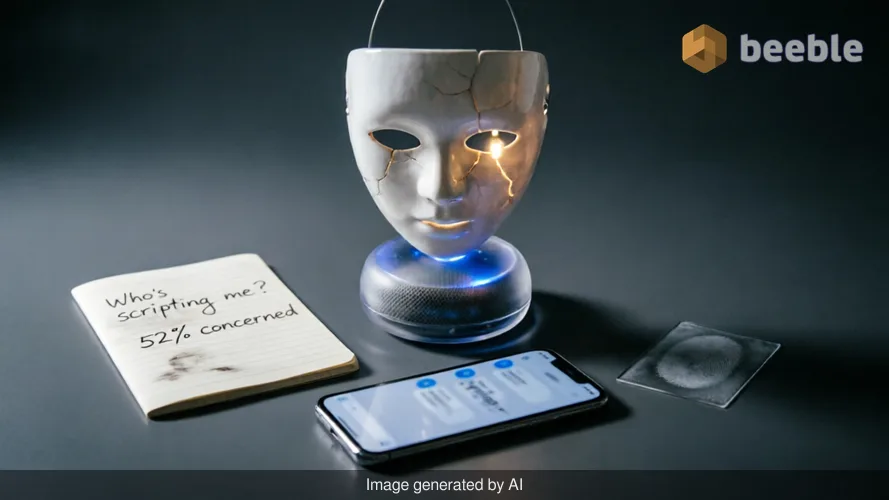
The promise of artificial intelligence is a world of boundless creativity and friction-free living unless the very tools designed to connect us end up isolating our individual voices within a pre-determined script. The technology requires a massive surrender of privacy unless we demand transparency that the makers are currently unwilling to provide. This tension is visible in the data. A study by Pew Research indicates that 52% of Americans are now more concerned than excited about the presence of AI in their daily routines. This is a sharp increase from 37% just five years ago. Only 9% of the population feels genuine excitement. This shift suggests that the novelty of the chatbot has worn off, leaving behind a residue of systemic anxiety.
This sentiment is even more pronounced among younger generations. For the first time, a majority of adults under 30—roughly 55%—report that their concern outweighs their enthusiasm. To put it another way, the digital natives who were expected to embrace this evolution are the ones most wary of its trajectory. In sociological terms, this is a breakdown of the habitus. The deeply ingrained habits and dispositions that once allowed us to navigate the digital world with ease are now under friction. We no longer see these tools as extensions of ourselves. We see them as external forces that demand our compliance.
The faces behind the opaque algorithm
The distrust is not limited to the lines of code. It extends to the architects of the system. A CNBC Generation Lab poll recently asked respondents whether they trusted the industry's most prominent leaders to act with responsibility. The results were a categorical rejection of tech paternalism. Every single leader on the list faced a majority of distrust. Microsoft CEO Satya Nadella had the most favorable rating, yet 65% of people still do not trust him. At the other end of the spectrum, Palantir CEO Alex Karp is distrusted by 81% of the public. Dario Amodei and Sundar Pichai are viewed with suspicion by three-quarters of respondents.
Historically, the public has often been skeptical of new technologies, but the level of personal animosity toward these executives is unusual. It reflects a sense of atomization. People feel that a small, insulated group of individuals is making decisions that will alter the social contract for everyone else. Only 36% of respondents believe an independent expert body should set the rules. This suggests a total collapse of faith in both the creators and the potential regulators. When the public views the leaders of an industry as untrustworthy, the technology itself becomes a symbol of that bad faith. The software is not just a tool; it is a manifestation of the values of the people who built it.
Anxiety across the Atlantic archipelago
Across the Atlantic, the landscape of distrust takes a different shape. While Americans worry about the cultural and personal impact, Europeans are focused on the structural threat to their livelihoods. A 2025 study by EY found that 42% of European employees worry that AI is a threat to their job security. The Verian Group found that 66% of the wider public believes AI will destroy more jobs than it creates. This is not a luddite reaction. It is a rational response to the economic shifts of liquid modernity. In a world where work is increasingly fragmented and ephemeral, the introduction of a machine that can replicate cognitive labor feels like a final blow to stability.
Paradoxically, Europeans are more open to the potential benefits of the technology in specific fields. Half of those surveyed believe AI can help tackle global challenges like climate change and serious diseases. There is a clear distinction between the collective good and the individual risk. While 62% of Europeans view the use of AI at work favorably, 84% demand stronger oversight to protect privacy and ensure transparency. Linguistically speaking, the discourse in Europe is focused on protection and management, whereas the American discourse is focused on personal resentment and resistance.
The disconnect between infrastructure and individual benefit
In the United States, this resistance has moved from the digital space into the physical world. Plans to build new data centers are meeting significant public backlash. Developers offer incentives like job guarantees, but the residents remain unmoved. This pushback stems from a simple disconnect. Many consumers do not see a clear personal benefit from the infrastructure that is being built in their backyards. The data center is a massive, energy-hungry monolith that serves the needs of a distant corporation while offering nothing to the local community.
For a long time, AI was a narrow tool. It was a search function or a simple chatbot. Now, it is pervasive. It is in our televisions, our email, our music, and our schools. This expansion has been largely negative for the average person. Students use it to circumvent the learning process. Artists see their life's work absorbed into training data without consent. The technology has moved from being a useful assistant to being a parasitic presence that feeds on human creativity to produce a cheaper, thinner version of reality. Consequently, the public sees the expansion as an extraction rather than an evolution.
Reclaiming the human discourse in a scripted world
Linguistically speaking, the word "intelligence" has been hijacked. We use it to describe statistical models that predict the next most likely token in a sequence. This is not intelligence; it is high-speed mimicry. When we interact with these systems, we are often forced to adapt our own language to be more machine-readable. We simplify our queries. We use specific keywords. We participate in the flattening of human communication. Through this lens, the widespread distrust of AI is a healthy sign. It shows that people still value the nuance and the messiness of genuine human interaction.
On an individual level, the path forward requires a conscious effort to resist this flattening. It means choosing the difficult word over the suggested one. It means valuing the friction of a real conversation over the seamlessness of a curated interface. Culturally speaking, we are at a point where we must decide if we want our society to be a patchwork quilt of human experiences or a sterile, automated grid. The data suggests that the public is not yet ready to surrender the quilt. The lack of trust is a defense mechanism. It is a way of holding onto the parts of our lives that the machines cannot yet replicate.
Ultimately, the failure of AI to win people's trust is not a technical problem. It is a human one. It is a rejection of a future where efficiency is the only metric of success. If the makers of these tools want to win back the public, they cannot do it with more data or better algorithms. They must do it by demonstrating a commitment to the people their technology is supposed to serve. Until then, the airport traveler will continue to close his laptop, preferring the silence of his own thoughts to the helpful suggestions of a machine that does not know him.
Sources
- Pew Research Center, "Public Awareness and Views of AI-Driven Technologies."
- CNBC Generation Lab, "Trust in Tech: A Poll of Emerging Sentiments."
- EY (Ernst & Young), "AI in the European Workforce: 2025 Outlook."
- Verian Group for the European Commission, "Public Attitudes Toward Artificial Intelligence."
- Zygmunt Bauman, "Liquid Modernity."
- Pierre Bourdieu, "The Logic of Practice."



See you on the other side.
Our end-to-end encrypted email and cloud storage solution provides the most powerful means of secure data exchange, ensuring the safety and privacy of your data.
/ Create a free account
