


The Battle for the Source of Truth: Why Encyclopedia Britannica is Suing OpenAI

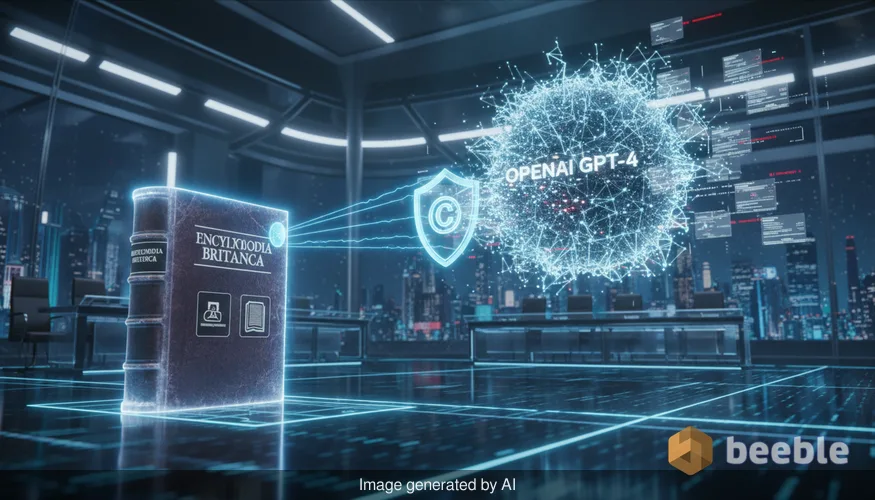
The legal storm surrounding generative AI has reached a new peak. Encyclopedia Britannica and its subsidiary, Merriam-Webster, have officially filed a lawsuit against OpenAI, alleging that the AI giant’s models have not just learned from their vast repositories of knowledge, but have effectively “memorized” them.
This lawsuit, filed in federal court following reports from Reuters, marks a significant escalation in the ongoing tension between traditional publishers and the architects of Large Language Models (LLMs). While previous lawsuits from authors and news organizations focused on the act of training, Britannica’s case highlights a more technical and perhaps more damaging phenomenon: the near-verbatim regurgitation of proprietary facts and definitions.
The Core of the Conflict: Memorization vs. Learning
At the heart of the complaint is the distinction between an AI “understanding” a concept and simply storing a copy of the text. Britannica alleges that GPT-4 can output near-identical copies of its copyrighted articles on demand. For a company that has spent over 250 years curating human knowledge, this isn't just a copyright violation—it is a direct threat to their business model.
To understand the gravity of this, consider the analogy of a student and a textbook. If a student reads a history book and then writes an original essay based on what they learned, that is generally considered transformative use. However, if that student walks into an exam and recites the textbook word-for-word, they are no longer demonstrating understanding; they are acting as a human photocopier. Britannica argues that OpenAI’s models are doing the latter.
The Evidence of “Regurgitation”
The lawsuit provides specific examples where GPT-4 allegedly produced responses that were “substantially similar” to Britannica’s entries. In the world of LLMs, this is known as “regurgitation.” It occurs when a model is trained so heavily on a specific dataset that the weights of the neural network become tuned to reproduce that data exactly when prompted with specific keywords.
For Merriam-Webster, the stakes are equally high. Dictionary definitions are, by necessity, concise and specific. If an AI provides a definition that matches Merriam-Webster’s unique phrasing and structural nuances, it bypasses the need for a user to ever visit the publisher’s website. This “zero-click” reality drains ad revenue and subscription potential from the very institutions that provide the high-quality data AI relies on.
Why This Lawsuit is Different
We have seen similar cases from The New York Times and various prominent novelists, but the Britannica case is unique for two reasons:
- The Nature of the Data: Unlike a novel, which is protected by creative expression, an encyclopedia is a collection of facts. While facts themselves cannot be copyrighted, the selection and arrangement of those facts can be. Britannica argues that OpenAI has co-opted the specific structure and synthesis that makes their entries authoritative.
- The “Source of Truth” Problem: OpenAI positions ChatGPT as an assistant that provides factual information. If that information is sourced directly from Britannica without attribution or compensation, OpenAI is essentially selling Britannica’s reputation for accuracy as its own product.
OpenAI’s Likely Defense: Fair Use and Transformation
While OpenAI has not yet released a full rebuttal to this specific filing, their historical defense remains consistent. They argue that training AI models on publicly available internet data constitutes “fair use.” They contend that the models are creating something entirely new—a multi-purpose reasoning engine—rather than a database of existing works.
OpenAI also frequently points to “guardrails” they have implemented to prevent the exact type of regurgitation Britannica is complaining about. However, as this lawsuit suggests, those guardrails may be more porous than the company admits, especially when users employ specific prompting techniques to “extract” training data.
The Technical Challenge of Unlearning
One of the most difficult aspects of this legal battle is the technical reality of LLMs. Once a model is trained on a dataset, “unlearning” that specific data is notoriously difficult. It isn't as simple as deleting a file from a hard drive. The information is diffused across billions of parameters.
If the court rules in favor of Britannica, OpenAI might be forced to do more than just pay a fine. They could be required to filter outputs more aggressively or, in a worst-case scenario for the tech firm, retrain models from scratch without the disputed data—a process that would cost millions of dollars and months of compute time.
What This Means for the Future of AI
This lawsuit is a bellwether for the “data licensing” era of AI. We are moving away from the “Wild West” period where AI companies scraped the web with impunity. In the coming months, we will likely see more high-profile partnerships where AI firms pay for access to high-quality, verified data silos.
For users, this could mean that AI responses become more transparent, with clearer citations and links back to original sources. For the industry, it means that the cost of building a top-tier LLM is about to go up significantly as “free” data sources start putting up legal paywalls.
Practical Takeaways for Businesses and Creators
As the legal landscape shifts, here is how you should navigate the changing environment:
- Verify AI Outputs: If you use AI for factual research, cross-reference the information with primary sources. The “memorization” issue proves that AI can sometimes present copyrighted material as its own original thought.
- Respect Licensing: If you are building tools using LLM APIs, be aware that the legal status of the training data is still in flux. Ensure your use cases don't inadvertently facilitate copyright infringement.
- Watch the Precedent: The outcome of the Britannica vs. OpenAI case will likely set the standard for how “factual” content is treated in the age of AI. A win for Britannica could lead to a more fragmented, pay-to-play information ecosystem.
Sources
- Reuters: Encyclopedia Britannica and Merriam-Webster sue OpenAI over copyright
- U.S. Copyright Office: Artificial Intelligence and Copyright Public Inquiries
- OpenAI Blog: Our approach to data and privacy in the age of AI



See you on the other side.
Our end-to-end encrypted email and cloud storage solution provides the most powerful means of secure data exchange, ensuring the safety and privacy of your data.
/ Create a free account
