


The Billable Hour is Dying, and Your Lawyer Couldn't Be Happier

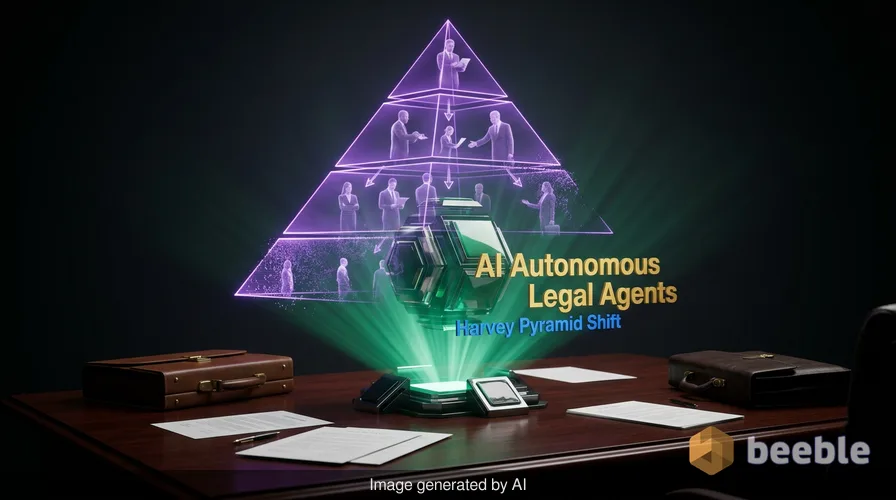
While the popular narrative suggests that artificial intelligence is coming to replace your lawyer entirely, the reality unfolding in the world’s most prestigious law firms is far more nuanced—and arguably more disruptive. For years, the fear was that a chatbot might hallucinate a fake case and get a lawyer disbarred. Today, however, we are moving past the era of 'chatting with documents' and into the era of the autonomous legal agent.
Looking at the big picture, the legal profession has historically been a pyramid. At the top sit the partners, who delegate complex tasks to associates, who then hand the 'grunt work' down to junior lawyers and paralegals. This hierarchy is the foundational structure of the billable hour. But according to Winston Weinberg, the CEO of the $11 billion legal-AI powerhouse Harvey, that bottom layer of the pyramid is being replaced by software.
The Shift from Chatbots to Autonomous Agents
To understand why this matters, we have to look under the hood at how AI has evolved. In 2023 and 2024, lawyers were using AI primarily as a high-end search engine—asking it to find a specific clause in a 400-page contract or summarize a deposition. It was a tool for consumption.
Practically speaking, Harvey’s latest push into 'agents' changes the AI from a librarian into a tireless intern. An agent doesn't just answer a question; it performs a workflow. If a lawyer needs to run due diligence on a merger, they don't just ask the AI to read the documents. They set an agent in motion to identify liabilities, flag inconsistent termination clauses, draft a summary memo, and prepare a set of questions for the next negotiation session.
Harvey recently revealed it has over 500 of these specialized agents live, covering everything from complex litigation to corporate tax. Perhaps more importantly, they’ve launched an 'Agent Builder' tool. This allows a lawyer—someone who likely hasn't written a line of code since their MySpace days—to customize a digital worker for their specific niche. It is a streamlined approach to automation that removes the technical barrier to entry.
By the Numbers: An Explosion in Efficiency
On the market side, the data suggests this isn't just a pilot program; it’s a systemic shift in how work gets done. Harvey’s platform is now used by 100,000 lawyers across 1,500 firms. But the real headline is the activity level. Users are currently running more than 700,000 agent-powered tasks every single day.
To put it another way, if a junior lawyer takes 10 to 20 hours to perform a deep-dive research task, and an agent can perform a robust version of that same task in 20 minutes, the math of the legal industry begins to look volatile. Harvey reports that the hours spent in their software per user have jumped 75% in just the last four months. This tells us that lawyers aren't just 'trying' AI; they are living in it. They are shifting their billable time away from manual document review and toward the higher-level strategy of directing these digital agents.
The Staffing Paradox: Fewer People, More Work
This leads to an uncomfortable question: what happens to the human beings at the bottom of the pyramid? Historically, the first three years of a lawyer’s career are spent in the trenches of 'doc review' and memo drafting. If an agent can do that work faster and more accurately, the entry-level job market faces a resilient challenge.
Weinberg offers a contrarian view on this. While common sense suggests that automation equals layoffs, he argues that we will see a shift in the ratio of lawyers to matters. Essentially, instead of a team of ten lawyers working on one massive case, you might have two lawyers directing a fleet of agents.
However, because the cost of legal work drops, the total volume of legal work in the world is likely to expand. As AI makes it easier for companies to launch more products, sign more contracts, and navigate more complex global regulations, the demand for legal oversight grows. It is a cyclical phenomenon: technology reduces the cost of a service, which in turn spikes the demand for that service. The 'tireless intern' handles the volume, while the human lawyer handles the judgment.
Trust, Verification, and the Quality Gap
One of the most robust criticisms of AI in legal work is the 'black box' problem—how do you trust a machine with a multi-million dollar contract? To address this, Harvey is building what they call quality-control agents.
Essentially, they are using AI to police AI. When one agent produces a 100-page report, another 'evaluator' agent runs standardized tests to verify the citations, check for logical consistency, and flag potential errors. This creates a transparent audit trail that a human lawyer can review in a fraction of the time it would take to do the original work.
| Feature | Traditional Junior Lawyer | Harvey AI Agent |
|---|---|---|
| Turnaround Time | 10–20 Hours | 15–30 Minutes |
| Scalability | Limited by sleep/fatigue | High (thousands of tasks at once) |
| Cost Structure | High Hourly Billable | Monthly Subscription |
| Primary Value | Learning & Nuanced Judgment | Pattern Recognition & Speed |
| Risk Factor | Human Error/Fatigue | Algorithmic Hallucination |
What This Means for You
For the average user—whether you are a small business owner or someone just trying to understand a lease agreement—this shift is monumental. Historically, high-quality legal work was a luxury of the elite because it required hundreds of human hours.
Ultimately, as agents become the invisible backbone of the legal industry, we should expect two things. First, the 'democratization' of complex legal services. As the cost to produce a high-end legal memo drops, those savings will eventually (though perhaps slowly) trickle down to the consumer. Second, the 'advice' you receive from a lawyer will become more data-driven. Instead of a lawyer giving you their 'gut feeling' based on the five cases they remember, they will provide advice based on an agent’s review of 50,000 cases.
From a consumer standpoint, the 'So What?' is simple: The value of a lawyer is no longer in their ability to find information, but in their ability to tell you what that information means for your specific life.
Moving Forward
As we look ahead, the legal industry provides a roadmap for other white-collar professions. Whether you are in accounting, marketing, or architecture, the 'agentification' of work is coming. We are moving away from tools that we use and toward systems that we manage.
Instead of worrying about whether an AI will take your job, a more practical approach is to observe how your daily 'grunt work' could be packaged into a set of instructions for a digital agent. The lawyers who are thriving in 2026 aren't the ones fighting the software; they are the ones learning to be the 'Partner' to a thousand digital 'Associates.' The billable hour may be under threat, but the value of human judgment has never been more scalable.
Sources:
- Harvey Official Product Announcement: Agent Builder and Workflow Automation
- Business Insider Exclusive: Winston Weinberg Interview on Legal Agents
- Market Analysis: Legal Tech Valuation Trends 2024-2026
- Industry Report: The Impact of LLMs on Associate Billing Cycles



See you on the other side.
Our end-to-end encrypted email and cloud storage solution provides the most powerful means of secure data exchange, ensuring the safety and privacy of your data.
/ Create a free account
