


The death of document-based trust: Why 6.9 million stolen licenses necessitate a new identity architecture

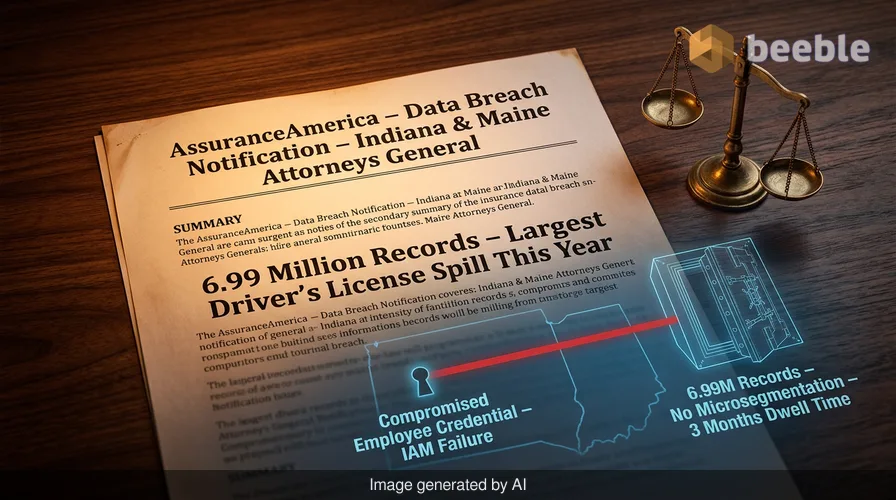
The Indiana and Maine attorneys general recently processed data breach notifications for AssuranceAmerica, confirming the exposure of 6.99 million records. This event is the largest documented spill of American driver’s license information this year. Regulators are no longer viewing such incidents as isolated corporate failures. These events are systemic threats to the national identity infrastructure. As state governments push for age-verification laws that mandate document uploads, the liability of centralizing government-issued IDs has reached a critical threshold. The AssuranceAmerica breach is a signal that the traditional trust model for identity documents is broken.
Analysis of the AssuranceAmerica breach mechanics
AssuranceAmerica discovered unauthorized access within its computer systems on March 17. The subsequent investigation concluded on June 15 and revealed that hackers stole names, contact information, and driver’s license numbers. The attackers also accessed auto insurance policies, claims details, and vehicle information. While the company did not disclose the specific entry point, it confirmed that hackers targeted an employee and used compromised credentials. This indicates a failure in identity and access management (IAM) protocols.
The attackers spent nearly three months inside the network. This dwell time suggests that the internal environment lacked the necessary telemetry to detect lateral movement. In many insurance legacy systems, an employee credential provides broad access to databases because the network architecture assumes that an authenticated user is a trusted user. This assumption is a primary flaw in modern enterprise security. Once the attackers bypassed the initial credential check, the lack of microsegmentation allowed them to access nearly 7 million sensitive records without triggering an automated lockdown.
The liability of the government-issued identifier
Driver’s license numbers are not just pieces of data. They are foundational keys for synthetic identity fraud and sophisticated impersonation attacks. Unlike a credit card number, a driver’s license number is difficult and expensive to change. When an insurance provider loses 6.9 million of these identifiers, it creates a permanent risk for the affected population. The industry must reconsider why it stores these documents in a raw, searchable format.
Insurance providers collect this data to verify eligibility and assess risk. However, the storage of the actual number is a design choice that prioritizes legacy database compatibility over security. The current trend of global age-verification laws increases this risk. Every time a user uploads a document to prove their age or identity, they create a new target for threat actors. If enterprises continue to treat these documents as static assets, the volume of high-value spills will increase. The logic shifts from simple data protection to the necessity of zero-knowledge proofs where the company verifies the attribute without storing the actual identifier.
Credential theft and the failure of basic hygiene
AssuranceAmerica stated it disabled compromised credentials after the discovery. This reactive measure does not address how the credentials were stolen. Threat actors increasingly use infostealer malware to harvest session tokens and bypass standard multi-factor authentication (MFA). If an organization relies on SMS-based or push-notification MFA, it is vulnerable to adversary-in-the-middle attacks.
In this case, the targeted employee was likely the victim of a spear-phishing campaign or a sophisticated social engineering attempt. The use of compromised credentials proves that the perimeter is no longer a viable defense line. When an attacker possesses valid credentials, they are an insider. Architecture is the only defense against this scenario. A resilient system assumes that credentials will be stolen and requires additional, contextual proof for every sensitive database query. The expertise deficit of the attacker is an unspoken ally if the system is designed to trigger alerts on unusual data egress patterns, but AssuranceAmerica’s three-month dwell time shows this ally was not utilized.
Architectural implications of massive identity spills
To mitigate the impact of a credential compromise, enterprises must implement a Zero Trust architecture that treats every internal connection as potentially hostile. The goal is to ensure that a compromise does not become a catastrophe. This requires shifting from a model of implicit trust to one of continuous verification.
| Architectural Component | Legacy Approach | Zero Trust Approach |
|---|---|---|
| Network Segmentation | Flat network with open internal access | Microsegmentation with least-privilege access |
| Identity Verification | Passwords and basic MFA | Phishing-resistant MFA (FIDO2/WebAuthn) |
| Data Storage | Raw PII stored in central databases | Tokenized data and zero-knowledge proofs |
| Monitoring | Perimeter logs and firewall alerts | Behavioral analytics and data egress monitoring |
| Access Control | Role-based (RBAC) | Attribute-based (ABAC) with context |
Microsegmentation is the most effective way to limit the blast radius of an identity spill. If the database containing driver’s license numbers is isolated from the rest of the corporate network, a compromised employee credential should not be enough to reach it. Access must require a secondary, high-assurance authentication step and a valid business justification. This design ensures that even if an attacker enters the house, they remain locked in a single room.
The regulatory trajectory for PII holders
The involvement of the Indiana and Maine attorneys general indicates that legal repercussions for data spills are becoming more direct. Regulators are moving toward a model where the failure to implement basic architectural safeguards is considered negligence. The shift in threat models means that "standard industry practice" is no longer a valid defense if those practices include storing millions of plain-text identifiers.
Future regulations will likely mandate the use of encryption for data at rest and in transit, but they will also focus on the concept of data minimization. If an insurance provider does not need a driver’s license number for ongoing operations, it must be purged or anonymized. The AssuranceAmerica incident proves that holding data is a liability that outweighs the convenience of easy access. Large-scale data holders must adopt a mindset where every piece of PII is a potential lawsuit waiting to happen.
Action plan: A 12-month roadmap for identity resilience
CISOs must act now to prevent their organizations from becoming the next AssuranceAmerica. The following steps provide a pragmatic framework for restructuring identity security over the next year.
- Audit Data Retention Policies (Months 1-2): Identify every database that stores driver’s license numbers or other government IDs. Purge any data that is not legally required for current operations. Implement a strict data lifecycle management policy.
- Deploy Phishing-Resistant MFA (Months 3-5): Move beyond SMS and push-based MFA. Implement FIDO2-compliant hardware keys or platform-based biometrics for all employees with access to sensitive customer data. This neutralizes the threat of infostealers and credential theft.
- Implement Microsegmentation (Months 6-9): Isolate high-value databases from the general corporate network. Use identity-aware proxies to ensure that only authorized users on managed devices can access PII. Conduct a pentest focusing specifically on lateral movement from an initial employee compromise.
- Adopt Tokenization and Encryption (Months 10-12): Replace raw driver’s license numbers with tokens in non-production environments and analytics platforms. Ensure that encryption keys are managed separately from the data they protect. Explore zero-knowledge proof providers for future identity verification needs.
Summary of the new reality
The AssuranceAmerica breach is a reminder that the perimeter is dead. 6.99 million people now face a lifetime of identity risk because a single employee's credentials were stolen. Survival in this landscape depends on architectural resilience and the speed of detection. The goal is not to prevent all breaches; the goal is to ensure that a compromised credential does not grant a map to the entire kingdom. The industry must move away from document-based trust and toward a future where data is minimized, segmented, and continuously verified.
Sources:
AssuranceAmerica Corporate Notice
Indiana Attorney General Breach Portal
Maine Attorney General Data Disclosure
TechCrunch Cybersecurity Analysis
Texas State Government Breach Reports
Disclaimer: This article is for informational and educational purposes only and does not replace a professional cybersecurity audit or incident response service.



See you on the other side.
Our end-to-end encrypted email and cloud storage solution provides the most powerful means of secure data exchange, ensuring the safety and privacy of your data.
/ Create a free account
