


The death of document trust: why centralizing identity verification creates a systemic single point of failure

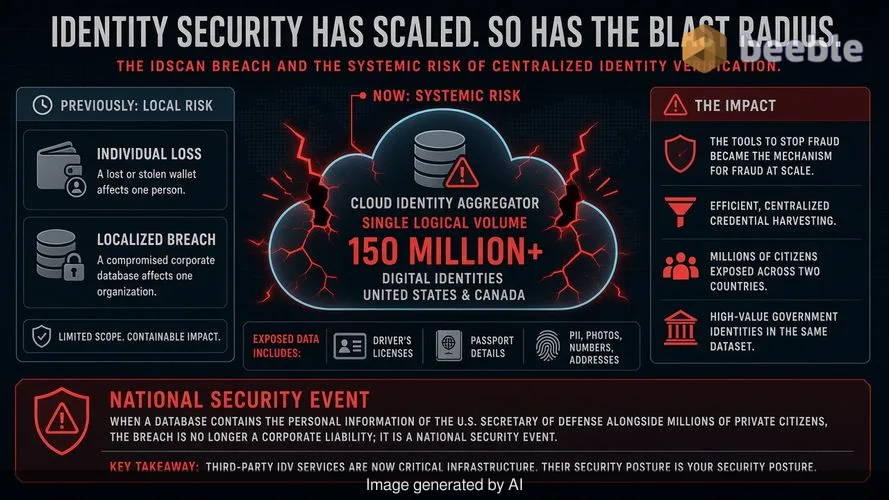
Previously, the primary risk to identity security was the individual loss of a physical wallet or the localized compromise of a corporate database. Now, the risk is the systemic failure of a cloud-based aggregator that holds 150 million digital identities in a single logical volume. The IDScan breach, which exposed the driver’s licenses and passport details of over 150 million residents in the United States and Canada, marks a critical transition in how enterprises must view third-party identity verification (IDV) services. The incident demonstrates that the very tools used to mitigate fraud have become the most efficient mechanisms for large-scale credential harvesting. When a database contains the personal information of the U.S. Secretary of Defense alongside millions of private citizens, the breach is no longer a corporate liability; it is a national security event.
The collapse of the outsourced trust model
Corporate security teams often view IDV providers as a way to offload the regulatory burden of 'Know Your Customer' (KYC) requirements and age verification. The logic shifts to a model where a specialized third party assumes the risk of handling sensitive government-issued documents. This assumption is flawed because it ignores the concentration of risk. IDScan was the gatekeeper for entertainment venues, cannabis dispensaries, and retail corporations, yet the perimeter protecting its cloud assets failed to withstand a year-long intrusion. The expertise deficit is an unspoken ally for threat actors here. Organizations trusted the provider because of its market position, not necessarily because of a verified zero-trust architecture within the provider's cloud environment. The result is a searchable dark web database where authenticity is confirmed by the hackers themselves, rendering the stolen documents 'burned' for any future security purpose.
To gauge the scale, one must look at the accessibility of the stolen data. The dark web portal reported by Brian Krebs allowed users to query specific names and retrieve full license images and photos. This functionality suggests the attackers did not just exfiltrate raw files; they likely gained access to the database schema or the application layer that manages document retrieval. In an enterprise context, this means that every driver's license ever scanned by a client of IDScan is now a liability. The traditional trust in a government-issued ID as a 'root of trust' is dead. If an attacker possesses a high-resolution scan of a legitimate license, they can bypass many automated visual verification systems used by banks and insurance companies. The breach has effectively democratized high-quality identity theft.
The structural vulnerability of centralized identity vaults
Identity verification services are digital ammunition dumps sitting in the middle of a civilian population. They aggregate the most sensitive PII (Personally Identifiable Information) possible, yet they often operate with the same security posture as a standard SaaS (Software as a Service) platform. The IDScan incident highlights a fundamental flaw in centralized IDV: the lack of data minimization. There is rarely a business reason for a verification provider to retain full images of driver’s licenses for years after the initial check. However, many providers keep this data to satisfy vague compliance 'best practices' or to train internal OCR (Optical Character Recognition) models. This retention policy expands the blast radius of a breach from a single day’s transactions to a decade’s worth of customer history.
Architecturally, the failure likely stems from a lack of microsegmentation between the public-facing ingestion API and the long-term storage buckets. If an attacker can dwell in a network for a year, as reports suggest occurred at IDScan, it indicates a complete breakdown of internal monitoring and lateral movement detection. A resilient architecture treats each document as a temporary guest in a solitary cell. Once the verification is complete, the provider should issue a signed token to the client and delete the raw image, or at least encrypt it with a key that is not accessible to the application layer. IDScan’s situation suggests that the data was either unencrypted at rest or that the attackers acquired the keys necessary to provide a searchable interface for the stolen records.
Identity as a burned asset in the post-IDScan era
What this means in practice is that the driver’s license number has lost its utility as a primary identifier. When 150 million records are available for a fee on the dark web, any system that relies on a license number or a photo of a license for 'knowledge-based authentication' is compromised. This forces a paradigm shift in enterprise security. Organizations must assume that every customer’s static PII is already in the hands of malicious actors. The focus moves from what a user has (a license) to how a user behaves or what biometric signals they provide in real-time. For clarity, a static scan of a document is now zero-value evidence of identity.
For the global context, this breach will likely accelerate the adoption of decentralized identity and mDL (mobile Driver's License) standards like ISO 18013-5. In these models, the user holds their own data, and the 'verifier' only receives a cryptographically signed confirmation that the user is over 21 or holds a valid license. No raw data is transferred, and no central vault is created. The IDScan breach is the strongest argument yet for the immediate abandonment of centralized document scanning services in favor of zero-knowledge proofs. Until that transition occurs, every company using an IDV service is participating in a high-stakes gamble with their customers' most sensitive data.
Architectural strategies for identity resilience
CISOs must reconsider their reliance on third-party IDV providers immediately. The goal is not to prevent all breaches but to ensure that a compromise at a vendor does not lead to a catastrophe for your customers. This requires an architectural shift toward data avoidance. If you do not need to see the license image, do not ask the vendor to provide it. If you do not need to store the record, ensure your contract mandates immediate deletion upon verification. The current state of the industry, where companies 'collect everything just in case,' is a direct path to regulatory fines and reputational ruin.
Microsegmentation is not a common area; it is an individual solitary cell for every data flow. When integrating with an IDV provider, the connection should be sandboxed. The data returned by the vendor should be treated as untrusted and potentially malicious. Furthermore, enterprises should implement 'step-up' authentication for any high-value transaction, even if a user has 'verified' their identity through a third-party service. Use behavioral biometrics, device fingerprinting, and out-of-band verification to supplement the now-unreliable document check. The breach at IDScan proves that the third-party risk management (TPRM) questionnaires currently in use are insufficient. You cannot audit a vendor into being secure; you must architect your systems to survive their inevitable failure.
Action plan: mitigating the third-party identity vacuum
The following steps constitute a 6-12 month horizon for stabilizing identity infrastructure in the wake of the IDScan event:
- Audit all third-party IDV integrations to identify which vendors retain PII and images beyond the point of verification.
- Mandate a transition to API-based verification that returns only a 'Yes/No' boolean or a unique token, rather than full document scans.
- Update incident response playbooks to include scenarios where a primary IDV provider is the source of a systemic leak, including pre-drafted customer notifications.
- Implement a 'Bring Your Own Identity' (BYOI) strategy that supports cryptographically verified digital wallets, reducing the need for document scanning.
- Conduct a red-team exercise focusing on how an attacker with stolen IDScan data could impersonate employees or high-value customers within your existing support and authentication workflows.
- Evaluate insurance policies to ensure coverage for third-party data breaches, specifically focusing on the costs of identity monitoring for millions of affected individuals.
Sources
- Krebs on Security: Report on IDScan Dark Web Database
- TechCrunch: IDScan Data Breach Confirmation and Pentagon Response
- CISA: Guidance on Third-Party Risk Management and PII Protection
- FBI: Investigation into Identity Verification Service Compromises
Disclaimer: This article is for informational and educational purposes only. It does not replace a professional cybersecurity audit, legal advice, or incident response service. Every organization's architecture is unique and requires a dedicated security assessment.



See you on the other side.
Our end-to-end encrypted email and cloud storage solution provides the most powerful means of secure data exchange, ensuring the safety and privacy of your data.
/ Create a free account
