


The Digital Wild West: Why America’s Privacy Vacuum is a Toxic Asset

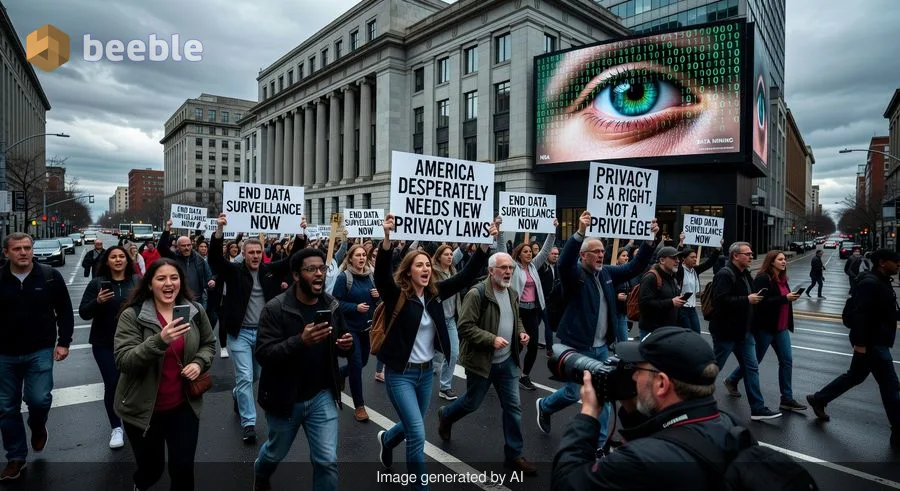
The 1973 Prophecy
Have you ever wondered how a document written before the invention of the World Wide Web could perfectly predict our modern digital malaise? In 1973, the US Department of Health, Education, and Welfare (HEW) released a report titled “Records, Computers, and the Rights of Citizens.” Its authors saw the writing on the wall, warning that networked computers were destined to become the primary medium for storing personal records. They recognized that while these systems were powerful management tools, they posed a systemic threat to the fundamental human right to privacy—specifically, an individual’s ability to control how their own information is used.
In response, Congress passed the Privacy Act of 1974. It was a bold, foundational step that set rules for how federal agencies handled data. But then, curiously, the momentum stalled. While the rest of the world moved toward comprehensive frameworks, the United States settled into a sectoral approach, passing niche laws for video rentals, children’s websites, and healthcare records. Today, in March 2026, we are living in the fallout of that hesitation. Our personal data has become a toxic asset—valuable to brokers but dangerous to the citizens it describes.
The Patchwork Quilt of State Laws
In a regulatory context, the United States currently resembles a patchwork quilt rather than a unified front. Without an overarching federal statute, states have stepped into the vacuum. We’ve seen the California Privacy Rights Act (CPRA) set a high bar, followed by a flurry of legislation from Virginia, Colorado, Utah, and Texas. From a compliance standpoint, this is a nightmare for any organization operating across state lines.
I recently spoke with a Data Protection Officer (DPO) who described their job as “compliance archaeology.” They had inherited a legacy database from a startup that had a “collect everything just in case” mentality. The database was a hoard of unmapped, non-compliant data points that triggered different legal obligations depending on whether the user lived in Austin or Albany. Ultimately, this fragmented landscape creates a precarious environment where rights are determined by zip code rather than a fundamental national standard.
Data as Uranium: The Cost of Over-Collection
To put it another way, we need to stop viewing data as “the new oil” and start viewing it as uranium. When handled with granular consent and stored in a robust, privacy-preserving manner, it can power incredible innovation. However, when it is hoarded without a clear purpose, it becomes a liability. A data breach is not just a technical glitch; it is an oil spill that causes long-term environmental and reputational disaster.
I remember a Friday afternoon data breach notification at a former firm. We were racing against the 72-hour notification deadline—a standard set by the GDPR that has become a de facto global benchmark. The legal vs. engineering tug-of-war was palpable. The lawyers wanted to know exactly what was leaked to satisfy statutory requirements, while the engineers were still trying to figure out how the attacker bypassed the firewall. If we had a comprehensive federal law that mandated Privacy by Design as the foundation of our systems, that “Friday afternoon from hell” might have been a non-event.
The Labyrinth of Terms of Service
Under this framework of neglect, the burden of privacy has shifted entirely to the consumer. We are forced to navigate a labyrinth of Terms of Service and cookie banners that are designed to be clicked through, not understood. This is non-compliant with the spirit of true transparency. When consent is not granular, it isn’t really consent—it’s a hostage situation.
In practice, many companies use these opaque agreements to shield intrusive surveillance practices. Whether it is location tracking or the sale of pseudonymous browsing habits to third-party brokers, the lack of a binding federal law means there are few consequences for those who treat privacy as an afterthought. We need a law that treats the DPO as a translator between legal and engineering, ensuring that privacy is baked into the product roadmap from day one.
AI and the Need for Stringent Oversight
As we move deeper into 2026, the rise of generative AI has made the need for new laws even more urgent. Conducting a Data Protection Impact Assessment (DPIA) on a black-box AI is a sophisticated challenge that most current US laws are ill-equipped to handle. How do we ensure that an algorithm isn't processing sensitive data in a discriminatory way if we don't have a statutory right to explanation?
Consequently, the lack of extraterritorial reach in our current laws means that American companies are often at a disadvantage when competing globally. Explaining the lack of a US federal privacy law to a foreign CEO is an exercise in embarrassment. They see our regulatory landscape as a liability, not an asset. A multifaceted federal law would not only protect citizens but also provide the legal certainty that businesses crave to innovate safely.
The Path Forward: A Call to Action
Notwithstanding the political gridlock in Washington, the momentum for a comprehensive federal privacy law has never been higher. We need a framework that moves beyond the “notice and consent” model and toward a model of data minimization and corporate accountability. Privacy should not be a compliance checkbox; it is a fundamental human right that requires a robust, systemic defense.
What can you do next?
- Audit your data: If you are a business owner, treat your data like uranium. If you don’t need it, get rid of it.
- Support federal standards: Advocate for legislation that mirrors the protections found in the American Privacy Rights Act (APRA) or similar comprehensive proposals.
- Demand transparency: Use your rights under existing state laws (like CCPA) to send Subject Access Requests (DSARs) and see what companies know about you.
Congress must act to turn the patchwork quilt into a shield. It is time to fulfill the promise made in 1973 and give Americans back control over their digital lives.
Sources
- US Department of Health, Education, and Welfare: Records, Computers, and the Rights of Citizens (1973).
- The Privacy Act of 1974, 5 U.S.C. § 552a.
- International Association of Privacy Professionals (IAPP) State Privacy Law Tracker.
- Federal Trade Commission (FTC) reports on Data Brokers and Consumer Privacy.
- Congressional Research Service (CRS) overviews of the American Privacy Rights Act (APRA).



See you on the other side.
Our end-to-end encrypted email and cloud storage solution provides the most powerful means of secure data exchange, ensuring the safety and privacy of your data.
/ Create a free account
