


The Dual-AI Architecture: Why General Models are Tools but SOC Autonomy is Infrastructure

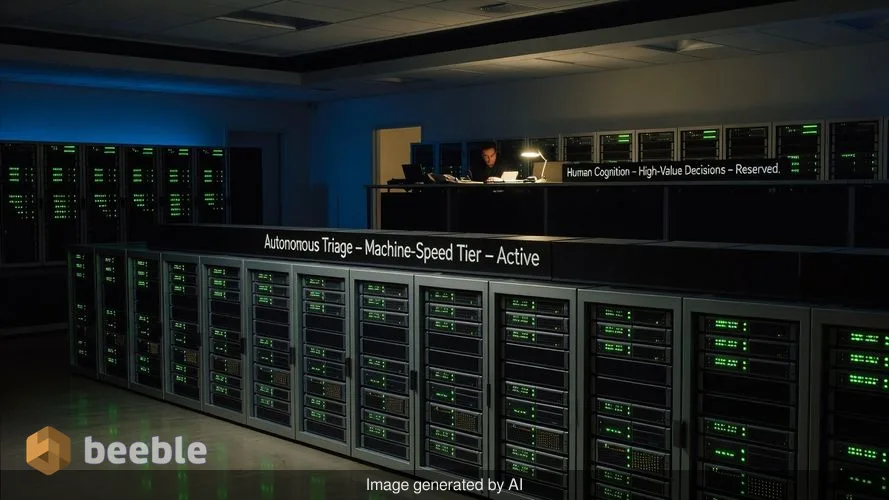
The speed of AI adoption in cybersecurity has created a significant strategic gap between those who view AI as a chatbot and those who view it as architecture. Previously, security leaders evaluated Large Language Models (LLMs) based on their ability to answer questions or write scripts. Now, the operational reality is that general-purpose AI platforms like Claude and Cursor are distinct from the specialized infrastructure required to run a high-volume Security Operations Center (SOC).
Security teams face a threat environment where attackers utilize AI to automate the reconnaissance and exploit phases of the kill chain. The traditional threat model, which relies on human speed to intercept machine-speed attacks, is fundamentally broken. To address this, organizations must move beyond the basic integration of AI assistants and establish a tiered intelligence architecture that separates high-volume autonomous triage from high-value human cognition.
The separation of cognition and volume
Modern security operations function across three distinct layers. At the base layer, existing security tools like EDR, SIEM, and cloud identity platforms generate raw telemetry and alerts. This layer is the primary source of data but lacks the reasoning capability to distinguish between a complex attack and a misconfigured administrative script.
In the middle sits the autonomous AI SOC layer. This is not a chatbot interface. It is a system of agents that continuously investigates every alert, correlates evidence across disjointed tools, and applies organizational context to determine risk. This layer reduces the noise by resolving benign alerts without human intervention.
At the top is the cognitive layer, where platforms like Claude, Codex, and Cursor operate. This is the interactive space where senior analysts and incident responders collaborate with frontier models to solve specialized problems. Using these models at the top layer is effective because they are designed for reasoning, not for the repetitive ingestion of thousands of telemetry streams. Each layer has a specific job, and confusing the cognitive layer with the autonomous layer leads to operational inefficiency.
The tokenomics of security reasoning
Architecture is often a byproduct of economics. Every interaction with a large language model incurs a cost, typically measured in tokens. A single security investigation is not a simple text prompt. It requires the ingestion of endpoint telemetry, process trees, authentication logs, and threat intelligence feeds. This context can quickly consume thousands of tokens per incident.
Previously, organizations assumed that a single AI license could solve every investigative need. Now, the math reveals that using a general-purpose LLM to investigate every informational alert is a financial impossibility. If a SOC receives 5,000 alerts per day and sends every one to a frontier model for a full forensic analysis, the annual API costs will exceed the budget of the entire security department.
Autonomous AI SOC platforms solve this by using cached context and selective reasoning. They do not treat every alert as a fresh conversation with an expensive model. Instead, they use deterministic workflows for routine data gathering and engage LLMs only when a specific reasoning task is required. This architectural approach makes it possible to investigate 100% of alerts while keeping costs predictable. Using Claude to investigate every benign log is like using a surgical laser to clear a forest; the tool is precise, but the application is an architectural mismatch.
Data gravity and the MDR friction point
Many enterprises rely on Managed Detection and Response (MDR) providers to manage their security monitoring. This creates a data access asymmetry. The MDR provider typically owns the investigation workflow and the enriched telemetry. The customer only sees the final escalated incident, which limits the effectiveness of internal AI platforms.
If an analyst tries to use Claude to investigate an alert, they often lack the raw data needed to provide the model with sufficient context. The LLM cannot reason over data it cannot see. This is why a local autonomous AI SOC layer is becoming a critical component of the enterprise stack. It sits alongside the security tools, captures the investigation history, and builds a local knowledge base.
This architecture allows the organization to retain institutional knowledge rather than leaving it inside a third-party MDR portal. It ensures that when a senior analyst does engage a tool like Claude, the necessary evidence is already structured and ready for analysis. The autonomous layer acts as the bridge between raw, scattered logs and high-level cognitive work.
The hidden risk of informational alerts
Most SOCs ignore low-severity alerts because they lack the human capacity to review them. This prioritization is a necessity in a human-centric model, but it is also a systemic vulnerability. Analysis of 25 million alerts in 2025 indicated that roughly 1% of confirmed security incidents began as low-severity or informational logs.
Attackers often use stealthy lateral movement techniques that do not trigger high-severity alarms. A single failed login or a suspicious but non-malicious PowerShell command is easy to overlook. An autonomous AI SOC changes the math by providing the capacity to investigate everything. Because the machine does not tire and the cost per investigation is minimized through specialized architecture, the 'severity' of an alert no longer dictates whether it receives attention. Every alert is investigated, and only the genuine threats reach the human cognitive layer.
Where frontier models deliver the highest ROI
When the autonomous layer handles the repetitive triage, AI platforms like Claude become significantly more powerful. Analysts no longer use them for basic data gathering. Instead, they focus on high-impact strategic work.
For clarity, the cognitive layer is best used for:
- Developing and testing new detection logic based on emerging threat intelligence.
- Conducting deep-dive forensic analysis on complex, multi-stage incidents.
- Summarizing technical investigations for executive leadership and regulatory bodies.
- Hunting for threats by generating complex queries across multiple data lakes.
- Translating legacy detection rules into modern query languages like Sigma or KQL.
In this model, the human and the LLM work together on the problems that require nuance and judgment. The autonomous system ensures that their time is never wasted on the 99% of alerts that are benign.
Action Plan: Building a tiered AI architecture
To move from AI FOMO to a resilient defense, CISOs should follow this 6-12 month roadmap to restructure their security operations.
- Audit the telemetry pipeline (Month 1-2): Map all data sources and identify where telemetry is stored. Determine if your MDR provider allows real-time API access to raw logs and investigation artifacts.
- Tier the AI spend (Month 3-4): Separate the budget for cognitive tools (Claude, Cursor) from the budget for autonomous infrastructure. Do not try to force one tool to do both jobs.
- Implement an autonomous triage layer (Month 5-8): Deploy a system that can automate the forensic gathering process. Focus on reducing the time-to-triage for low-severity alerts first to prove the concept.
- Codify organizational context (Month 9-10): Build a repository of internal documentation, network maps, and policy files that the autonomous system can use to distinguish between authorized admin activity and attacker behavior.
- Refine the analyst workflow (Month 11-12): Shift Tier 1 and Tier 2 analysts toward detection engineering and threat hunting. Use cognitive AI platforms to support this transition by automating the writing of new rules and reports.
The goal of this architecture is not to eliminate humans from the SOC. It is to ensure that a compromise does not become a catastrophe because a human was too busy triaging noise to see the signal. Survival in the current threat environment depends on architecture and speed, not just better tools.
Sources:
- CISA (Cybersecurity and Infrastructure Security Agency) - Guidelines on AI Security and Triage.
- NIST (National Institute of Standards and Technology) - AI Risk Management Framework 1.0.
- Anthropic - Claude Enterprise and API Documentation.
- Internal analysis of telemetry trends and tokenomics in enterprise security operations (2025-2026).
Disclaimer: This article is for informational and educational purposes only and does not replace a professional cybersecurity audit or incident response service.



See you on the other side.
Our end-to-end encrypted email and cloud storage solution provides the most powerful means of secure data exchange, ensuring the safety and privacy of your data.
/ Create a free account
