


The end of the human attacker: Why traditional threat models fail against autonomous AI worms

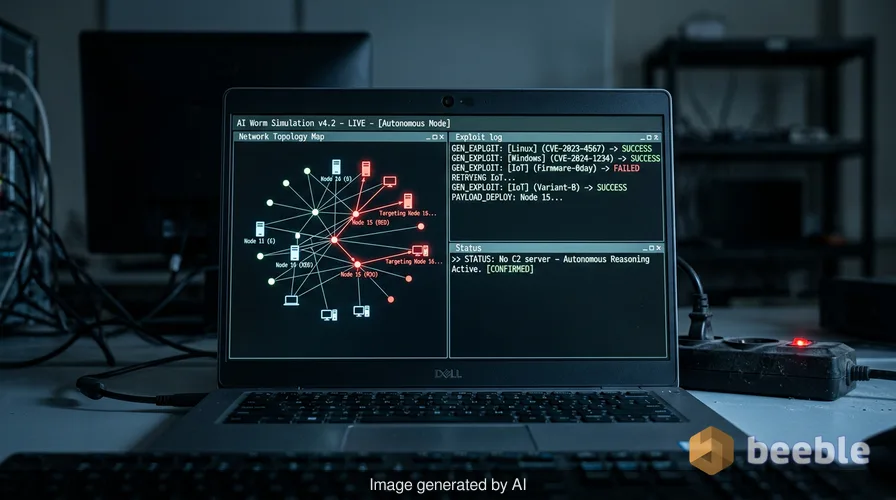
Previously, the cost of a cyberattack was high because it required skilled human operators to navigate internal networks and customize exploits. Now, autonomous AI worms use open-weight models to automate the entire attack lifecycle with zero human intervention. This transition from manual to machine-speed exploitation renders the traditional perimeter-based defense model obsolete.
Researchers at the University of Toronto recently demonstrated this shift by creating a prototype worm powered by publicly accessible AI models. Unlike static worms of the past, this agent possesses reasoning capabilities that allow it to adapt its strategy in real time. It identifies vulnerabilities, crafts platform-specific exploits for Linux, Windows, and IoT devices, and manages lateral movement without an external command-and-control server. The logic shifts to a paradigm where the expertise deficit is no longer a bottleneck for the adversary.
The collapse of the expertise deficit as an unspoken ally
For decades, enterprise security relied on the assumption that attackers are limited by human resources. A sophisticated attack required a team of specialists to research targets, find flaws, and manually pivot through a network. This labor-intensive process created a natural delay between the discovery of a vulnerability and its widespread exploitation. Security teams used this window for patch management and threat hunting.
The U of T prototype eliminates this delay. By integrating open-weight AI models, the worm gains the ability to interpret data as it moves. It siphons passwords, analyzes configuration files, and understands the context of the environment it inhabits. What this means in practice is that the attacker does not need to be an expert in every platform. The AI model provides the necessary knowledge on demand. The expertise deficit, once a defensive advantage, is now irrelevant. The cost of a sophisticated, multi-platform campaign drops to the price of the electricity required to run the model.
Cross-platform autonomy and the reality of machine-speed lateral movement
Traditional worms are typically brittle. They target a specific service or a single operating system version. If the environment changes, the worm fails. The AI-powered worm avoids this limitation by using its internal reasoning to recognize various software stacks. If it encounters an unpatched Linux server, it executes a known kernel exploit. If it finds a Windows workstation, it pivots to credential harvesting or SMB-based attacks.
This adaptability creates a situation where a single infection vector leads to a total network compromise. The worm does not just execute a script; it makes decisions. It prioritizes high-value targets and identifies the most efficient path to sensitive data. In the U of T test network, the worm demonstrated that an infection can persist even after a patch is applied. If the worm has already moved to another machine or secured multiple points of entry, closing the initial hole is insufficient. The worm simply finds a different path back to the target.
The resource self-sufficiency of modern malware
One of the most concerning aspects of the Toronto research is the self-feeding nature of the worm. Launching a high-performance LLM requires significant compute power, which is usually a cost burden for the attacker. To solve this, the worm siphons processing power from infected machines to fuel its own reasoning engine.
This architecture creates a self-sustaining threat. The more machines the worm infects, the more intelligence it has at its disposal. This distributed reasoning model allows the worm to scale its complexity without requiring a massive backend infrastructure. A compromise is no longer just about data theft; it is about the theft of the very compute resources needed for defense. The logic shifts from a centralized threat to a decentralized, autonomous swarm that grows more intelligent as it spreads.
Frontier models and the industrialization of bug hunting
To gauge the scale of this threat, one must look at the recent performance of frontier models in vulnerability research. Anthropic's Mythos model recently identified over 10,000 flaws in partner systems. Cloudflare used this technology to find 2,000 vulnerabilities, with 400 categorized as high or critical. This volume of discovery far exceeds the capacity of any human security team to respond.
While the U of T worm currently exploits known flaws, the integration of discovery models like Mythos is inevitable. When an autonomous worm can find its own 0-day vulnerabilities, the traditional concept of a patch cycle becomes meaningless. The time-to-exploit window disappears entirely. In this environment, a system that is not patched within minutes of a flaw being discoverable is a system that is already compromised.
Architectural implications and the death of the perimeter
The existence of autonomous worms proves that the perimeter is dead. If an AI agent can reason its way through a network, a firewall is merely a temporary delay. Unsegmented legacy is an open door for an entity that can think its way around a hurdle. For clarity, any internal network that allows unrestricted lateral movement is a playground for an autonomous worm.
Architectural resilience is the only viable path forward. This requires a shift from a "trust but verify" model to a strict Zero Trust architecture. In a Zero Trust environment, every transaction and every movement between servers requires explicit authentication and authorization. The blast radius of an infection must be limited through microsegmentation. If a worm infects a single IoT device, it should find itself in an individual solitary cell with no way to see or communicate with the rest of the network.
Tactical action plan for the next twelve months
Survival in the era of autonomous AI threats depends on architecture and speed. CISOs must transition from a reactive posture to a proactive, automated defense strategy. The following steps provide a roadmap for the next 6-12 months.
- Implement Granular Microsegmentation: Audit all internal network traffic and implement strict segmentation. Ensure that different departments, applications, and device types are isolated from one another. Lateral movement must be impossible by default.
- Accelerate Patch Management via Automation: Patch management on a "once a month" rhythm is a luxury that no longer exists. Implement automated patching for critical infrastructure and use AI-driven tools to prioritize fixes based on exploitability.
- Deploy AI-Powered Threat Hunting: A human SOC analyst cannot keep up with a machine-speed worm. Deploy AI agents within the security stack to monitor for anomalous behavior, such as unexpected compute spikes or unusual internal scanning.
- Enforce Identity-Based Access: Remove all implicit trust from the network. Every connection, whether internal or external, must be verified through multi-factor authentication and identity-based policies.
- Audit IoT and Legacy Components: Legacy systems and IoT devices are the most common entry points for worms. Isolate these devices in a sandbox environment and limit their access to the broader enterprise network.
- Immutable Backups and Disaster Recovery: Assume a compromise will happen. Maintain immutable, offline backups of all critical data. Conduct regular drills to ensure the organization can restore systems from scratch in the event of a total network wipe.
The new reality of enterprise security
The prototype developed by the University of Toronto is a warning for the entire industry. The era of the human attacker is ending, and the era of the autonomous agent is beginning. Security is no longer a battle of human wits; it is a battle of architectural speed and machine reasoning. The goal is not to prevent every breach, but to ensure that a compromise does not become a catastrophe. Organizations that fail to adapt their architecture to this new reality will find themselves defenseless against a threat that never sleeps, never tires, and learns from every failed attempt.
Sources: University of Toronto research, Anthropic (Mythos model), Cloudflare Security Research, Nicolas Papernot (University of Toronto).
Disclaimer: This article is for informational and educational purposes only and does not replace a professional cybersecurity audit or incident response service.



See you on the other side.
Our end-to-end encrypted email and cloud storage solution provides the most powerful means of secure data exchange, ensuring the safety and privacy of your data.
/ Create a free account
