


The end of the perimeter: Why the traditional threat model no longer works

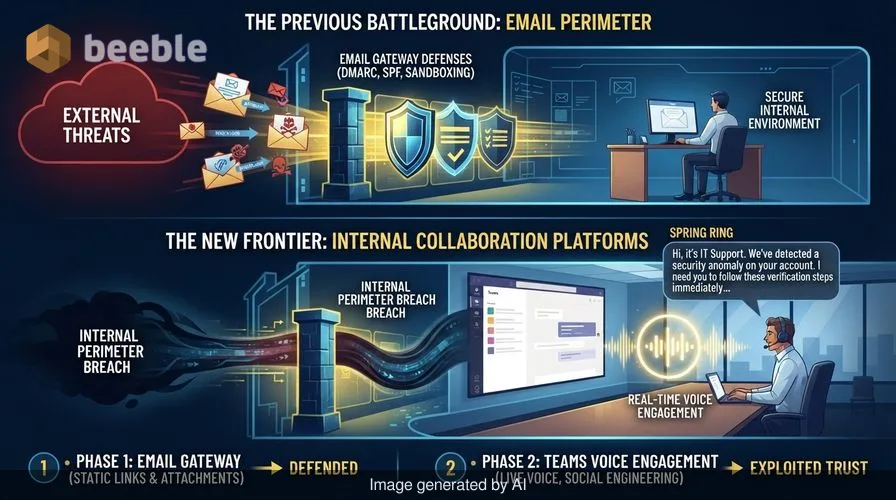
Previously, the corporate email gateway was the primary theater for identity theft and malware delivery. Security teams invested millions in DMARC, SPF, and attachment sandboxing to filter external noise before it reached the user. Now, the battle has moved inside the perimeter to collaboration platforms like Microsoft Teams. The Spring Ring operation demonstrates that the perceived safety of internal communication tools is a structural liability. By shifting from email to real-time voice engagement within Teams, attackers bypass traditional filters and exploit the inherent trust users place in their workplace productivity suite. The threat is no longer a static link in a suspicious email. The threat is a live voice on a trusted channel.
The mechanics of the Spring Ring operation
Between January and April 2026, researchers at Palo Alto Networks tracked a sophisticated campaign targeting at least 150 Microsoft Teams users across 10 distinct organizations. This operation, dubbed Spring Ring, utilizes voice phishing or vishing as its primary entry vector. The process begins when an attacker, often using a compromised external Teams account or a convincingly spoofed guest profile, initiates a chat with an employee. This initial contact bypasses most legacy email security stacks because the traffic originates from within the Microsoft 365 ecosystem. The attacker then transitions the chat to a voice call, assuming the persona of an IT support desk agent or a security technician.
During these calls, the attacker guides the victim through the installation of remote monitoring and management (RMM) tools. Common utilities like AnyDesk, ScreenConnect, or NetSupport Manager are the tools of choice. Because these are legitimate software packages used by actual IT departments, they often evade signature-based detection by antivirus programs. Once the victim installs the RMM agent, the attacker gains full interactive control over the workstation. This method allows the threat actor to bypass automated security controls by performing actions that appear to be local user activity. The vishing component adds a layer of social pressure that traditional phishing lacks. A live voice demands immediate action, which reduces the time a user has to evaluate the legitimacy of the request.
Access asymmetry and the expertise deficit
The Spring Ring campaign highlights a critical flaw in modern enterprise architecture known as access asymmetry. Organizations frequently configure Teams to allow external communication by default to facilitate business-to-business collaboration. This configuration grants an outsider the same digital presence as a trusted colleague. The expertise deficit of the general workforce is an unspoken ally for these attackers. Most employees cannot distinguish between a legitimate IT support request and a social engineering attempt when the interaction occurs on a platform they consider a safe zone.
Traditional defense-in-depth strategies focused on the network edge are ineffective here. The attacker does not need to break into the network through a firewall. They are invited in through a legitimate business application. This shift represents a move from a passive click-and-harvest model to a real-time engagement strategy. The attacker adapts their script based on the victim's responses, making the attack far more resilient to user awareness training than standard phishing templates. Once the RMM tool is active, the workstation becomes a beachhead for the next phase of the operation. The goal is rarely the data on a single laptop. The goal is the entire infrastructure.
Lateral movement and the hunt for domain controllers
After establishing a foothold on a user workstation, the Spring Ring actors focus on lateral movement. They utilize the installed RMM tools to execute scripts, harvest credentials, and scan the internal network for high-value targets. The ultimate objective in several observed cases was the compromise of the organization's domain controllers. An unsegmented legacy network is an open door for an attacker with local administrative rights on a single machine.
The attackers search for cached credentials in memory or misconfigured service accounts with excessive permissions. If the organization lacks internal segmentation, the attacker can move from the marketing department to the server room with minimal resistance. This lateral progression is often silent. Because the RMM tool provides a persistent encrypted tunnel, the attacker's traffic blends with normal administrative activity. The breach is not a sudden explosion but a slow and deliberate infiltration of the core identity systems. When an attacker compromises a domain controller, they gain the ability to create new accounts, modify existing permissions, and deploy ransomware across the entire fleet. The blast radius of a single successful vishing call can encompass the entire enterprise.
Architectural implications of collaboration suite abuse
The Spring Ring operation necessitates a fundamental rethink of how collaboration tools sit within the security stack. Treating Teams or Slack as an extension of the internal local area network is a mistake. These platforms are better understood as public-facing gateways that require the same level of scrutiny as a DMZ. A DMZ is not a common area, but an individual solitary cell. Every interaction originating from outside the immediate organization must be treated as untrusted, regardless of the platform used for delivery.
Zero Trust architecture provides the only viable defense against this evolution. The core of the shift lies in moving away from implicit trust based on location or application. If an employee receives a call on Teams, the system should not assume the caller is who they claim to be. Security teams must implement granular controls that restrict the ability of standard users to install RMM software or execute unauthorized scripts. The reliance on user judgment is a failing strategy. The architecture must enforce the security policy regardless of the user's choices.
The RMM tool as a double-edged sword
The use of RMM tools by threat actors creates a unique challenge for security operations centers. These tools are ubiquitous in corporate environments, making them a de facto cloaking device for malicious activity. When a SOC analyst sees an AnyDesk connection, their first instinct is often to assume a legitimate support session is in progress. The logic shifts to a need for behavioral analytics rather than simple file scanning.
Organizations must establish a baseline for authorized RMM usage. This involves strictly defining which tools are permitted and which accounts are authorized to deploy them. Any deviation from this baseline must trigger an immediate high-priority alert. Patch management on a once-a-month rhythm is a luxury that no longer exists when attackers can gain full remote control in minutes. Detection must be near real-time to intercept the attacker before they can pivot from the workstation to the domain controller. The speed of the attack must be met with the speed of an automated response.
Action plan for enterprise defense
To mitigate the risk of Spring Ring and similar vishing-based campaigns, CISOs must execute a structured defense plan over the next 6 to 12 months. The focus must be on technical controls that remove the burden of detection from the end user.
- Audit external collaboration settings: Review Microsoft Teams and Slack configurations to restrict external communication. Implement a whitelist for approved external domains and disable guest access for users who do not require it for their specific job functions.
- Implement application control: Use AppLocker or a similar solution to prevent the execution of unauthorized RMM tools. Create a strict allow-list that only permits the organization's official remote support software to run on corporate endpoints.
- Enforce FIDO2-based MFA: Move away from SMS or push-based multi-factor authentication. Use hardware security keys or platform-based biometrics to prevent session hijacking and credential harvesting. This ensures that even if a user is tricked, the attacker cannot easily reuse their credentials.
- Implement microsegmentation: Isolate user workstations from critical infrastructure like domain controllers and database servers. Use host-based firewalls and software-defined networking to ensure that lateral movement requires more than just local admin rights.
- Deploy EDR with behavioral monitoring: Ensure Endpoint Detection and Response tools are configured to flag the use of RMM tools by non-IT accounts. Look for unusual parent-child process relationships, such as a browser or Teams initiating a software installation.
- Conduct targeted vishing simulations: Move beyond standard phishing tests. Conduct controlled vishing exercises through collaboration platforms to identify which departments are most susceptible to social engineering and provide them with specific, role-based training.
The new reality of enterprise security
The Spring Ring operation is not an isolated incident. It is the beginning of a trend where attackers exploit the human element by abusing the very tools designed for cooperation. The goal is not to prevent every vishing attempt, but to ensure that a single compromised workstation does not lead to a catastrophic loss of the domain. Survival depends on architecture and speed. When the perimeter is no longer a physical or logical boundary, security must reside within the identity and the endpoint itself. Organizations that continue to rely on the perceived safety of their internal suites will remain the primary targets for these high-engagement attacks. The cold reality is that trust is a vulnerability that attackers are now systematically exploiting.
Sources:
- Palo Alto Networks Unit 42: Spring Ring Research Report
- Microsoft Security Response Center: Guidance on Collaboration Platform Abuse
- CISA: Technical Guidance on Remote Monitoring and Management Tool Risks
Disclaimer: This article is for informational and educational purposes only and does not replace a professional cybersecurity audit or incident response service.



See you on the other side.
Our end-to-end encrypted email and cloud storage solution provides the most powerful means of secure data exchange, ensuring the safety and privacy of your data.
/ Create a free account
