


The fall of the prestige theater and the rise of the vertical movie star

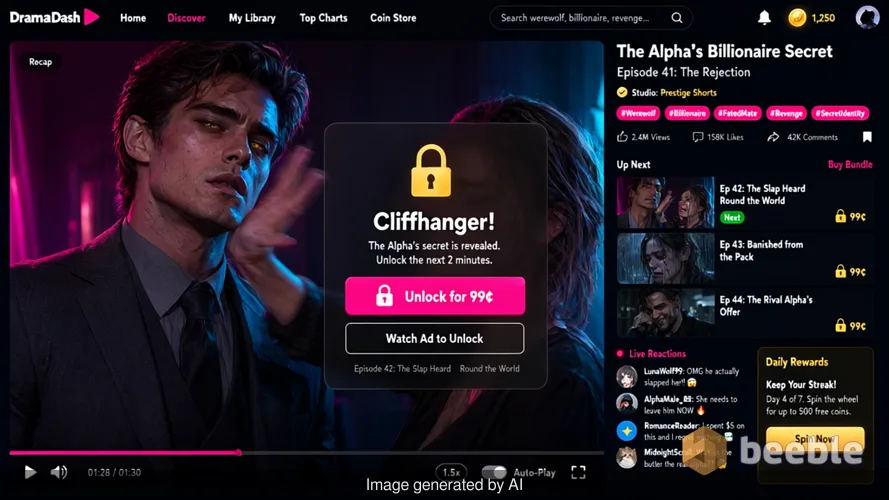
You are lying in bed, thumb hovering over the screen, watching a billionaire werewolf reject his fated mate in a ninety-second burst of high-contrast lighting and breathless dialogue. The episode ends on a literal slap. A prompt appears, asking for ninety-nine cents to see the next two minutes. You feel a faint, hollow pulse of dopamine mixed with the specific irritation of a cliffhanger. This is the microdrama experience. It is a fragmented, erratic form of storytelling that feels less like cinema and more like a slot machine designed by a soap opera writer.
Behind this immediate, subjective frustration lies a clinical reality of the modern attention economy. Traditional studios are struggling to capture the shrinking windows of free time in a typical consumer day. Most people no longer sit down for a two-hour film on a Tuesday night. They fill the gaps between chores, commutes, and restless sleep with the vertical scroll. This behavior is no longer just a niche habit for bored teenagers. It is a billion-dollar industry that is currently attracting the same Hollywood elite who once defined the prestige era of television.
The industrialization of the digital snack
Microdramas originated in China before migrating to the West through apps like ReelShort and DramaBox. The business model is simple. Production companies film dozens of episodes at once, often on shoestring budgets, with each segment lasting between sixty and one hundred twenty seconds. These apps do not rely on monthly subscriptions like Netflix or Max. Instead, they use a microtransaction model where users pay per episode or watch advertisements to unlock the next piece of the story.
Omdia reports that the United States revenue for microdramas is on track to reach $1.5 billion this year. This is not a speculative bubble. It is a response to the way platforms like TikTok and Instagram Reels have rewired the human brain to expect a narrative payoff every minute. The industry refers to this as snackable content, but the metaphor is incomplete. A snack implies a temporary bridge between meals. For many viewers, these vertical dramas are becoming the main course.
Hollywood is taking notice because the traditional movie business is increasingly precarious. Mid-budget movies have vanished from theaters. Streaming services are cutting costs and canceling shows after one season. In this climate, the microdrama offers a low-risk, high-reward alternative for talent and crew who find themselves squeezed out of the old system. The infrastructure is already changing to accommodate this shift. SAG-AFTRA recently introduced a new verticals agreement. This union contract specifically covers low-budget microdramas, providing a formal framework for actors to participate in these mobile-first projects without losing their labor protections.
James Franco and the vertical comeback
James Franco is perhaps the most visible example of a major actor moving into this space. He stars in Love, Lies & Frank, a series available on the Shortical app. The premise is a chaotic blend of corporate intrigue and supernatural tropes. Franco plays an advertising CEO caught in a web of crime and werewolves. The production values are noticeably lower than a standard television series, and the narrative moves at a breakneck speed that ignores traditional pacing.
Franco’s presence in a microdrama is a sign of the times. He was once a bankable movie star and an Oscar nominee. Now, he is the face of a platform that lives entirely on a smartphone. His involvement serves two purposes. First, it provides Shortical with the kind of legitimacy that attracts new investors. Second, it offers Franco a way back into the industry following years of legal settlements and sexual misconduct allegations. In the world of microdramas, the barrier to entry is low, and the need for recognizable faces is high. The quality of the performance is secondary to the clickable nature of the star. Variety described his performance as sleepwalking, but for the app, the quality of the acting matters less than the metadata associated with his name.
Issa Rae and the strategic pivot
While some actors use microdramas as a last resort, others see them as a logical evolution of their digital roots. Issa Rae built her early career on YouTube with The Misadventures of Awkward Black Girl. She understands how to tell stories in non-traditional formats. Her company, Hoorae Media, recently partnered with PineDrama, a vertical video app launched by TikTok. Their thriller series, Screen Time, became a massive success, reaching over 150 million views.
Rae is not just an actor in this space. She is a producer who recognizes that the audience is already on their phones. Screen Time uses the vertical format to create a sense of claustrophobia that suits its thriller premise. A double date goes wrong when a mysterious figure hijacks a television screen. The story is told in rapid bursts that fit the TikTok aesthetic. This is a deliberate move by a creator who knows that the content walled garden of traditional streaming is becoming too crowded. By moving to PineDrama, Rae reaches an audience that might never search for her work on a traditional streaming platform.
Building the infrastructure for a mobile future
Taye Diggs is taking a different approach by focusing on the business side of the trend. He recently starred in Off Limits & All Mine for the CandyJar platform, but his most significant contribution is the launch of his own company, Microhouse Films. This platform aims to give filmmakers more control over their work and how they make money from it. One of the debut projects, Tides of Temptation, was created in collaboration with Lifetime.
This partnership indicates that traditional cable networks are also looking for a way into the vertical market. Lifetime has a long history of producing romantic dramas and thrillers with high emotional stakes. These are the exact genres that thrive in the microdrama format. By working with Diggs, the network can experiment with shorter formats without the overhead of a full television season. This is the industrialization of the soap opera. The storytelling is streamlined to remove anything that does not lead directly to a cliffhanger or a romantic reveal.
The Kardashian investment and the theater kid niche
Even figures who are not traditionally associated with scripted acting are buying into the format. Kim Kardashian and Kris Jenner are angel investors in GammaTime, a company focused on the short-form market. This is a purely financial bet on the future of how people consume media. The Kardashians built an empire on the transition from reality television to social media. They recognize that the next shift involves turning social media into a scripted entertainment hub.
Jesse Tyler Ferguson is also expanding the genre's range. Most microdramas rely on romance or revenge tropes, but Ferguson’s project, Theater Kids Vs. Zombies, is a musical comedy for the aTwist platform. The story follows theater students who must put on a musical to survive a zombie outbreak. This project moves away from the melodrama that dominates the app stores. It targets a specific subculture and uses the vertical format for comedic effect. If successful, it could prove that microdramas have room for genre diversity beyond the usual billionaire romance stories.
Reclaiming the choice to watch
This shift toward microdramas is a response to the fragmentation of our daily lives. We have traded the communal experience of the theater for the solitary, algorithmic scroll of the smartphone. The entry of Hollywood stars into this space is a signal that the prestige era is giving way to the attention era. In this new landscape, the value of a story is measured by how many seconds it can hold a viewer before they swipe to the next video.
The entertainment industry is currently a digital buffet of endless, bite-sized options. While these apps offer convenience and quick hits of drama, they also demand a continuous stream of small payments and constant attention. The presence of James Franco or Issa Rae might make these apps feel more like legitimate entertainment, but the underlying mechanics remain the same. The algorithm is the new director, and the cliffhanger is the new currency. As viewers, the challenge is to notice when our entertainment has stopped being a choice and started being a reflex.



See you on the other side.
Our end-to-end encrypted email and cloud storage solution provides the most powerful means of secure data exchange, ensuring the safety and privacy of your data.
/ Create a free account
