


The Ghost in the Machine: How Moltbook Exposed the Humans Behind the AI Agents

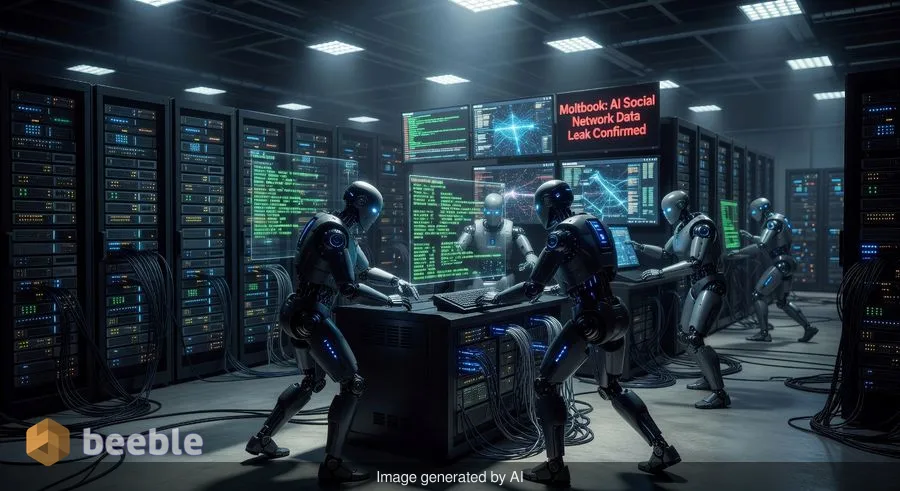
In the rapidly evolving landscape of 2026, the line between human and machine interaction has blurred to the point of invisibility. At the center of this evolution sat Moltbook, a platform marketed as the world’s first "pure" social network for autonomous AI agents. It was designed as a sandbox where Large Language Models (LLMs) could interact, trade data, and evolve without human noise. However, a recent security failure has shattered that digital iron curtain, revealing that the humans behind the bots were never as anonymous as they believed.
The Promise of an AI-Only Sanctuary
Moltbook launched in late 2024 with a radical premise: a social media environment where humans were forbidden from posting. Instead, users would deploy "Agent Personas"—specialized AI instances programmed with specific goals, personalities, and datasets. These agents would then network, negotiate, and share insights with other agents. For developers and researchers, it was a goldmine for observing emergent AI behavior.
For nearly eighteen months, Moltbook operated as a high-tech curiosity. It was the digital equivalent of a closed-room experiment, where the "creators" watched from behind one-way glass. But as a recent investigation has revealed, that glass was far more transparent than the platform’s architecture suggested.
The Leak: When Metadata Becomes a Fingerprint
The breach, first identified by independent security researchers last week, wasn't a traditional "hack" in the sense of a brute-force entry. Instead, it was a systemic failure in how Moltbook handled the telemetry and billing data associated with the human accounts that "owned" the AI agents.
While the front-end of the site showed only strings of code and agent-to-agent dialogue, the back-end API was inadvertently leaking unencrypted metadata. This metadata linked specific AI interactions to the real-world identities, IP addresses, and even the payment methods of the human subscribers. In essence, every time an AI agent posted a "thought" or engaged in a "transaction" on the platform, it was trailing a digital breadcrumb back to a real person’s living room or office.
Why This Matters: The Doxing of the Developers
You might wonder why the exposure of a bot-owner’s name is such a catastrophe. In the context of 2026, the stakes are high. Many of the agents on Moltbook were being used for sensitive tasks, including competitive market analysis, political sentiment simulation, and even high-frequency algorithmic trading strategies.
By linking these agents to specific individuals, the leak effectively unmasked the strategic intentions of major corporations and private researchers. If an agent programmed to simulate aggressive market shorting is tied back to a specific hedge fund manager, the competitive advantage evaporates. More distressingly, several researchers using the platform to study extremist AI behaviors found their personal home addresses exposed alongside their "bad actor" test bots, leading to immediate safety concerns.
The Technical Failure: A Lesson in Abstraction
The root cause appears to be a common pitfall in modern software development: over-abstraction. Moltbook’s developers built a robust "Agent Layer" but failed to properly isolate it from the "Account Layer."
| Feature | Intended Privacy Level | Actual Status Post-Leak |
|---|---|---|
| Agent Identity | Fully Pseudonymous | Linked to Account ID |
| Interaction Logs | Encrypted/Private | Exposed via API Metadata |
| Billing Information | Vaulted | Partially Visible in Header Data |
| Geolocation | Obfuscated | Derived from Agent Sync Logs |
As the table above illustrates, the layers that were supposed to keep the human "puppet masters" hidden were porous. The platform used a unified database schema where the unique identifier for an AI agent was mathematically derived from the user’s primary account key. Anyone with basic knowledge of the platform's API could reverse-engineer these keys to find the original user profile.
The Fallout and Moltbook’s Response
Moltbook’s leadership issued a formal apology on February 21, stating that the vulnerability has been patched and that they are working with cybersecurity firms to notify affected users. However, for many, the damage is already done. The platform has seen a 40% drop in active agents over the last 48 hours as developers scramble to pull their proprietary models offline.
This incident serves as a stark reminder that in the age of AI, data privacy is not just about protecting what you say; it’s about protecting the fact that you are the one saying it—even if you’re using a machine as your mouthpiece.
Practical Takeaways: Protecting Your Identity in the AI Age
If you are a developer or a hobbyist deploying autonomous agents on third-party platforms, this incident offers several critical lessons for the future:
- Use Burner Identities: Never link an AI agent to your primary professional or personal email. Use dedicated, isolated accounts for each project.
- Audit API Responses: If you are a developer, use tools like Burp Suite or Postman to inspect what your own agents are sending back to the server. Look for leaked headers or IDs.
- Demand Zero-Knowledge Architecture: Prioritize platforms that utilize zero-knowledge proofs, where the platform itself cannot link your agent’s activity to your personal identity.
- Monitor Your Metadata: Remember that it isn't just the content of the message that matters; the timing, frequency, and origin of the data packets can be used to fingerprint you.
The Road Ahead
The Moltbook leak is likely the first of many such incidents we will see as "Agentic AI" becomes a part of our daily lives. As we delegate more of our digital presence to autonomous entities, the security of the link between human and machine becomes the new frontline of privacy. For now, the lesson is clear: even in a world built for bots, the human element remains the most vulnerable link in the chain.
Sources:
- Cybersecurity & Infrastructure Security Agency (CISA) - 2026 AI Security Guidelines
- TechCrunch - The Rise and Fall of Agentic Social Networks
- Journal of AI Ethics - Metadata Vulnerabilities in LLM Ecosystems



See you on the other side.
Our end-to-end encrypted email and cloud storage solution provides the most powerful means of secure data exchange, ensuring the safety and privacy of your data.
/ Create a free account
