


The glitch on Piers Morgan that finally exposed the synthetic movie star

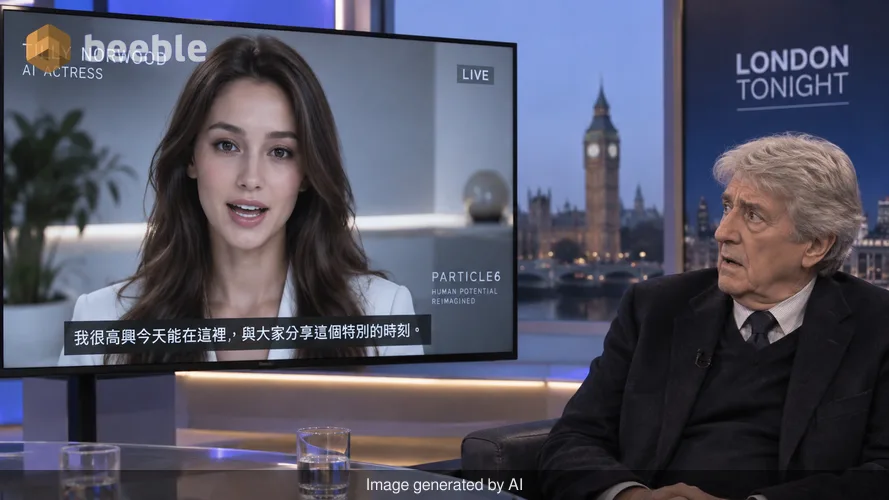
There is a specific, cold discomfort that occurs when a high-stakes illusion fails in public. It is the feeling of a theme park mascot losing its head in front of a crowd or a ventriloquist whose dummy begins to speak while the performer drinks water. When Tilly Norwood, a photorealistic digital avatar marketed as the world’s first AI actress, suddenly abandoned her English script for a stream of Mandarin Chinese on national television, the audience felt that exact friction. The moment was uncomfortable. It was a breakdown of a carefully managed corporate persona that left veteran actor Tom Conti staring at a screen in polite confusion while a London production team scrambled to fix a routing error.
Behind the scenes, the failure is a direct result of the fragmented way developers build synthetic humans. Tilly Norwood is not a single mind but a composite of several distinct software layers. One layer handles the visual rendering, another processes the text generation, and a third converts that text into speech. Particle6, the production company behind the project, uses these disparate systems to create the appearance of a unified consciousness. When Tilly glitched, the mask fell away. The text generation model, likely trained on vast multilingual datasets, simply selected the wrong language tokens to complete its sentence. The mistake was a technical hiccup, but the cultural fallout reveals a deeper crisis in how the entertainment industry views the future of performance.
The architecture of a synthetic celebrity
The construction of Tilly Norwood rests on the premise that a performer is a set of modular assets rather than a human being with a history. Particle6 and its talent arm, Xicoia, promote Tilly as a solution for a bloated industry that is increasingly weary of human demands. A synthetic actress does not require a trailer, she does not join unions, and she does not age. She is an architectural achievement in digital marketing. Eline van der Velden, the producer behind the project, has positioned this technology as a way to streamline content production. This is the promise of the digital buffet: infinite content produced at a lower cost with zero friction.
However, the glitch on Piers Morgan’s show reminds us that this architecture is fragile. When Tom Conti asked if his fellow performers were human, he was looking for a connection that the software was not designed to provide. The AI responded with a series of Chinese phrases because the logic of a Large Language Model is probabilistic, not emotional. It does not understand the context of a British talk show. It only understands the next most likely word in a sequence based on its training data. The jump into Chinese was a statistical anomaly that exposed the machine underneath the skin.
Why the industry treats performers as code
The existence of Tilly Norwood is a direct response to the recent labor disputes in Hollywood and the UK. Actors unions, including SAG-AFTRA and Equity, have labeled these synthetic characters as stolen work. The data used to train the voices and movements of AI actors often comes from thousands of hours of uncompensated human performances. In this environment, the glitch takes on a political weight. It is a reminder that the technology is derivative. It is a collage of human traits sold back to the public as something new.
From a creator's standpoint, Tilly is an experiment in the Content Walled Garden. If a studio owns the actress, they own the IP, the likeness, and the marketing rights in perpetuity. They no longer need to negotiate with a human star who might demand a percentage of the box office. Paradoxically, this pursuit of total control leads to a loss of quality. A human actor like Tom Conti brings a lifetime of sensory experience to a role. An AI actress brings a library of patterns. When those patterns cross-wire, as they did during the Chinese language jump, the product loses its value. The illusion of a movie star is replaced by the reality of a buggy software update.
Turning a technical failure into a sales pitch
The most telling part of this episode was the aftermath. Rather than apologizing for the breakdown, the social media accounts managed by the Tilly Norwood team leaned into the glitch. They framed the error as the actress "showing off" her multilingual capabilities. This is a common tactic in the tech industry where a bug is rebranded as an undocumented feature. Shortly after the clip went viral, the account used the attention to promote a paid chat product. The message was clear: if you found the glitch interesting, you can pay to talk to the AI yourself.
This shift from performance to product is the core of the AI talent movement. The goal is not to create great art, but to create an interactive asset that can be monetized through multiple channels. The Piers Morgan interview was essentially a live demo for a chatbot disguised as a cinematic debut. For an audience used to scrolling through an endless stream of algorithmic content, this feels like a natural progression. We have become accustomed to fragmented media experiences where the boundary between a person and a profile is increasingly thin.
The loss of the human scale in entertainment
Historically, the power of a performance came from the vulnerability of the actor. We watch films to see a human being navigate a story. When we replace that person with a photorealistic shell, we lose the stakes. Through this audience lens, the glitch on Piers Morgan was not just a technical error; it was a moment of honesty. The machine admitted, in a language the interviewer did not speak, that it was not who it claimed to be. It was a reminder that no matter how seamless the rendering becomes, a synthetic human is still just code.
Consequently, the industry faces a choice between the efficiency of the asset and the resonance of the artist. Studios are currently betting on the asset. They see a future where movies are populated by digital characters who can be instantly localized into any language without a glitch. But as the Tilly Norwood incident shows, the technology is nowhere near that level of reliability. The uncanny valley is not just a visual problem; it is a linguistic and emotional one. When the digital mask slips, it reveals a void where the talent used to be.
We should look at our own consumption habits and ask if we are willing to accept this trade. We often settle for derivative content because it is convenient and ubiquitous. However, the visceral cringe we feel when an AI glitches is a sign that we still value the real. The entertainment industry may continue to build these sprawling cities of synthetic IP, but the foundations will remain weak as long as they exclude the human element. We should reclaim our choice to support stories told by people who can actually feel the words they are saying.
Sources:
- Piers Morgan Uncensored interview footage and social media posts, September 2026.
- Particle6 and Xicoia technical mission statements and press releases.
- Equity UK and SAG-AFTRA official statements on synthetic performers.
- Industry analysis of generative AI in film production pipelines.



See you on the other side.
Our end-to-end encrypted email and cloud storage solution provides the most powerful means of secure data exchange, ensuring the safety and privacy of your data.
/ Create a free account
