


The Great Transition: How AI-WIPS is Redefining the Global Labor Market in 2026

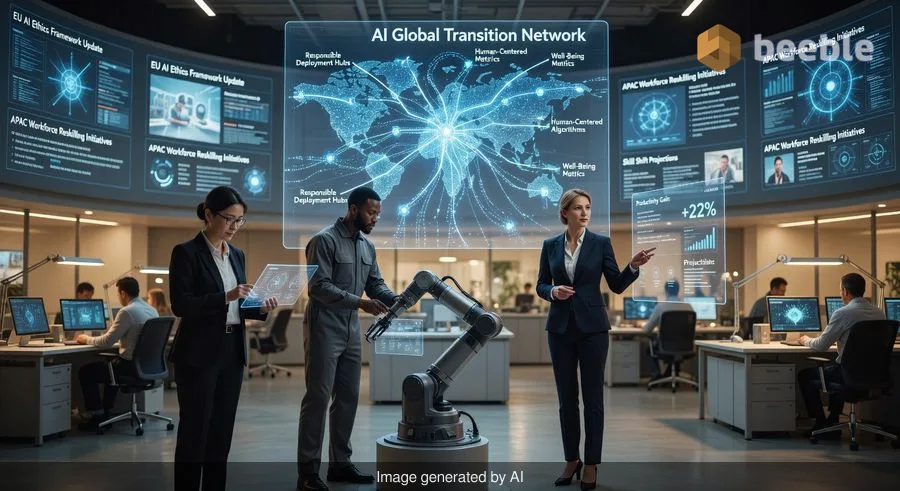
As we move through the first quarter of 2026, the conversation around artificial intelligence has shifted from speculative wonder to a grounded, often complex reality. The initial wave of generative AI excitement has matured into what economists call the 'Great Transition'—a period where the integration of AI into Work, Innovation, Productivity, and Skills (AI-WIPS) is no longer a pilot project, but a fundamental pillar of global economic strategy.
Governments and enterprises are no longer asking if AI will change the workplace, but rather how to manage the friction of that change. The goal is a human-centered approach that balances the undeniable efficiency of automation with the essential need for societal well-being and job quality.
The Shift from Tools to Agents
In 2024, we used AI as a sophisticated typewriter or a search engine on steroids. By 2026, the paradigm has shifted toward 'Agentic AI.' These are systems capable of planning, executing multi-step workflows, and collaborating with other software without constant human hand-holding. This evolution has fundamentally altered the productivity equation.
Productivity is no longer measured solely by the volume of output, but by the quality of 'cognitive offloading.' When a project manager uses an AI agent to handle resource allocation, risk assessment, and meeting synchronization, their role shifts toward high-level strategy and interpersonal leadership. This is the 'complementary' promise of AI: it handles the mundane, allowing humans to focus on the exceptional.
The Innovation Paradox: Replacement vs. Augmentation
One of the most significant challenges identified by the AI-WIPS framework is the uneven distribution of AI’s impact. While AI generates new types of work—such as AI ethicists, workflow orchestrators, and data provenance specialists—it also exerts pressure on entry-level cognitive roles.
We are witnessing an innovation paradox. While AI accelerates the pace of technical breakthroughs, it can also stifle 'on-the-job' learning for junior employees who previously learned the ropes through the very rote tasks AI now performs. To counter this, forward-thinking organizations are redesigning their mentorship programs to ensure that the 'human element' of professional growth isn't lost to an algorithm.
Comparing the Old and New Work Paradigms
To understand the depth of this transformation, it is helpful to look at how specific work functions have evolved over the last two years.
| Feature | Traditional Work (Pre-2024) | AI-Augmented Work (2026) |
|---|---|---|
| Task Execution | Manual, step-by-step human input | Autonomous agents with human oversight |
| Skill Focus | Technical proficiency in specific software | Prompt engineering and system orchestration |
| Data Usage | Periodic analysis for reporting | Real-time data integration into daily tasks |
| Problem Solving | Based on personal experience and intuition | Augmented by predictive modeling and simulations |
| Work Structure | Fixed roles and rigid hierarchies | Fluid, project-based, and cross-functional |
The Skills Pivot: What Matters Now?
The skills gap is the defining hurdle of 2026. The technical shelf-life of many hard skills has shrunk significantly. Today, the most resilient workers are those who possess 'meta-skills'—the ability to learn how to learn.
Key competencies now include:
- Algorithmic Literacy: Understanding not just how to use AI, but the biases and limitations inherent in the models.
- Complex Communication: The ability to negotiate, persuade, and lead in a world where data is a commodity but empathy is a premium.
- Critical Evaluation: As AI-generated content becomes the baseline, the value of a human 'editor' who can verify accuracy and ensure ethical alignment has skyrocketed.
Government Policy and Human-Centered Design
Governments are playing a more active role than ever in managing the AI transition. Following the frameworks established by the OECD and various national AI acts, the focus has moved toward 'Human-in-the-loop' requirements. These regulations ensure that high-stakes decisions—such as hiring, firing, or medical diagnostics—cannot be made by an autonomous system without meaningful human intervention.
Responsible deployment also means addressing the psychological impact of AI. 'Algorithmic management'—where software monitors worker performance—has faced significant pushback, leading to new labor laws that protect worker privacy and mental health. The objective is to ensure that AI improves well-being rather than creating a high-tech 'digital sweatshop.'
Practical Takeaways for the AI Era
For individuals and organizations looking to navigate this landscape, the following steps are essential:
- Audit Your Workflow: Identify tasks that are repetitive and data-heavy. These are the primary candidates for AI augmentation. Focus your human energy on tasks requiring nuance and emotional intelligence.
- Invest in 'Durable' Skills: While learning specific AI tools is important, prioritize durable skills like critical thinking, ethics, and strategic planning.
- Implement Ethical Guardrails: If you are a business leader, establish clear guidelines on how AI can and cannot be used. Transparency with employees about AI's role in the company is crucial for maintaining trust.
- Stay Informed on Regulation: AI policy is moving fast. Ensure your workflows comply with the latest data privacy and AI governance standards in your region.
Looking Ahead
The AI-WIPS transition is a marathon, not a sprint. As we look toward the rest of 2026, the focus will remain on refining the partnership between human intuition and machine intelligence. The goal is not to build a world where AI replaces us, but one where AI enables us to do more meaningful work, more efficiently, while preserving the human-centered values that define a healthy society.
Sources:
- OECD: AI in Work, Innovation, Productivity and Skills (AI-WIPS) Program
- International Labour Organization (ILO): Generative AI and Jobs report
- European Commission: The AI Act and the Future of Work
- Stanford Institute for Human-Centered AI (HAI): 2025-2026 Index Report



See you on the other side.
Our end-to-end encrypted email and cloud storage solution provides the most powerful means of secure data exchange, ensuring the safety and privacy of your data.
/ Create a free account
