


The Human Touch in a Digital Age: Why Capcom is Drawing a Line in the Sand Against GenAI Art

A New Frontier or a Digital Mirage?
Have you ever had that distinct feeling of stepping out of the vault for the first time, squinting at a sprawling horizon and wondering if what you’re seeing is real or just a clever facade? In the current landscape of game development, that horizon is increasingly clouded by the dust kicked up by Generative AI. While some of the industry’s biggest players are rushing to integrate AI-generated NPCs and procedurally generated textures into their next-gen titles, Capcom—the house that built Resident Evil, Monster Hunter, and Street Fighter—has decided to take a different path.
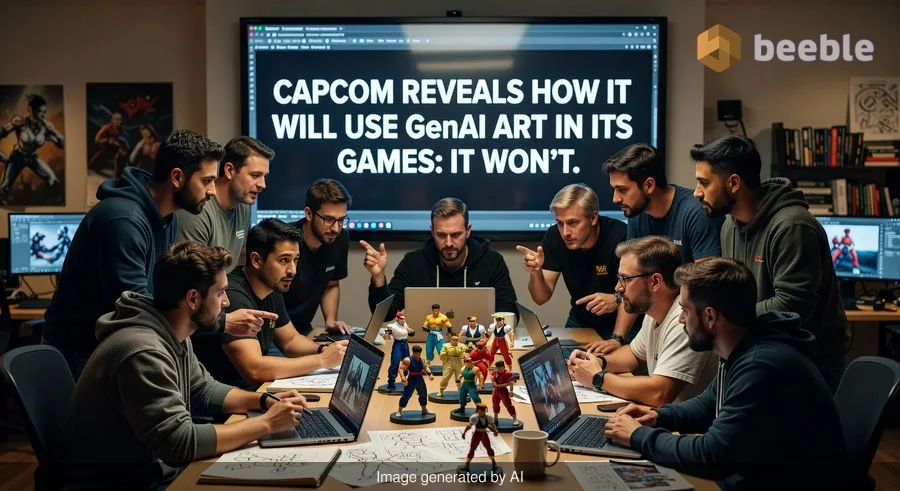
During a recent shareholder meeting, the company made its stance crystal clear: "Our company will not be implementing any AI-generated assets into our video game content." At a time when the industry feels like it's being held together by duct tape and shifting market trends, this declaration feels less like a corporate update and more like a manifesto. But what does this actually mean for the players, and why is one of the world’s most successful developers choosing to keep the "human" in the machine?
The Distinction Between Creation and Efficiency
To understand Capcom’s position, we have to look at the nuance often lost in the AI discourse. Simply put, Capcom isn't rejecting AI as a concept; they are rejecting it as a creator. Interestingly enough, the company confirmed it will "actively utilize" AI technologies to streamline the development process.
Think of it this way: development is a boss fight that never ends. To win, you need the best tools available. Capcom plans to use AI as the cogs in the machine—helping with programming, sound processing, and internal graphics workflows to make the grind more manageable. On paper, this sounds like a standard efficiency play. But in reality, it’s a protective measure for their creative IP. They want the AI to sharpen the sword, but they still want a human hand to swing it.
Why Handcrafted Still Matters in a Sprawling World
We’ve all experienced "Open-World Exhaustion." It’s that moment in a massive, 100-hour RPG where you realize the forest you’re running through feels barren, or the side quests feel like they were written by a committee of algorithms. When a game loses its soul, the player’s arc stops feeling like a pilgrimage and starts feeling like a treadmill.
Capcom’s recent streak of stellar hits—from the visceral horror of the Resident Evil 4 remake to the layered mechanics of Street Fighter 6—relies heavily on intentionality. Every shadow in a labyrinthine hallway and every frame of a character’s animation is a deliberate choice. By rejecting GenAI assets, Capcom is betting that players can tell the difference between a breathtaking, handcrafted environment and one generated by a prompt. They are leaning into the "human touch" as a premium feature, a way to ensure their games don't become part of a bland, AI-generated hivemind.
The RE Engine: A Walled Garden of Innovation
Unsurprisingly, much of this strategy likely revolves around the RE Engine. This proprietary toolset has been groundbreaking for Capcom, allowing them to produce games that are both visually stunning and remarkably fluid. Because they own the pipeline, they don't have to follow the industry's shift toward the "Live-Service as an ecosystem" model that often demands the rapid, low-quality asset production that GenAI facilitates.
That being said, the catch is that maintaining this level of quality is expensive and time-consuming. While other studios might use AI to fill their worlds with "filler" content to satisfy the backlog burden of modern gamers, Capcom seems content to focus on density over pure scale. They are prioritizing the core loop—the foundation of the experience—over the sheer volume of assets.
The Industry Meta: A Living, Breathing Entity
Looking ahead, Capcom’s stance puts them in a polarizing position. On the flip side of their conservative approach, we see companies like Ubisoft and Microsoft experimenting with AI-driven dialogue trees and environment generation. The industry meta is a living, breathing entity, and right now, it is deeply divided.
Ultimately, Capcom’s decision feels like a response to their community. Gamers are increasingly wary of "overhyped" tech that promises the world but delivers a clunky, unbalanced experience. By promising to keep AI out of the final art and sound that the player actually touches, Capcom is reinforcing a sense of trust. They are telling their audience that when they buy a Capcom game, they are buying the work of artists, not the output of a server farm.
Practical Takeaways for the Future
So, what should we expect from Capcom—and the rest of the industry—moving forward? Here is a quick breakdown of how this "No GenAI Assets" policy might manifest:
- Higher Fidelity, Lower Volume: Expect Capcom titles to remain highly-anticipated for their visual polish, even if they don't release as frequently as some annual franchises.
- The Tool vs. The Product: Watch for more developers to adopt this "middle ground"—using AI for backend coding (the plumbing) while keeping the front-facing art (the architecture) human-made.
- The Premium of "Handmade": As AI-generated content becomes more common, "Human-Made" might become a marketing label, much like "Organic" or "Artisan" in the food industry.
Capcom’s refusal to let AI take the wheel in the art department is a bold move in an era of rapid automation. Whether it remains a sustainable strategy as development costs skyrocket is yet to be seen, but for now, it’s a refreshing reminder that in the world of high-end gaming, the human element is still the most powerful engine of all.
Sources
- Capcom Shareholder Meeting Q&A (Transcribed by Automaton)
- Capcom Integrated Report 2025/2026
- Industry analysis on RE Engine development cycles



See you on the other side.
Our end-to-end encrypted email and cloud storage solution provides the most powerful means of secure data exchange, ensuring the safety and privacy of your data.
/ Create a free account
