


The New Front Lines: Thales on the AI Arms Race and the Quantum Cybersecurity Threat

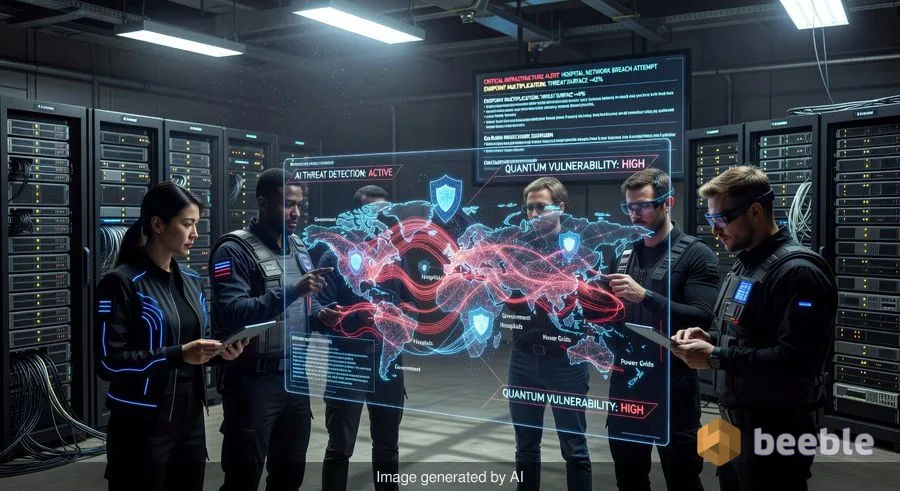
At the recent Mobile World Congress in Barcelona, the atmosphere was one of cautious innovation. While the halls buzzed with the latest in 6G prototypes and hyper-connected IoT devices, a more sobering conversation took place behind the scenes. Eva Rudin, Senior Vice President of Mobile Connectivity Solutions at Thales, delivered a stark warning: our rapidly expanding digital ecosystem is outpacing our ability to secure it.
As we move deeper into 2026, the cybersecurity landscape is no longer defined by human hackers sitting in dark rooms. Instead, we are entering an era of machine-speed warfare, where the primary battle is AI versus AI, and the looming shadow of quantum computing threatens to render today’s encryption obsolete.
The Expanding Threat Surface
The fundamental challenge of modern cybersecurity is mathematical. Every new connected device—whether a smart sensor in a municipal water system or a wearable health monitor—represents a new entry point for malicious actors. Rudin pointed out that as we multiply these connectivity points, we exponentially increase the "threat surface."
In the past, critical infrastructure like power grids and hospitals were largely isolated from the public internet. Today, the drive for efficiency and real-time data has brought these systems online. The consequence is a world where a vulnerability in a seemingly minor software component can escalate into a national security crisis. The shift from "if" we get hacked to "when" has never been more pronounced.
AI versus AI: The Automated Battlefield
One of the most significant shifts highlighted by Thales is the role of artificial intelligence in offensive operations. AI-powered attackers can now perform reconnaissance and exploit vulnerabilities at a velocity that renders traditional human-led defense teams ineffective.
Imagine a digital locksmith that can try a million keys a second while simultaneously redesigning the keys based on the resistance it feels in the lock. That is the reality of AI-driven intrusion. These systems can identify "zero-day" vulnerabilities—flaws unknown to the software's creators—and weaponize them before a patch can even be conceived.
To counter this, the defense must also be autonomous. Cybersecurity is evolving into a game of algorithmic chess. Defensive AI must now monitor network traffic for patterns so subtle that they are invisible to human analysts, isolating compromised segments of a network in milliseconds to prevent the lateral spread of an attack.
The Quantum Threat: Harvest Now, Decrypt Later
While AI is the immediate battle, quantum computing represents the strategic horizon. The threat isn't just about what happens when a functional quantum computer is finally switched on; it is about what is happening to data right now.
Security experts refer to this as the "Harvest Now, Decrypt Later" (HNDL) strategy. Adversaries are currently intercepting and storing vast amounts of encrypted sensitive data—government communications, trade secrets, and personal medical records. While they cannot read this data today, they are betting that a quantum computer in the near future will be able to crack current RSA and ECC encryption standards with ease.
Thales emphasizes that the transition to Post-Quantum Cryptography (PQC) must begin immediately. Building "trusted connectivity" means ensuring that the data we transmit today remains secure for the next twenty to thirty years.
Building Trusted Connectivity
So, how do we navigate this high-stakes environment? Rudin suggests that the goal is to build an environment of "real confidence." This involves moving beyond perimeter-based security—the idea that you can build a wall around your data—and toward a "Zero Trust" architecture.
In a Zero Trust model, no device or user is trusted by default, regardless of whether they are inside or outside the network. Every connection request must be verified, authenticated, and continuously monitored. This is particularly vital for critical infrastructure, where the cost of a breach is measured not just in dollars, but in human lives.
Practical Takeaways for Organizations
As we look toward the remainder of 2026 and beyond, organizations must shift their strategy from reactive patching to proactive resilience. Here are the essential steps for securing the modern enterprise:
- Audit the IoT Ecosystem: Map every endpoint connected to your network. If a device does not need internet access to function, isolate it.
- Adopt AI-Driven Monitoring: Invest in security platforms that use machine learning to detect anomalies in real-time. Human teams should be reserved for high-level strategy, not manual log review.
- Prepare for Post-Quantum: Begin an inventory of your encrypted data. Identify which datasets have a long shelf-life and prioritize them for migration to PQC-ready algorithms.
- Implement Micro-Segmentation: Divide your network into small, isolated zones. This ensures that if one area is compromised, the attacker cannot easily move to more sensitive systems.
- Focus on Identity: In a world of ubiquitous connectivity, identity is the new perimeter. Multi-factor authentication (MFA) and robust identity management are non-negotiable.
The Path Forward
The warnings from Thales serve as a reminder that technology is a double-edged sword. The same connectivity that allows for remote surgery and smart cities also provides the tools for unprecedented disruption. The battle for cybersecurity is no longer a niche IT concern; it is the foundation upon which the safety of our physical world now rests. By embracing AI-driven defense and preparing for the quantum future, we can begin to build the trusted connectivity that Eva Rudin and Thales envision.
Sources
- Thales Group: Cybersecurity Solutions
- NIST: Post-Quantum Cryptography Standardization
- Mobile World Congress (MWC) Barcelona Official Site
- CISA: Securing Critical Infrastructure



See you on the other side.
Our end-to-end encrypted email and cloud storage solution provides the most powerful means of secure data exchange, ensuring the safety and privacy of your data.
/ Create a free account
