


The Privacy Darling of AI Just Asked for Your Passport

For the past year, a quiet migration has been underway in the world of artificial intelligence. While OpenAI’s ChatGPT remains the household name, a significant cohort of privacy-conscious power users, developers, and writers packed their digital bags and moved to Anthropic’s Claude. The narrative was simple: OpenAI was becoming too cozy with government surveillance interests—highlighted by the appointment of a former NSA director to its board—while Anthropic remained the principled, safety-first alternative.
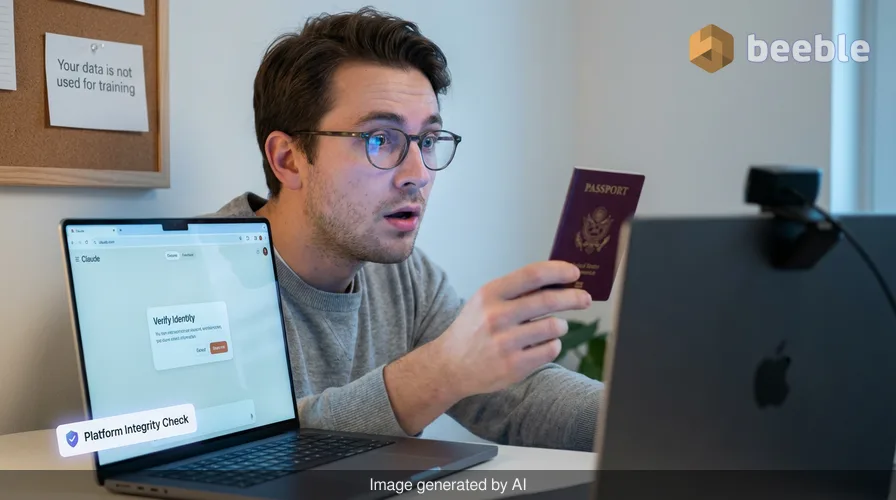
But the reality of the tech industry is rarely that binary. This week, that narrative hit a significant speed bump. Anthropic quietly updated its protocols to include a requirement that some users provide a government-issued photo ID and a live selfie to continue using the service. For a community that joined Claude specifically to escape the feeling of being watched, the irony is thick. It raises a foundational question about the future of the internet: Can we ever truly have high-level utility without surrendering our absolute anonymity?
The Great Migration Meets the Digital Border
To understand why this move feels like such a betrayal to some, we have to look at the atmosphere that preceded it. In mid-2024 and throughout 2025, OpenAI faced a series of PR crises regarding data handling and its relationship with federal agencies. This created a vacuum that Anthropic was happy to fill. They marketed themselves as the creators of 'Constitutional AI,' a system governed by a set of ethical principles rather than just raw data patterns.
For the average user, Claude felt like a more thoughtful, less 'corporate' version of the AI future. It was the tireless intern who didn't just do the work but seemed to care about the rules. However, the honeymoon phase of the AI boom is ending, and the regulatory reality is setting in. Anthropic’s new identity verification isn't a random whim; it is a response to the systemic pressure of operating a tool that is increasingly being used for high-stakes tasks.
While it seems like a sudden pivot, looking at the big picture reveals a shifting landscape where 'trust but verify' is becoming the mandatory operating procedure for any company handling massive amounts of compute power.
Under the Hood: How Verification Works
Practically speaking, Anthropic isn't building a giant database of passports in-house. Like many fintech apps and car-sharing services, they are outsourcing the heavy lifting to a third-party identity platform called Persona. When a user is flagged for verification, they are prompted to scan their ID and take a 'liveness' selfie to prove they aren't a bot or a deepfake.
Behind the jargon of 'platform integrity,' there are three main reasons why a company like Anthropic would take this drastic step:
- Preventing Model Misuse: AI can be used to generate phishing emails, write malware, or coordinate disinformation campaigns. By tying an account to a real human, the 'cost' of getting banned becomes much higher.
- Resource Rationing: High-end AI models like Claude 3.5 Sonnet or Opus are incredibly expensive to run. Bad actors often create thousands of 'sock-puppet' accounts to bypass usage limits. A passport check is an effective, if blunt, tool to stop this.
- Regulatory Compliance: Governments are increasingly looking at 'Know Your Customer' (KYC) laws, similar to those in banking, for AI companies. They want to ensure that powerful technology isn't being exported to sanctioned regions or used by prohibited entities.
Curiously, Anthropic is the first major player to make this a visible part of the consumer experience. While Google and Microsoft have vast amounts of data on you already, they haven't yet asked you to hold up your driver's license just to chat with their bot. Anthropic’s move is transparent, but for many, it is also jarringly invasive.
The Privacy Trade-off: A Comparison
From a consumer standpoint, the choice between AI providers is no longer just about which one writes better poetry or code. It is about what 'tax' you are willing to pay for the service.
| Feature | Anthropic (Claude) | OpenAI (ChatGPT) | Google (Gemini) |
|---|---|---|---|
| Primary Data Source | User-provided prompts | User-provided prompts | Integrated Google ecosystem |
| Identity Verification | Government ID/Selfie (for some) | Email/Phone number | Google Account history |
| Training Opt-out | Available for Pro/Team users | Available in settings | Available in settings |
| Third-party Sharing | Uses Persona for ID checks | Shared with security partners | Internal Google data sharing |
Essentially, we are seeing a split in how privacy is handled. Google and Microsoft already know who you are because you live in their ecosystems. OpenAI knows you through your phone number and payment method. Anthropic, lacking that deep historical data, is choosing a more robust, 'hard' verification method.
Why This Matters for the Everyday User
For the person using Claude to summarize a PDF or help draft an email, this might feel like overkill. To put it another way, it’s like being asked for a fingerprint to enter a public library. However, the 'So What?' filter suggests that this is the beginning of a broader trend.
As AI models become more capable of performing real-world actions—like booking flights, moving money, or accessing medical records—the need for 'Proof of Personhood' will grow. If an AI agent is going to act on your behalf, the system needs to be 100% sure it is actually you giving the orders.
On the market side, this move might actually hurt Anthropic’s growth in the short term. The volatile nature of user trust means that even a small friction point like an ID check can send people running back to competitors. But from a resilient business perspective, Anthropic is likely betting that being the 'most compliant' company will make them the preferred choice for big enterprise clients and government contracts in the long run.
The Bottom Line for Your Digital Life
Ultimately, the 'surveillance fears' that drove users to Claude haven't been solved; they’ve just changed shape. We’ve moved from worrying about our data being used to train a brain, to worrying about our physical identity being tied to our digital queries.
If you are prompted to verify your identity, you have a choice to make. Anthropic states that this data is not used for training and is handled by a specialized security firm. For many, the utility of the 'tireless intern' is worth the trade. For others, the requirement is a bridge too far.
Looking at the big picture, we should expect this to become the industry standard. The era of the anonymous, high-powered AI assistant is likely drawing to a close. As these tools become the digital crude oil of our economy, the gatekeepers are going to want to see some ID before they let us pump.
Instead of viewing this as a single company’s betrayal, observe it as a signal of where the entire internet is heading. We are moving toward a 'verified web' where your digital actions are tethered to your physical self. Whether that makes the world safer or just more restrictive is a question we will be answering for the next decade. For now, keep your passport handy—your AI might need it.
Sources
- Anthropic Official Support Documentation: Identity Verification FAQ (April 2026).
- Persona Identity Verification Platform: Security and Compliance Standards Report.
- Industry Analysis: The Impact of KYC in Generative AI Markets (TechTrends Quarterly).
- Comparative Privacy Study: Data Retention Policies of Major LLM Providers.



See you on the other side.
Our end-to-end encrypted email and cloud storage solution provides the most powerful means of secure data exchange, ensuring the safety and privacy of your data.
/ Create a free account
