


The Quantum Countdown: Why Google is Racing to Replace Modern Encryption by 2029

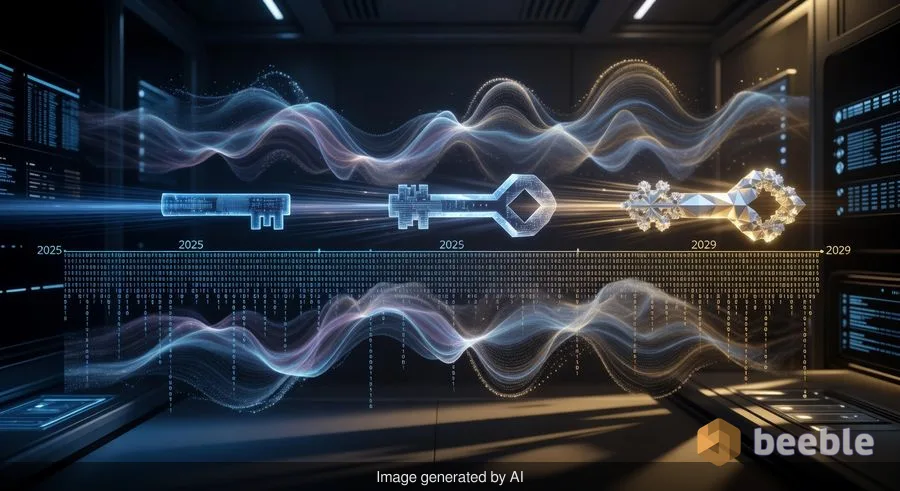
If a powerful quantum computer were to come online tomorrow, would your encrypted data remain a secret, or would it become an open book for anyone to read? This isn't a plot point from a science fiction novel; it is the central anxiety driving the latest strategic shift at Google. The tech giant recently signaled a new sense of urgency, setting a 2029 timeline to migrate its vast infrastructure to post-quantum cryptography (PQC).
For years, the cybersecurity community has treated the 'Quantum Apocalypse'—the day a quantum computer becomes powerful enough to break RSA and ECC encryption—as a distant, theoretical problem. However, Google’s warning suggests that the threat landscape is shifting. From a risk perspective, we are no longer looking at a 'if' scenario, but a 'when.'
The Shatterproof Digital Vault is Cracking
To understand the gravity of the situation, we must look at the architectural level of how we protect data today. Current encryption relies on mathematical problems that are easy to perform in one direction but nearly impossible to reverse. Think of it like a shatterproof digital vault: a classical computer would take trillions of years to guess the combination.
Quantum computing, however, operates on the principles of superposition and entanglement. Essentially, while a classical computer tries every key one by one, a sufficiently powerful quantum computer could, in principle, evaluate all possible keys simultaneously. This systemic vulnerability means the very math we trust to protect our bank accounts, medical records, and state secrets could be rendered obsolete overnight.
Harvest Now, Decrypt Later: The Stealthy Threat
One might wonder why we are panicking in 2026 if the 'Q-Day' computer doesn't exist yet. The answer lies in a malicious strategy known as 'Harvest Now, Decrypt Later.' Sophisticated threat actors are currently intercepting and storing massive amounts of encrypted, sensitive data.
Even though they cannot read it today, they are betting on the fact that once a quantum computer is available, they can retroactively unlock this treasure trove. Consequently, data with a long shelf life—such as genomic data or classified intelligence—is already compromised. Proactively speaking, if we don't switch to quantum-resistant algorithms now, the 'oil spill' of data leaks will have a decades-long impact.
Navigating the Post-Quantum Migration
Google’s 2029 goal isn't just about their own servers; it’s a signal to the entire ecosystem. The transition to PQC is not as simple as a routine software update. It is a multifaceted overhaul of how digital signatures and handshakes work.
In practice, this means implementing new algorithms vetted by NIST (National Institute of Standards and Technology). These new standards are designed to be robust against both classical and quantum attacks. However, the migration is a precarious journey. Older systems may not support the larger key sizes required by PQC, leading to 'shadow IT' pockets where legacy encryption remains a vulnerable back door.
From an End-User Perspective: What Changes?
For the average person, this transition should ideally be transparent. You won't necessarily see a 'Quantum Protected' badge on your browser, but behind the scenes, the protocols that secure your HTTPS connections and Signal messages are being swapped out.
Curiously, the biggest challenge isn't the math—it's the implementation. As a journalist who has spent years analyzing complex APT attacks, I’ve seen that the most sophisticated encryption in the world is useless if the human element fails or if the deployment is non-compliant with security best practices. We are building the foundation of a new house while still living in the old one, and we must ensure the transition doesn't leave the door unbolted.
A Call to Action: Auditing Your Data Longevity
We cannot afford to be reactive when the stakes involve the fundamental integrity of the global economy. While Google is leading the charge at the infrastructure level, businesses must begin their own forensic look at their data assets.
To prepare for the quantum era, consider these actionable steps:
- Inventory Your Encryption: Identify where your organization uses RSA or ECC, particularly for data that must remain confidential for more than five years.
- Prioritize Data Longevity: Assess which datasets are most at risk from 'Harvest Now, Decrypt Later' tactics.
- Engage with Vendors: Ask your cloud and security providers about their specific roadmap for PQC integration.
- Adopt Crypto-Agility: Design your systems so that cryptographic algorithms can be updated or replaced without tearing down the entire architecture.
Ultimately, the arrival of quantum computing doesn't have to be a disaster. By treating privacy as a fundamental human right and encryption as a living, breathing defense mechanism rather than a static checkbox, we can ensure our digital world remains resilient in the face of the next great technological leap.



See you on the other side.
Our end-to-end encrypted email and cloud storage solution provides the most powerful means of secure data exchange, ensuring the safety and privacy of your data.
/ Create a free account
