


The quiet arrival of private bitcoin and why your financial history is no longer public property

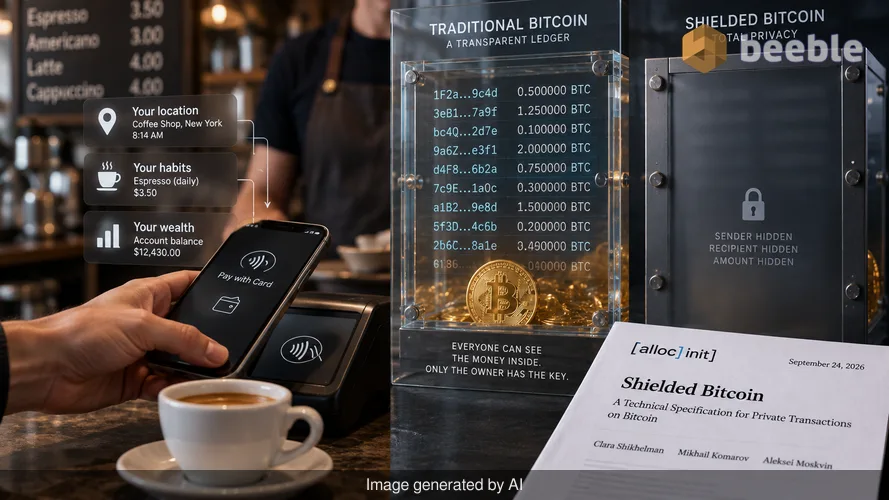
Every time you tap a card or scan a phone to pay for a morning espresso, you leave a digital footprint that reveals your location, your habits, and your wealth. In the traditional banking system, these footprints are stored in private databases owned by institutions that sell your data to advertisers or hand it over to regulators. When you use bitcoin today, the footprint is even more stark; your entire transaction history is visible to anyone with an internet connection. The blockchain is a glass bank vault where everyone can see the money inside, but only the owner has the key. This total transparency was originally a feature meant to prevent fraud, but it has become a pervasive barrier for individuals who value their personal safety and for businesses that need to protect their trade secrets.
On September 24, 2026, a research team at the cryptography firm [[alloc]] init published a technical specification that aims to paint over the glass of that vault. The paper, titled "Shielded Bitcoin," describes a system that allows users to send and receive bitcoin with total privacy. By borrowing the math behind Zcash, a privacy-focused cryptocurrency, researchers Clara Shikhelman, Mikhail Komarov, and Aleksei Moskvin have designed a way to hide the sender, the recipient, and the amount of every transfer. This development happens at a time when the financial world is divided; regulators demand more transparency while market participants crave the same anonymity they once had with physical cash.
How the glass bank vault finally gets curtains
Historically, bitcoin has operated as a public ledger where every coin has a traceable lineage. If you receive a fraction of a bitcoin from a friend, you can theoretically trace those specific units back through thousands of hands to the moment they were first mined. This transparency is systemic and deeply rooted in the original 2008 design. For years, the trade-off was simple: you gained a decentralized currency free from central bank inflation, but you sacrificed the right to a private wallet. The new proposal from [[alloc]] init changes this equation by introducing a layer of encryption that sits on top of the existing Bitcoin network.
In the old model, the network verified transactions by checking a public list of available coins; in the shielded model, the network verifies transactions by checking a mathematical proof that the coins exist. The system uses a specific type of cryptography known as zero-knowledge proofs. These proofs allow a sender to prove they have enough money to make a payment without revealing their total balance or the identity of the person receiving the funds. To the rest of the world, the transaction appears as a scrambled block of data. The money moves, the ledger balances, and the participants remain anonymous.
The mechanics of a shielded transfer
Value in this new system is held as encrypted "notes." When you want to pay someone, you do not simply move a coin from one address to another; instead, you destroy an old note and create a new one for the recipient. The Bitcoin network records a public marker called a nullifier to ensure that the same note is not spent twice. Because these nullifiers are also encrypted, observers cannot link the new note to the old one. This process breaks the chain of traceability that has defined the Bitcoin experience for nearly two decades.
Zooming out to the technical requirements, the researchers utilize the Groth16 proof system. This specific method of cryptography is efficient enough to fit within the data limits of a standard bitcoin transaction, yet it requires a one-time setup process to ensure its security. The proposal relies on a technical feature in Bitcoin Core v30 that allows for larger data attachments in transactions. While some node operators have resisted this change, the firm [[alloc]] init argues that the benefits of privacy outweigh the costs of increased data usage on the network. Each shielded transfer takes up about 625 vbytes of space, which is significantly larger than a standard payment but small enough to remain practical for daily use.
Why institutions demand an opaque ledger
Financially speaking, privacy is not just a tool for activists; it is a requirement for institutional adoption. A company cannot pay its employees in a transparent currency because every worker would know their colleagues' salaries. A hedge fund cannot move large amounts of capital on a public ledger because competitors would front-run their trades. This need for secrecy explains why Zcash has recently moved into the regulated mainstream. On August 25, 2026, Grayscale launched a Zcash ETF on the NYSE Arca; shortly after, 21Shares listed a similar product in Europe. As of late September, ZEC trades near $1,592, reflecting a growing market belief that privacy is a premium asset.
Shielded Bitcoin brings this institutional-grade privacy directly to the world's largest digital asset. It allows a business to conduct its affairs with the same confidentiality it enjoys in the traditional banking system. Paradoxically, the path to mass adoption of decentralized finance requires the same level of discretion that central banks have provided for centuries. Without privacy, bitcoin remains a speculative tool for the few; with privacy, it becomes a functional tool for the many. The [[alloc]] init design provides a bridge between the radical transparency of the early crypto era and the practical needs of modern commerce.
The reality of digital signatures and compliance
While the core technology hides transaction details, the researchers have included an optional layer for compliance. An appendix in the paper describes a "Trust Authority" that can certify deposits. This mechanism allows a user to prove to a bank or a tax authority that their bitcoin came from a legitimate source without revealing their entire spending history to the public. In practice, this means you could prove you are not a money launderer while still keeping your grocery bills and rent payments private. This balance is a nuanced response to the increasing pressure from global financial regulators who view total anonymity as a systemic risk.
Curiously, the Shielded Bitcoin protocol does not hide everything. The timing of a transaction, the fees paid to miners, and the number of inputs and outputs remain public. If you send a payment at 3:00 PM every Friday, an observer can still see that a shielded transfer occurred, even if they cannot see who received it or how much was sent. Privacy in this context is not a magic cloak that makes you invisible; it is a set of blinds that keeps people from looking through your windows. The paper also leaves the process of moving money into and out of the shielded system for a later study, focusing for now on how the money moves once it is already inside the vault.
Reclaiming the right to financial quiet
From a consumer standpoint, the evolution of Shielded Bitcoin represents a shift in how we think about digital property. For years, we have accepted a fragmented financial existence where our data is the price we pay for convenience. We trade our privacy for the ability to send money across borders or to store wealth outside of a government-controlled bank. The work of Shikhelman, Komarov, and Moskvin suggests that this trade-off is no longer mandatory. By embedding privacy into the base layer of the network, they are attempting to restore the anonymity of physical cash to the digital age.
Ultimately, the success of this protocol depends on whether the Bitcoin community accepts the additional data load. In everyday terms, we are deciding whether we want our digital wallets to be glass boxes or leather pouches. As market cycles swing between the need for transparency and the desire for protection, Shielded Bitcoin offers a middle path. It preserves the decentralized nature of the network while acknowledging that a healthy financial life requires a degree of silence. Whether this becomes the standard for all bitcoin users or remains a tool for a specialized few, it marks a profound change in the architecture of money.
Food for thought
- How much of your personal story is currently visible to your bank or your apps through your spending habits?
- If your entire transaction history were made public tomorrow, which specific payments would cause you the most anxiety?
- Does the ability to audit a government's spending outweigh your individual right to keep your own salary private?
- Would you be willing to pay higher transaction fees if it meant your financial life remained invisible to third-party observers?
Sources
- [[alloc]] init Research: Shielded Bitcoin Technical Specification (September 2026).
- CoinGecko: ZEC Price Index and Market Data.
- Grayscale Investments: Zcash ETF (ZCSH) Fund Fact Sheet.
- Bitcoin Core: Version 30 Release Notes and OP_RETURN default changes.
- 21Shares: Zcash ETP Listing Announcement (Euronext Paris/Amsterdam).



See you on the other side.
Our end-to-end encrypted email and cloud storage solution provides the most powerful means of secure data exchange, ensuring the safety and privacy of your data.
/ Create a free account
