


The quiet drift away from the television screen and what it means for our shared reality
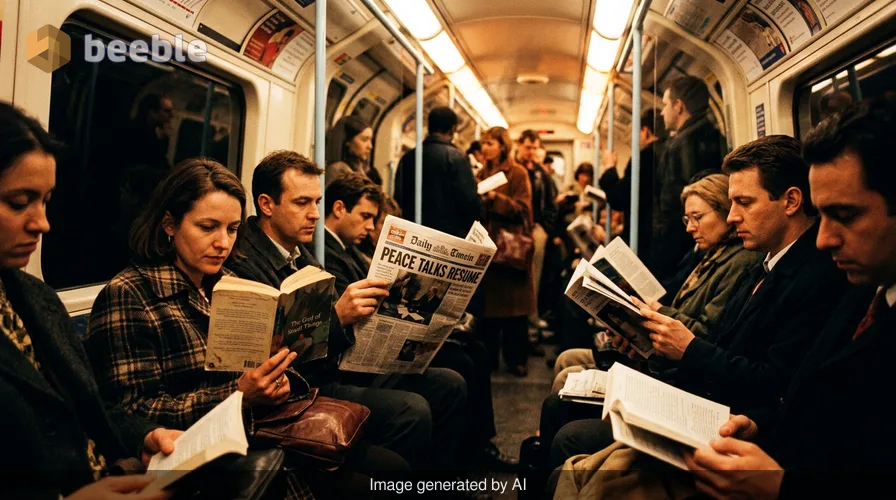
A woman sits on the evening train out of the city, her face illuminated by the cold blue light of a smartphone. She moves her thumb in a rhythmic, downward stroke, a gesture that millions of people perform in unison across the planet. Twenty years ago, the carriage was a landscape of rustling broadsheets and the occasional paperback. Today, the space is silent, yet it hums with an invisible intensity. Each passenger exists within a private, curated universe of information. This is the hallmark of our atomized age. We are physically close, yet our intellectual environments are light-years apart. The promise of the internet was a global village where knowledge is free and connection is absolute. However, this hyper-connection requires a surrender to algorithms that prioritize engagement over objective truth. It algorithmically isolates us into an archipelago of individual realities where the concept of a shared fact is a relic of the past.
The statistical tipping point of news consumption
Recent data confirms that the way we understand the world has reached a permanent threshold. According to the Digital News Report from Oxford University, social media is now the primary news source for the majority of the global population. Fifty-four percent of people use social media for news at least once a week. This number surpasses the 51% who rely on traditional media like television, radio, or established news websites. This is the first time in history that conventional sources occupy a secondary position across all age groups and markets. The shift is systemic and reflects a fundamental change in our daily habits.
Among young adults aged 18 to 24, the gap is even more pronounced. In this demographic, 52% name social media and video networks as their main source of information. This is 32 points higher than any other medium. Traditional television news and dedicated news apps have declined by 13 and 12 points since 2020. The movement is a drift rather than a sudden shift. It is a slow, pervasive migration of attention from the public square to the private feed. Consequently, the shared cultural experience of the evening news broadcast has vanished for a large portion of the world.
Liquid modernity and the death of the anchor
Sociologically, this transition reflects what Zygmunt Bauman called liquid modernity. In the past, news was a solid institution. It had fixed times, physical forms, and trusted gatekeepers. Today, information is fluid and transient. It flows through our social media feeds like a stream that never stops. This ephemeral nature of news makes it difficult for individuals to find an anchor. When news is just another post between a friend's vacation photo and an advertisement, its weight changes. It becomes part of the mundane texture of digital life.
In this environment, the social media feed is a hall of mirrors. It reflects and amplifies our own existing biases. Because the algorithms prioritize content that triggers a visceral reaction, the news we see is often the most extreme version of reality. This creates a fragmented society where two neighbors can live in entirely different informational worlds. One neighbor sees a world of progress while the other sees a world of collapse. They no longer have a common vocabulary to discuss their differences. The collective patchwork quilt of cultural memory is unravelling into individual threads.
The philology of the feed and the shift in discourse
Linguistically speaking, the words we use to describe our news consumption reveal a great deal about our changing relationship with truth. We no longer "read the news" in the active sense. We "consume content." The word "feed" is particularly telling. Historically, a feed was something provided to livestock or a mechanical input for a machine. Now, it describes the primary way we receive information. This implies a passive relationship. We wait for the algorithm to deliver what it thinks we need. The news is no longer a set of facts to be analyzed. It is a commodity to be digested.
This change in language mirrors a change in discourse. Traditional news was built on the idea of a narrative with a beginning, middle, and end. Social media news is a series of disconnected fragments. A tweet here, a short video there, and a headline without the article. This fragmented style of communication fits our fast-paced lives, but it lacks deep emotional nutrition. It is a digital diet of fast food that leaves us intellectually hungry. The systemic pressure to be first rather than right has transformed the journalist into a content creator. This shift alters the habitus of how we interact with the world.
Geographic resilience and the trust gap
Curiously, this trend is not uniform across the globe. Traditional outlets still maintain their dominance in several European and Asian countries. In the United Kingdom, Germany, Sweden, and Finland, legacy media institutions remain the primary choice for news. These nations possess a deeply rooted public trust in their traditional institutions. This trust acts as a barrier against the complete atomization of the media landscape. In these markets, users still go to established news providers even when they use social media.
In contrast, many countries in the Global South or regions with high political polarization show a different pattern. In these markets, there is significant criticism of how traditional media covers conflict. During the war in Iran or the Israel-Hamas war, younger populations turned to social media in massive numbers. Almost 40% of people under 35 say social media is the best way to follow news about the war in Iran. They view traditional media as opaque or biased. To them, the raw, unfiltered footage on a video network feels more authentic than a polished studio broadcast. This is a profound shift in how we define credibility.
The invisible hand of the algorithm and the AI horizon
Behind the scenes of this trend, the technology itself is evolving. The report notes that 10% of people used artificial intelligence as a news source in the last week. While this number is small, it represents the next stage of the information evolution. Google and other search engines are prioritizing AI-generated summaries over direct links to news websites. This change will inevitably alter our consumption habits again. If an AI summarizes the news for us, we lose the nuance of the original reporting. The information becomes even more processed and detached from its source.
This creates a paradox. We have more access to information than any generation in human history. Yet, we are increasingly reliant on opaque systems to tell us what is important. The news is no longer a window to the world. It is a mirror that reflects the algorithm's calculation of our interests. On an individual level, this leads to a sense of modern anxiety. We feel connected to every global crisis, yet we lack the structural context to understand them. We are overwhelmed by the pervasive nature of the data but isolated in our interpretation of it.
Food for thought for the digital age
As we navigate this new reality, it is helpful to reconsider our daily routines. The following questions offer a way to reflect on how these macro-sociological shifts affect our personal lives:
- When was the last time you sought out a news source that challenged your existing worldview?
- How much of your understanding of current events comes from a curated feed versus a direct search for information?
- Does your digital consumption feel like nourishment, or does it leave you feeling more anxious and isolated?
- In what ways can you recreate a shared reality with the people in your physical community?
Ultimately, the rise of social media as a news source is a symptom of a larger transformation in human relationship. We are moving away from collective institutions and toward individual experiences. While this offers freedom and variety, it also carries the risk of total isolation. Reclaiming our shared reality requires a conscious effort to look past the screen. It involves a return to the mundane, visceral experience of talking to our neighbors and acknowledging that truth is often more complex than a headline. We must decide if we want to live in an archipelago of private feeds or a society built on common ground.
Sources
- Reuters Institute for the Study of Journalism, Digital News Report 2024 (University of Oxford).
- Zygmunt Bauman, Liquid Modernity (2000).
- Pierre Bourdieu, Distinction: A Social Critique of the Judgement of Taste (1984) for concepts on habitus.
- Data regarding global news consumption habits and AI integration in search engines (June 2026).



See you on the other side.
Our end-to-end encrypted email and cloud storage solution provides the most powerful means of secure data exchange, ensuring the safety and privacy of your data.
/ Create a free account
