


The Quiet Erosion of the Demographic Dividend and the Rise of Algorithmic Vitality

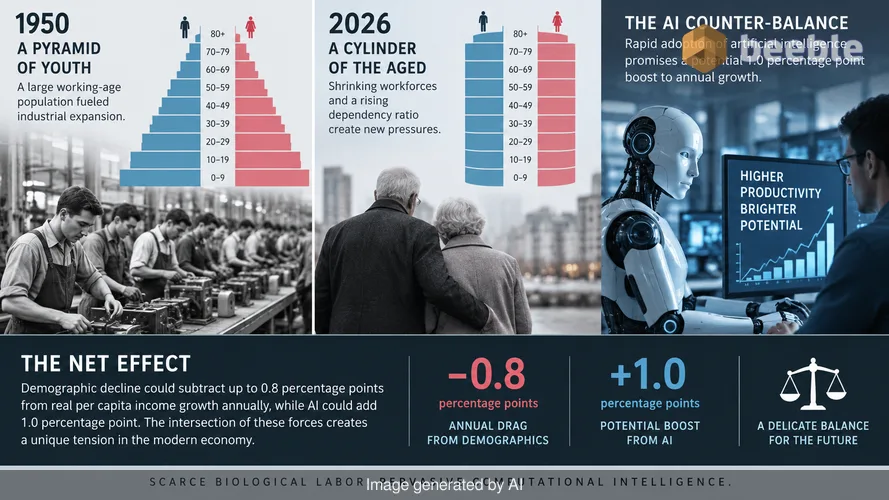
A century ago, the social contract relied on a pyramid of youth; today, that structure has inverted into a precarious cylinder of the aged. In the middle of the twentieth century, the average OECD nation possessed a vast reservoir of young labor to fuel industrial expansion; by 2026, the demographic reality consists of shrinking workforces and a rising dependency ratio. This systemic shift threatens to subtract up to 0.8 percentage points from real per capita income growth every year. Paradoxically, the rapid adoption of artificial intelligence promises a counter-balance of one percentage point in growth annually; the intersection of these two forces creates a unique tension in the modern economy. We are witnessing a transition where biological labor becomes scarce while computational intelligence becomes pervasive.
The archipelago of the silver years
In a small apartment in a Seoul high-rise, an eighty-year-old man named Min-jun speaks to a sleek device on his nightstand. He asks it for the weather, his medication schedule, and a summary of the morning news. The device responds with a voice that mimics the cadence of a human friend. Min-jun is part of what sociologists call an atomized society. He lives in a densely populated city, yet his daily interactions are almost entirely digital or transactional. The traditional family structure that once provided a safety net for the elderly has fragmented into a collection of individuals living in separate geographical nodes. Linguistically speaking, the word "care" has shifted from a verb describing a communal duty to a noun describing a service sector product.
Behind the scenes of this trend, the architecture of the modern city functions as a theater stage for a play with fewer and fewer actors. In the hallways of hospitals and the aisles of grocery stores, the absence of young workers is visceral. The labor shortage is no longer a theoretical economic concept. It is a tangible reality that affects the speed of emergency room triage and the availability of public transport. Through this lens, we see a society that is literally running out of people to maintain its own momentum. The demographic drag is a silent force that pulls at the edges of national budgets and social security systems.
Liquid modernity and the algorithmic anchor
Zygmunt Bauman described our current era as liquid modernity, a state where social forms melt faster than the time it takes to cast them. In this environment, the habits of the elderly often feel like an anchor in a sea of systemic chaos. However, as the workforce ages, the traditional habitus of the labor market begins to fail. The skills and dispositions that once drove growth are less effective in a world that demands rapid digital adaptation. This is where artificial intelligence enters the social fabric. It is an attempt to automate the routine and the mundane so that a smaller population can still enjoy a high standard of living.
Historically, economic growth depended on the number of hands in the factory. As the number of hands decreases, we look to the silicon chip to provide the missing output. The OECD data suggests that AI adoption could mirror the trajectory of the internet in the late 1990s. If this holds true, the productivity gains will be substantial. The interaction between a shrinking population and a booming AI sector is the great experiment of the 2020s. We do not yet know if a society of retirees and algorithms can maintain the cultural vibrancy of a society of young creators. The systemic pressure to adopt AI is not just about profit; it is about survival in a world with too few workers.
The semantics of the automated assistant
Language is an archaeological site where every new term reveals a layer of cultural change. We now speak of "algorithmic empathy" and "robotic companionship" without irony. These phrases represent a profound shift in our collective understanding of human connection. When we replace a human caregiver with a digital interface, we change the discourse of aging. The experience of growing old becomes a series of data points to be optimized. We track sleep cycles, heart rate variability, and step counts. We treat the human body like a machine that requires predictive maintenance.
This philological shift is symptomatic of a larger movement toward the quantification of life. In an atomized society, data is the only thing that connects the individual to the collective. The elderly are no longer the keepers of tradition; they are the subjects of remote monitoring. This transformation has a visceral impact on the daily routine. A morning walk is no longer just a walk. It is a contribution to a health database. The mundane activities of life are now integrated into the attention economy, even for those who are no longer part of the formal workforce.
A comparative look at the demographic and technological shift
The following table outlines the diverging paths of demographic decline and technological acceleration in contemporary society.
| Factor | Population Ageing Trend | AI Adoption Trend |
|---|---|---|
| Economic Impact | -0.8% growth per year | +1.0% growth per year |
| Primary Resource | Biological labor | Computational power |
| Social Structure | Atomized/Fragmented | Interconnected/Data-driven |
| Labor Market | Shortages and skill gaps | Automation of routine tasks |
| Cultural Narrative | Nostalgia and decline | Innovation and efficiency |
Essentially, the two trends operate in opposite directions. Ageing acts as a brake on the economy, while AI acts as an accelerator. The net result is a fragile equilibrium. In practice, this means that the standard of living might remain stable even as the streets grow quieter. However, this stability comes at a cost. The social fabric becomes thinner as we delegate human interaction to machines. We are building a world that is efficient but increasingly opaque to those who live in it.
The paradox of the modern city
On an individual level, the rise of AI in an ageing society creates a strange paradox. We are more connected to information than ever, yet we are more isolated from each other. An elderly woman in London can use AI to translate a letter from her grandson in Tokyo instantly. At the same time, she might not know the name of the neighbor who lives three feet away through a shared wall. The digital communication we rely on is a fast-food diet for the soul. It is quick and accessible, but it lacks the deep emotional nutrition of a face-to-face conversation in a third place.
Zooming out, we see that the disappearance of community spaces is linked to the rise of the digital assistant. When an algorithm can order your groceries and manage your appointments, the need to step out into the public square diminishes. The city becomes an archipelago of private spaces connected by delivery routes and fiber-optic cables. This atomization is the hidden price of technological efficiency. We gain a percentage point in GDP, but we lose a degree of social cohesion. The trade-off is often transparent until the moment we realize we are lonely.
Reclaiming the human routine
Ultimately, the interaction between AI and ageing societies is not just an economic puzzle. It is a sociological challenge that requires us to rethink the value of the human experience. We must ask ourselves if a boost in income is worth the erosion of our communal bonds. As the population continues to age, the temptation to automate everything will grow. We will see AI doctors, AI therapists, and AI friends. These tools are useful, but they are not replacements for the visceral presence of another person.
We should observe our daily routines and identify the moments where we have traded human connection for algorithmic convenience. Perhaps we can choose the longer line at the market to speak with a cashier. We might decide to visit an elderly relative in person rather than sending a programmed greeting. The future of an ageing society depends on our ability to integrate technology without losing our humanity. We must ensure that the algorithms serve the people, rather than the people serving the optimization of the algorithms. By being mindful of these systemic shifts, we can navigate the next decade with both economic resilience and social depth.
Sources
- OECD Employment Outlook 2024: The Digital Transformation and the Ageing Workforce.
- Bauman, Z. (2000). Liquid Modernity. Polity Press.
- Bourdieu, P. (1977). Outline of a Theory of Practice. Cambridge University Press.
- World Economic Forum. (2025). The Future of Jobs Report.
- United Nations Department of Economic and Social Affairs. (2023). World Social Report: Leaving No One Behind in an Ageing World.



See you on the other side.
Our end-to-end encrypted email and cloud storage solution provides the most powerful means of secure data exchange, ensuring the safety and privacy of your data.
/ Create a free account
