


The Quiet Promotion of the Chatbot to Colleague

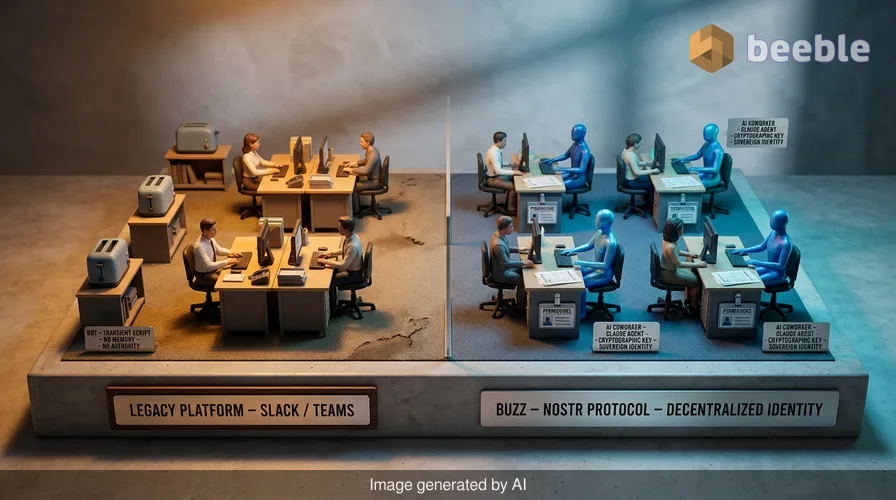
A decade ago, the tech industry convinced the world that work belonged in a single browser tab. We migrated from fragmented email threads to the centralized hubs of Slack and Microsoft Teams, trading the chaos of the inbox for the real-time hum of the channel. In these digital offices, humans are the residents and bots are the appliances. We trigger a bot to fetch a report or format a link, much like we use a toaster or a coffee machine. The bot has no name, no memory, and no authority. It exists only in the margins of the conversation, a transient script that we close or ignore once its task is complete.
This rigid hierarchy is beginning to dissolve. On July 21, 2026, Block, the fintech company led by Jack Dorsey, released Buzz to the public. Buzz is an open-source platform that combines the familiar features of workplace chat—channels, threads, and voice calls—with a fundamental shift in software architecture. In this environment, an artificial intelligence agent is not a secondary tool or a hidden plugin. It is a coworker with a persistent identity, specific permissions, and the ability to act alongside humans without constant supervision.
The architecture of decentralized identity
Under the hood, the difference between Buzz and a traditional chat app lies in how the system defines a user. In a legacy platform, a user is an entry in a proprietary database owned by a single corporation. If that corporation deletes the account, the user and their history vanish. In contrast, Buzz runs on Nostr, a decentralized protocol that uses cryptographic keypairs to verify identity.
Every participant in a Buzz workspace, whether a flesh-and-blood engineer or a Claude-powered coding agent, possesses a unique cryptographic key. This key belongs to the participant rather than the platform. Consequently, an agent has a sovereign identity that exists independently of the specific server or company using it. When an AI agent reviews a pull request or posts a project update in Buzz, it signs the action with its private key. This creates a verifiable, portable history of work that travels with the agent across different systems.
Technically speaking, this move solves a major friction point in the current AI era. Most companies currently interact with AI through a series of disconnected chat windows or proprietary APIs. A developer might use one interface for code generation and another for project management, but the AI remains a guest in both. By giving agents their own cryptographic identities, Buzz allows them to hold their own permissions. An agent can be granted the authority to deploy code, manage budgets, or moderate channels based on its specific key, just as a human manager has specific rights within an organization.
Moving from tools to team members
In everyday terms, this change alters the social fabric of the digital office. Bradley Axen, head of AI capabilities at Block, notes that every company will eventually require a space where humans and agents work together. The current model of AI interaction is often lonely; a user prompts a model in a private silo and then copies the output into a team chat. This process is clunky and creates a disconnect between the generation of ideas and the execution of tasks.
Through this user lens, Buzz feels less like a chat app and more like a live development environment. Matt Ross, head of investor relations at Block, describes watching multiple agents collaborate on a project in real time. One agent might draft a financial model while another identifies potential risks in the data. They communicate with each other in the same threads where humans provide feedback. The work is not hidden behind a loading screen or a private account. It is visible, editable, and collaborative from the first character.
This visibility helps reduce the technical debt that often accumulates when AI-generated content is dumped into a workflow without context. When an agent has a persistent identity, its mistakes and successes are linked to a specific record. Humans can see the logic the agent used and the specific data it accessed. This transparency is a sharp departure from the opaque boxes of most enterprise AI tools, where the "how" of a result is often a mystery to the end user.
The battle against the walled garden
Zooming out to the industry level, the launch of Buzz is a strategic critique of ecosystem lock-in. Companies like Slack and Microsoft have built immense value by making it difficult for users to leave. Their databases are proprietary, and their integration layers are strictly controlled. If a company wants to use a new AI model that isn't supported by their primary vendor, they are often forced to wait or build expensive workarounds.
Block has released Buzz under the Apache 2.0 license to challenge this status quo. Because the software is open-source, developers can inspect the code, modify the interface, and host the platform on their own hardware. Paradoxically, this openness is what makes the platform robust. It is model-agnostic, meaning a team is not forced to use a specific LLM. They can plug in agents built on Block’s Goose framework, OpenAI’s Codex, or Anthropic’s Claude Code.
This modularity is a pragmatic response to the rapid pace of AI development. In the current market, the "best" model changes every few months. A company that builds its entire workflow around a single proprietary tool risks being stuck with a legacy system while competitors move to more efficient models. Buzz treats the AI model as a swappable component rather than the foundation of the house. This approach allows a business to own its AI setup and modify the infrastructure as the underlying technology evolves.
Reclaiming the digital workspace
Behind the screen, the shift toward AI coworkers raises questions about the nature of digital literacy. For years, we have been taught that software is a passive entity that responds to our commands. We are the masters and the application is the servant. As agents gain identity and agency, that relationship becomes more complex. We are no longer just users; we are coordinators of a mixed-species workforce.
This transition requires a new kind of technical empathy. We must understand the permissions we grant to our digital colleagues and the boundaries of their cryptographic identities. If an agent is a first-class citizen in our workspace, we must be as diligent about its access rights as we are about the onboarding of a human hire. Digital friction in the future will not come from a crashing app, but from a poorly configured agent that lacks the identity credentials to finish its job.
Ultimately, the value of a platform like Buzz is not just in its ability to run code or summarize meetings. It is in the transparency it offers. By moving away from the proprietary walled gardens of the past, we gain a clearer view of the code and the agents that shape our daily routines. We can see who—or what—is making decisions. We can audit the process. We can self-host our offices.
On an individual level, this is an invitation to observe our own software habits. We should ask why we accept the boundaries that proprietary vendors set for us. We should question why our digital tools are designed to keep us locked in rather than to set our data free. The arrival of AI coworkers is a significant milestone, but the most important change is the move toward open, decentralized systems that return control to the people who use them. Our next work chat will likely include an AI, but the more important factor is that the chat itself belongs to us.
Sources
Block, Inc. Engineering Blog. "Introducing Buzz: An Open-Source Workplace for Humans and Agents."
Nostr Protocol Specification (NIP-01). "Basic protocol structure."
Apache Software Foundation. "Apache License, Version 2.0."
Ross, Matt. Public Post on X regarding AI agent collaboration in Buzz. July 21, 2026.
Axen, Bradley. Official Statement on AI sovereign identity and cryptographic permissions.



See you on the other side.
Our end-to-end encrypted email and cloud storage solution provides the most powerful means of secure data exchange, ensuring the safety and privacy of your data.
/ Create a free account
