


The Search Box is Dying and Taking the Old Internet With It

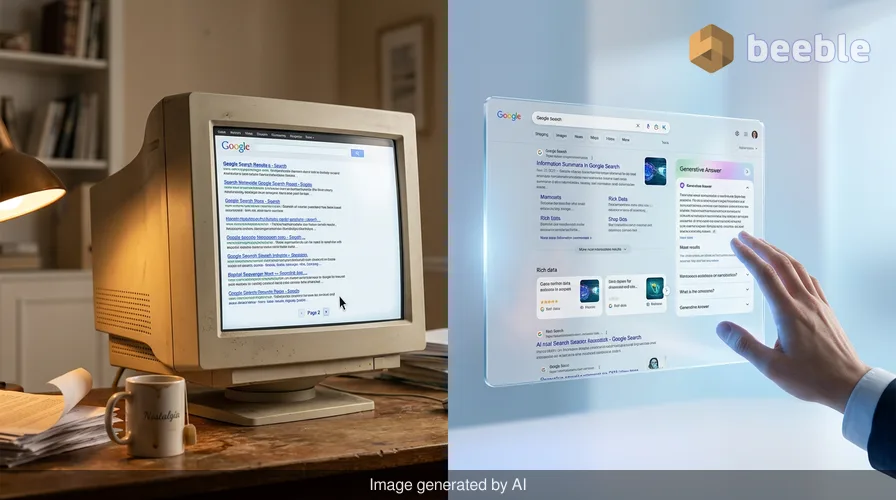
When was the last time you actually scrolled to the bottom of a Google search results page, let alone clicked over to 'Page 2'? For most of us, that behavior already feels like a relic of a bygone era. We have spent two decades training ourselves to speak in 'keywordese'—clunky strings of words like 'best lightweight tent waterproof under 200'—hoping the algorithm would point us toward a website that might have the answer. But that era of the digital scavenger hunt is officially coming to an end.
Following the latest developments at Google I/O, it is clear that the company is no longer interested in being a simple directory of the world’s information. Instead, Google is pivoting to become a doer. The familiar list of ten blue links is being swallowed by a new, interactive interface that doesn't just find information but processes and presents it in custom-built layouts.
Looking at the big picture, we are witnessing the transformation of the search engine from a digital phonebook into an omnipresent research librarian. This librarian doesn't just tell you which shelf the book is on; they pull the book, read the relevant chapters, and present you with a handwritten summary, a custom chart, and a plan for what to do next. For the average user, the web is about to become much faster, but for the people who actually build the web, the ground is shifting in a way that feels both disruptive and foundational.
Behind the Jargon: How 'Generative UI' Changes Your Screen
Under the hood, the most significant shift isn't just that Google is using AI to answer questions, but how it displays those answers. Traditionally, Google had a static layout. You searched for a product, and you got a list of products. You searched for a flight, and you got a flight widget. Now, Google is introducing something called 'Generative UI.'
In simple terms, this means the search results page doesn't exist until you ask a question. Using a new, high-speed model called Gemini Flash 3.5, Google’s system can build custom widgets, interactive visuals, and data tables on the fly. If you ask a complex question about the physics of a black hole, you won't just get a paragraph of text; you might get an interactive 3D model that you can manipulate.
This is a scalable approach to information. Rather than forcing every user through the same narrow door, the interface expands to accommodate the query. From a consumer standpoint, this is incredibly user-friendly. It removes the 'middleman' of the click. You no longer have to visit three different blogs to compare the specs of two different smartphones; Google will build a side-by-side comparison table for you, synthesized from those sources, right there in the search box.
The Rise of the Tireless Digital Intern
Perhaps the most radical change is the introduction of 'information agents.' Historically, searching was a 'one-and-done' interaction. You searched, you found (or didn't), and you moved on. If you wanted to keep track of a changing situation—like the price of a stock or the availability of a specific house for sale—you had to keep coming back and hitting refresh.
Google is now allowing users to dispatch agents powered by a platform called Antigravity. Think of these as tireless interns that live inside your search engine. These agents can work in the background 24/7. Practically speaking, this means you can set an agent to monitor a specific sector of the market. You could tell it, 'Alert me if the price of copper drops by more than 5% and then summarize the three most likely reasons why based on recent news.'
These agents aren't just looking for keywords; they are looking for context. They can map out a monitoring plan, access real-time financial data, and provide a synthesized update. This moves search from a reactive tool to a proactive one. We are moving toward a world where 'searching the web' is something your AI does for you while you are asleep.
Personalized Mini-Apps: Searching as an Action
To put it another way, Google is trying to bridge the gap between knowing something and doing something. A major part of this overhaul involves letting users build their own 'mini-apps' within the search experience using natural language.
Imagine you want to plan your meals for the week based on your fitness goals and what’s already in your fridge. In the old world, you’d search for recipes, manually check your calendar to see when you have time to cook, and write a grocery list in a separate app. In the new system, you can build a temporary, stateful app directly in Search. You tell Google, 'Create a meal plan for my Tuesday and Thursday gym days using my Google Calendar and these high-protein recipes I found.'
This experience is persistent and stateful, meaning you can return to it day after day. It creates a robust bridge between the vast ocean of data on the internet and the small, personal pond of your daily life. It is an intuitive shift, but it also means we will spend significantly less time in other apps or on other websites.
The Hidden Cost to the Digital Ecosystem
While these features are a win for convenience, they present a systemic challenge to the way the internet is funded. For twenty years, there has been an unspoken contract: creators provide free information, and Google provides them with traffic in exchange. If Google’s AI now reads those websites and summarizes them so perfectly that the user never needs to click, that contract is broken.
Ultimately, this could further decimate the publishing industry. We have already seen a volatile decline in referrals for ad-dependent news and lifestyle sites. When 'information agents' and AI Overviews become the primary way people consume content, the incentive to create that content in the first place begins to evaporate.
Curiously, this creates a paradox. If the AI learns by reading the web, but the AI's presence kills the websites it learns from, where does the new information come from five years from now? This is a question Google is still attempting to answer, often by emphasizing that they still provide links within the AI summaries. However, for the average user, those links are increasingly becoming an afterthought.
Practical Implications: What This Means for You
So, how should you navigate this new landscape? Practically speaking, there are three main areas where your digital habits will likely change:
- Query Nuance Matters: You no longer need to speak in keywords. The more detail you give the new search box, the better the Generative UI can build a solution for you. Instead of 'Italy travel,' try 'Plan a 10-day trip to Northern Italy for a family of four that avoids tourist traps and stays under a $5,000 budget, including travel times between cities.'
- Privacy vs. Utility: To use 'information agents' or mini-apps effectively, you will need to grant Google more access to your personal data—your calendar, your emails, and your preferences. You will have to decide if the convenience of a personalized fitness app is worth the trade-off of more centralized data.
- The Accuracy Filter: AI agents are still prone to occasional hallucinations. While Gemini Flash 3.5 is faster and more capable, it is essential to treat AI-generated summaries as a first draft. For high-stakes decisions—like medical advice or major financial moves—always use the provided links to verify the source material.
The Bottom Line
Google is betting that we are ready to stop 'searching' and start 'finding.' By integrating agents that monitor the web and a UI that builds itself on the fly, they are creating a streamlined, frictionless experience that feels like something out of science fiction.
Zooming out, this is the most disruptive change to the internet's gateway in a generation. It suggests a future where the web is decentralized in terms of where information comes from, but highly centralized in terms of how we consume it. The era of the ten blue links was about exploration; the era of the AI agent is about efficiency.
As these tools roll out this summer—starting with a free rollout for search and moving to specialized features for Pro subscribers—take a moment to observe your own habits. You might find that the 'search' part of your day is slowly being replaced by 'action.' The internet isn't going away, but the way we see it is being completely reimagined by the very box that introduced us to it in the first place.
Sources:
- Google I/O 2026 Keynote Presentation and Official Press Briefing.
- Google DeepMind: Technical Specifications for Gemini Flash 3.5.
- Industry Analysis Report: The Impact of AI Overviews on Digital Publisher Referrals (Q1 2026).
- Google Antigravity Developer Documentation: Agentic Capabilities in Search.



See you on the other side.
Our end-to-end encrypted email and cloud storage solution provides the most powerful means of secure data exchange, ensuring the safety and privacy of your data.
/ Create a free account
