


The silent departure of the digital tether in French schools and the recovery of the shared gaze

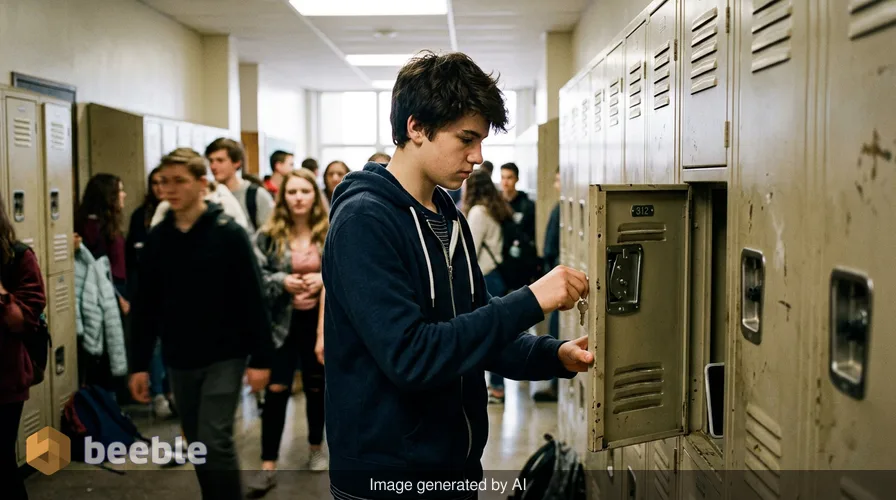
A teenage boy in a Parisian lycée stands before a row of lockers on a Tuesday morning. He performs a ritual that was once unthinkable for his generation. He silences his device, places it inside a small metal compartment, and turns the key. For the next eight hours, his world is limited to the physical radius of his reach. This scene is the new reality for students across France. Government spokesperson Maud Bregeon confirmed that the nationwide ban on mobile phones in high schools is now active for the new term. This decision, backed by President Emmanuel Macron, follows a period of legislative refinement after the Constitutional Council reviewed the text. The law aims to reclaim the classroom from the pervasive grip of the attention economy.
In the past, the schoolyard was a training ground for the unpredictable friction of human proximity; today, it is a collection of individual silos shielded by glass screens. Formerly, conflict required immediate, face-to-face resolution; now, it manifests as ephemeral digital whispers that bypass the physical room. The playground once functioned as a chaotic laboratory for human interaction; it has become a fragmented archipelago of private digital experiences. This shift in the French education system is a systemic attempt to reverse the atomization of the youth experience. By removing the device, the state is not just regulating a gadget. It is attempting to restore a lost habitus of presence.
The legislative architecture of the digital pause
The implementation of this ban is a calculated move within a stabilized legal framework. While the ban on social networks for those under fifteen was temporarily struck down by the Constitutional Council, the phone ban itself survived the legal scrutiny. Maud Bregeon noted that the government chose to enact the validated portions of the law to ensure immediate application for the new school year. The law allows for specific exceptions. Students in preparatory classes for the grandes écoles or those requiring devices for documented educational needs retain limited access.
Behind the scenes of this trend, the government is responding to a visceral concern among parents and educators. The constant presence of the smartphone has changed the nature of the French school day. It is no longer a discrete period of learning but a porous experience where the outside world constantly intrudes. Prime Minister Sébastien Lecornu is already preparing a revised text to address the social media ban for minors, signaling that the phone ban is only the first layer of a broader cultural intervention.
Zooming out to the sociology of the screen
On a macro level, the smartphone is an anchor in the storm of liquid modernity. Zygmunt Bauman described our era as one where social forms melt before they can set. In this environment, the phone provides a sense of constancy. For a teenager, the device is a portable identity. It is where their social capital is stored and where their status is measured. When the state removes this device, it forces the student to confront the mundane reality of the physical present. This experience is often uncomfortable because it lacks the dopamine-rich feedback loop of the algorithm.
Culturally speaking, the ban addresses the problem of the attention economy. In this system, human focus is the primary commodity. By allowing phones in schools, the educational system was essentially allowing third-party corporations to compete with teachers for the student's mind. The school, which was once a sacred space for deep discourse, became a hall of mirrors where students reflected the biases of their own curated feeds. The ban seeks to break these mirrors and force a return to a collective, shared reality.
The philological shift in the playground
Linguistically speaking, the presence of phones has altered how students communicate. In my observations of public spaces, I have noticed that the vocabulary of the young is becoming increasingly influenced by the clinical language of digital platforms. Their speech is often a series of shorthand references to viral memes or ephemeral trends. To put it another way, their language is an archaeological site where the top layer is composed entirely of digital debris. When students are forced to speak without the aid of a screen to show a video or a photo, they must rely on the descriptive power of words.
This recovery of language is a byproduct of the ban. Without the ability to simply point at a screen, a student must explain a feeling or narrate an event. This process builds the cognitive muscles required for complex thought. The digital diet of quick, accessible information is like fast food; it is convenient but it lacks deep emotional nutrition. The classroom, freed from the device, becomes a space where the slow work of semantic development can occur without the distraction of a notification.
Atomization and the search for the third place
On an individual level, the ban highlights the disappearance of the school as a third place. Sociologist Ray Oldenburg defined the third place as a social environment separate from the home and the workplace. For a student, the school was historically this space. However, when every student is looking at their own screen, the communal nature of the space vanishes. They are physically together but psychologically atomized. They inhabit a shared room while remaining locked in private digital corridors.
Paradoxically, the removal of the phone may increase anxiety in the short term. For many, the device is a coping mechanism for social awkwardness. It provides a shield. If a conversation becomes difficult, a student can simply look down. Without that shield, they must navigate the visceral reality of eye contact and body language. This is where the real learning happens. The school becomes a theater stage again, where students must perform their identities in real-time rather than through a filtered profile.
Beyond the classroom walls
The French government is aware that a school ban is a localized solution to a systemic problem. The pervasive nature of technology means that the moment the final bell rings, students return to the archipelago of their screens. Consequently, the ban is a symbolic gesture as much as a practical one. It establishes the school as a zone of exception—a place where the rules of the attention economy do not apply. This creates a friction between the digital world and the physical world that is necessary for critical thinking.
Ultimately, the success of this measure depends on how students and teachers fill the silence left by the devices. If the school provides no meaningful engagement, the ban will be seen as a mere restriction. If the school uses this space to foster deep discourse and physical play, it will be a liberation. The ban is a structural change that allows for a new social contract to be written within the walls of the lycée.
Food for thought
As this new term begins, the French experiment offers a moment for reflection on our own relationship with technology. We might consider how our own daily routines are anchored by the devices in our pockets.
- Observe how often you use your phone as a shield to avoid a mundane interaction with a stranger.
- Question whether your social circle is a community or an archipelago of isolated individuals connected by an app.
- Reflect on the last time you engaged in a conversation that lasted an hour without a single digital interruption.
- Reclaim a small part of your day where you are completely unavailable to the digital world.
France has decided that the education of its youth requires a return to presence. This policy is a reminder that while technology is a tool, our humanity is defined by the quality of our attention. The return of the shared gaze in the classroom is a small but resonant step toward a more connected, less atomized society.
Sources
- Bauman, Z. (2000). Liquid Modernity. Polity Press.
- Bourdieu, P. (1977). Outline of a Theory of Practice. Cambridge University Press.
- Official Statement of the French Government Spokesperson, Maud Bregeon, August 2026.
- Constitutional Council of the French Republic, Decision on the Law for the Protection of Minors in the Digital Space, 2026.
- Oldenburg, R. (1989). The Great Good Place. Marlowe & Company.



See you on the other side.
Our end-to-end encrypted email and cloud storage solution provides the most powerful means of secure data exchange, ensuring the safety and privacy of your data.
/ Create a free account
