


The Silent Erosion of the Apprentice: Why Remote Work Is Closing the Door on a New Generation

In 2019, the entry-level job was a rite of passage—a messy, vibrant initiation into the collective 'habitus' of the professional world; by 2026, it has become a logistical liability—a data point on a balance sheet that many firms are simply choosing to delete. For years, we have been told a convenient, almost cinematic story about our replacement by silicon and code. We watched with a mix of awe and dread as large language models began to draft memos and debug scripts, assuming that the disappearance of the 'Junior Analyst' or the 'Associate Developer' was the inevitable result of an algorithmic coup. Yet, as we stand in the mid-point of this decade, a more nuanced and unsettling truth is emerging from the data: the primary architect of the entry-level hiring crisis isn't a generative AI sitting in a server farm, but the empty office chair sitting in a suburban bedroom.
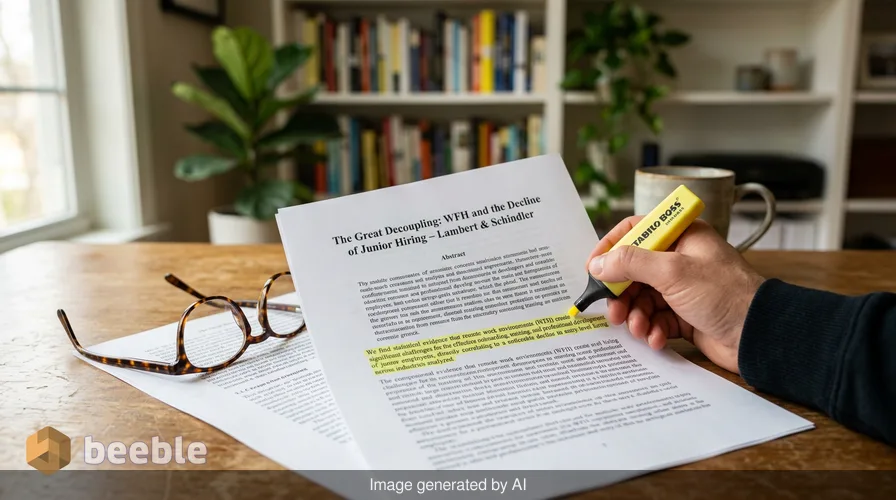
Recent research from Peter John Lambert of the London School of Economics and Yannick Schindler of the Ellison Institute of Technology has stripped away the techno-deterministic mask. By analyzing hundreds of millions of resumes and job postings across the US, UK, Canada, and Australia, they found that while AI is certainly a factor, the shift toward work-from-home (WFH) is a much more pervasive predictor of the decline in junior hiring. Zooming out, we see a systemic restructuring of the labor market—one where the convenience of the veteran worker has inadvertently become the gatekeeper for the novice.
The Myth of the Silicon Thief
There is a certain comfort in blaming technology for social upheaval; it allows us to view progress as an external force of nature rather than a series of human choices. When CEOs like Dario Amodei or Demis Hassabis warn of AI wiping out white-collar roles, they are describing a future that feels both inevitable and beyond our immediate control. Paradoxically, this narrative has blinded us to the structural changes happening in our physical (and digital) environments. The Lambert and Schindler study highlights a crucial overlap: the very jobs most 'exposed' to AI—consulting, accounting, data science—are the same jobs most likely to be performed remotely.
When the researchers isolated these variables, the 'AI effect' often vanished into statistical insignificance; in contrast, the 'WFH effect' remained robust and undeniable. It appears that our collective obsession with the robot in the room has distracted us from the silence of the office. Historically, the entry-level role was never just about 'output'; it was a long-term investment in human capital. In an atomized, remote-first world, that investment is increasingly seen as too expensive to maintain.
The Cost of Supervision in an Atomized World
In everyday terms, a junior employee is a sponge—a person whose primary value lies in their ability to absorb the unwritten rules of a profession through proximity. But proximity is exactly what the remote revolution has sacrificed. On a macro level, WFH has raised the cost of monitoring and mentoring to a point that many organizations find unsustainable. To put it another way: it is easy to guide a struggling new hire when you can see the frustration on their face at the desk next to yours; it is infinitely harder to manage that same frustration through the opaque barrier of a Slack status or a scheduled Zoom call.
From a sociological standpoint, we are witnessing the breakdown of professional 'enculturation.' When a workplace becomes an archipelago—a collection of isolated individuals connected only by ephemeral digital threads—the 'connective tissue' of mentorship begins to tear. The researchers estimate that by 2025, occupations with high remote-work exposure saw a 4-to-5 percentage point larger decline in junior hiring than their office-bound counterparts. This isn't a technological failure; it is an organizational friction. Companies are not necessarily replacing young people with AI; they are simply refusing to hire them because they no longer know how to train them.
The Linguistic Shift of the 'Junior' Role
Linguistically speaking, the word 'junior' has undergone a profound semantic shift. It once denoted a stage of growth—a period of protected learning. Today, in many job descriptions, it has been surreptitiously replaced by 'entry-level' requirements that demand two years of experience and mastery of five different software suites. This is a coping mechanism for a system that no longer has the patience for the mundane reality of teaching. Behind the scenes of this trend, the 'junior' has been transformed from a trainee into a 'task-unit.'
If a task can be automated, AI gets the job. If it can’t be automated but requires heavy supervision, the job simply isn't posted. Consequently, the US entry-level hiring market has contracted by a staggering 29% compared to pre-pandemic levels. This fragmented labor market reflects a broader 'liquid modernity,' where the long-term stability of the corporate-individual bond is dissolved in favor of short-term, low-friction transactions. The junior employee, requiring high friction and high investment, no longer fits the model.
The Vanishing Third Place of Professional Growth
We often talk about the loss of 'third places'—the cafes and libraries that keep our communities from becoming completely atomized—but we rarely discuss the loss of the office as a site of social stratification and learning. In the physical office, a junior employee learns through 'peripheral participation.' They overhear a difficult negotiation; they watch a senior partner handle a crisis; they absorb the professional 'habitus' by osmosis.
In the digital realm, every interaction is intentional. There is no 'overhearing' on a Microsoft Teams call. There is no 'casual observation' in a Jira ticket. As a result, the learning curve has become a vertical cliff. For a senior worker, the lack of interruptions is a productivity boon; for a junior worker, that same lack of interruptions is a professional death sentence. We have optimized for the efficiency of the individual at the expense of the resilience of the collective.
AI as the Scapegoat for Management Failure
Curiously, the AI narrative serves as a convenient 'cultural anesthetic.' If we believe that junior jobs are disappearing because of 'unstoppable technological progress,' then no one is to blame. Not the managers who find it too bothersome to mentor via webcam, and not the executives who prioritize immediate cost-savings over the future talent pipeline.
But the data suggests a different story. AI is currently being used to automate 'grunt work'—the very tasks that used to be the training ground for juniors. In a healthy system, this would push young workers into higher-level responsibilities earlier. In our current, remote-heavy system, it is simply being used as an excuse to trim the headcount. The 'junior squeeze' is symptomatic of a deeper refusal to engage with the visceral, often messy process of human development in a digital-first environment.
Reframing the Junior Proposition
Ultimately, the issue isn't that AI is too smart; it’s that our current remote-work structures are too rigid. If we continue down this path, we risk creating a 'lost generation' of white-collar workers—people who have the degrees but lack the professional intuition that only comes from shared space and collective experience. The unemployment rate for recent college graduates (5.7%) already exceeds the general average (4.2%), a clear signal that the entry-level engine is stalling.
To fix this, companies may need to rethink the 'remote-at-all-costs' mantra for their most vulnerable cohorts. Paradoxically, the solution to the AI threat might be a return to the most ancient form of human learning: the apprenticeship. This requires a shift in perspective—from seeing a junior hire as a cost-center to seeing them as a vital part of a firm's long-term survival.
Food for Thought: Questions for the Modern Professional
As we navigate this shifting landscape, we must ask ourselves how we can reclaim the human element of work in an increasingly digital world. Consider these reflections on your own daily routine:
- The Mentorship Gap: If you are a senior professional working remotely, when was the last time you invited a junior colleague to 'lurk' on a call or a project, not to contribute, but simply to observe the process?
- The Office as a Tool: Instead of viewing the office as a place of mandatory attendance, can we view it as a high-value 'learning lab' specifically designed for those in the first five years of their careers?
- Language of Growth: Are our job descriptions reflecting a desire for talent to grow, or are we seeking 'pre-packaged' experts because we’ve lost the infrastructure to train them?
- The Human Edge: In a world where AI can mimic the 'what' of a job, how are we teaching the 'how' and the 'why'—the subtle, social nuances that a machine can never replicate?
Our digital communication may be a 'fast-food diet'—quick, accessible, and efficient—but professional mastery requires the 'slow food' of human interaction. We must be careful not to let the convenience of our remote islands lead to the permanent isolation of the next generation.
Sources:
- Lambert, P. J., & Schindler, Y. (2024). The Impact of Remote Work and AI on the Junior Labor Market. London School of Economics / Ellison Institute of Technology.
- Revelio Labs. Workforce Dynamics and Resume Analysis Data (2017-2025).
- Lightcast. Global Job Posting Trends and Entry-Level Hiring Statistics.
- Federal Reserve Bank of New York. Labor Market for Recent College Graduates Report (Q1 2024/2026 update).
- Bauman, Z. (2000). Liquid Modernity. Polity Press.



See you on the other side.
Our end-to-end encrypted email and cloud storage solution provides the most powerful means of secure data exchange, ensuring the safety and privacy of your data.
/ Create a free account
