


The Silent Shift from Infinite Content to Verified Humanity

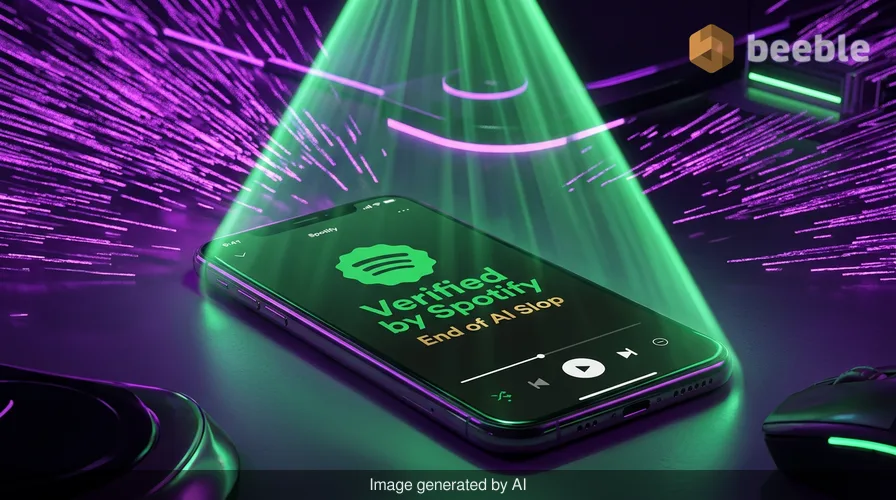
A few years ago, the promise of music streaming was its boundlessness. You could search for an obscure 1970s psych-rock band from Peru or a bedroom producer from Tokyo and find them in seconds. It was a digital library of Alexandria, seemingly infinite and always expanding. But lately, that experience has felt different. You search for a specific artist and find yourself wading through a sea of 'tribute' tracks, suspiciously generic lofi covers, and 'artist' profiles that seem to have been generated by a prompt rather than a person. This is the era of 'AI slop,' where the sheer volume of synthetic content threatens to drown out the very human artistry the platforms were built to celebrate.
Spotify’s recent introduction of the 'Verified by Spotify' badge—a green checkmark appearing next to names and in search results—is more than just a minor UI update; it is a profound admission that the era of 'more is better' has reached its breaking point. For years, the streaming industry focused on scale, priding itself on adding tens of thousands of tracks every day. Now, the priority has shifted from accumulation to curation. This badge represents a pivot away from the 'black box' of infinite content and toward a model where 'human-made' is a premium category that requires proof.
The Proof of Personhood: How Spotify Defines 'Human'
Technically speaking, distinguishing a human-composed melody from a high-quality AI generation by the audio alone is becoming a fool's errand. The math behind generative models has become too robust for a simple 'AI detector' to work reliably across millions of tracks. Instead of looking at the code within the audio file, Spotify is looking at the metadata of a life. To receive the 'Verified by Spotify' badge, an artist must show they exist outside the server. Spotify is searching for an identifiable presence both on and off the platform—concert dates, physical merch, and linked social accounts.
Zooming out to the industry level, this is a form of 'Proof of Personhood.' In a world where a generative model can churn out 10,000 songs an hour, the only thing it cannot do is play a live show at a local dive bar or sell a screen-printed t-shirt to a fan. By making these physical-world markers a requirement for verification, Spotify is essentially using the real world as a firewall. While an AI persona can be manufactured in minutes, a career—with its slow build, regional milestones, and sustained listener activity—cannot be easily faked. The badge isn't just validating the music; it is validating the history behind the music.
The End of Functional Music’s Free Ride
Curiously, Spotify is explicitly excluding what the industry calls 'functional music' from this new verification program. If you are a creator of white noise for sleeping, algorithm-optimized study beats, or generic background textures, you are likely out of luck. Historically, these creators were the darlings of the algorithm. They provided the 'lean-back' listening experiences that kept users on the platform for hours without requiring much royalty-payout friction.
Paradoxically, the very efficiency that made functional music successful is now its downfall. Because these tracks are designed for passive listening, they are the easiest for AI to replace. From a developer's standpoint, building a bot to generate 500 variations of 'Rain on a Tin Roof' is trivial. Spotify’s decision to prioritize artists with 'active fan interest' over background-noise creators is a strategic move to devalue content that lacks a human face. They are signaling that if a listener isn’t actively seeking you out by name, you aren't part of the 'core' musical ecosystem they want to protect.
Fighting the Fragmentation of the Stream
At its core, the rise of AI slop is a classic example of technical debt. For a decade, streaming platforms built their infrastructure to ingest as much data as possible, assuming that 'more' always equaled a better user experience. They didn't build robust guardrails against high-volume, low-quality automated uploads because, until recently, that wasn't a scalable threat. Now, with companies like Deezer reporting that AI-generated tracks represent 44% of new daily uploads, the debt has come due. The 'Verified' badge is an attempt to clean up a messy digital closet that has become too bloated to navigate.
We see this friction most clearly in the 'Artist Profile Protection' feature currently in beta. This tool allows human artists to review releases before they go live on their profiles—a necessary response to the growing problem of AI 'impersonators' who upload tracks using a famous artist's name to hijack their algorithmic traffic. Imagine a home renovation where you find that the original wiring was never meant to handle the load of modern appliances; Spotify is essentially rewiring its entire artist-attribution system while the house is still occupied by 600 million users.
The User Lens: Why Verification Matters to You
In everyday terms, these badges are a tool to help us navigate the 'digital friction' of the modern web. We have grown accustomed to the 'blue check' on social media as a symbol of celebrity or status, but Spotify's 'green check' serves a more pragmatic purpose: it is a trust signal. When you see that badge, the software is telling you, 'We have checked the receipts; a human actually worked on this.'
Through this user lens, we can see how our relationship with music is being forced to change. We can no longer take for granted that the voice we hear in our headphones belongs to a person with a story. Consequently, we are becoming more intentional about our listening. We are looking for the 'Career Milestones' section—another new feature Spotify is testing—to see if an artist has a touring history or a record of past releases. We are, perhaps for the first time in the digital age, demanding that our software prove the humanity of the content it serves us.
Reclaiming the Human Scale
Ultimately, Spotify’s verification program is a reactive measure in an ongoing arms race. As AI models become even more sophisticated, the markers of 'humanity' will likely need to become even more rigorous. Today, it’s a social media link and a tour date; tomorrow, it might require biometric verification or blockchain-based provenance of the recording process.
But for now, the green checkmark offers a moment of clarity. It reminds us that music is not just a 'content stream' to be optimized by an algorithm, but a form of communication between people. Software updates often feel like disruptions—home renovations that move the furniture when you aren't looking—but this specific shift feels necessary. It is an attempt to restore the 'intuitive' feeling of finding music you love without having to wonder if you’re being tricked by a bot.
As we navigate this new, verified landscape, it’s worth asking ourselves: what do we value more—the convenience of a perfectly tailored, infinite playlist, or the friction and flaws of a human artist’s career? Spotify has made its bet. By elevating the human over the functional, they are trying to ensure that their platform remains a place for culture, rather than just a storage unit for synthetic noise. As users, we can support this by looking past the algorithm and actively seeking out the artists who have done the hard work of being human.
Sources:
- Spotify for Artists: 'Introducing New Ways to Verify Artist Authenticity'
- Deezer Industry Insights: 'The Rise of AI-Generated Content in Global Streaming (2025 Report)'
- Sony Music Group: Statement on AI Copyright Infringement and Removal Requests
- GitHub Documentation: Metadata Standards for Digital Music Distribution (DDEX)
- International Federation of the Phonographic Industry (IFPI): 2026 State of the Music Industry Report



See you on the other side.
Our end-to-end encrypted email and cloud storage solution provides the most powerful means of secure data exchange, ensuring the safety and privacy of your data.
/ Create a free account
