


The silent shift toward a Linux handheld standard

The experience of handheld gaming is often a struggle between the hardware in your hands and the software on the screen. For years, the default choice for any portable PC was Windows. It was the safe choice for compatibility. It was also the primary source of digital friction. Anyone who has tried to navigate a Windows desktop on a seven-inch touchscreen knows the frustration of tiny icons, erratic updates, and battery drain. The hardware is ready for the future, but the operating system is a relic of the office cubicle. This weekend, Valve moved another step closer to solving that disconnect.
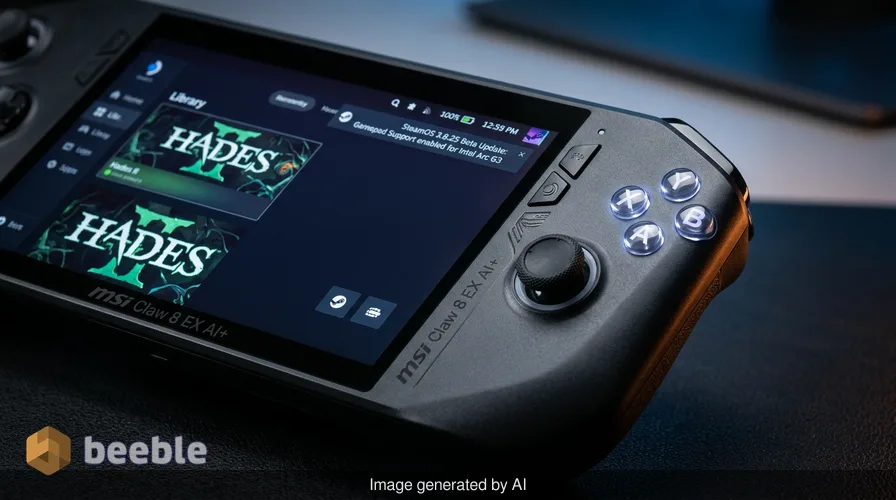
The release of the SteamOS 3.8.25 Beta marks a specific expansion of Valve’s Linux-based ecosystem. This update includes initial gamepad support for several new devices, most notably the MSI Claw 8 EX AI+. This device is a powerful handheld built on the Intel Arc G3 processor. While SteamOS has long supported AMD-based systems, this move into Intel territory is a significant technical milestone. It is a sign that the proprietary walls around handheld hardware are beginning to crumble.
The friction of a desktop on a handheld
In the early days of portable PC gaming, users accepted a compromise. We bought devices from GPD or OneXPlayer and spent hours tweaking Windows settings to make the experience bearable. We disabled background services; we installed third-party launchers; we prayed that a Windows Update would not break the custom controller drivers. The software was a bloated layer that stood between the player and the game. This was the era of the "handheld PC," a term that emphasized the computer over the console.
When the Steam Deck arrived, it changed the paradigm. It was not just about the hardware. It was about an operating system designed for a specific physical form factor. SteamOS treats the device like a console. It prioritizes the interface, the power management, and the input methods. Under the hood, it is a highly customized version of Arch Linux. For the average user, it is an invisible infrastructure that just works. The recent beta update shows that Valve is now willing to export that infrastructure to its competitors.
A slow march across fragmented hardware
Supporting a wide variety of hardware is a challenge for any software team. The handheld market is fragmented. Each manufacturer uses different screen panels, different battery controllers, and different button layouts. Historically, this fragmentation made it difficult for any non-Windows OS to gain a foothold. If the buttons do not work or the sleep mode fails, the device is a paperweight.
SteamOS 3.8.25 addresses these micro-level hardware details. It adds support for the controllers in the Ayaneo Pocket S2 and the Konkr Fit. It also improves support for the older MSI Claw models and the OneXPlayer line. These are not just minor bug fixes. They are the result of Valve reading dense developer documentation and writing custom drivers for hardware they do not sell. This is a pragmatic approach to building an ecosystem. Valve wants SteamOS to be the de facto platform for portable gaming, regardless of who makes the plastic shell.
Intel and the arc of compatibility
The most interesting part of this update is the focus on Intel. Most handhelds, including the Steam Deck, use AMD processors. AMD provides excellent Linux drivers, which made the initial development of SteamOS much easier. Intel is a different story. The Intel Arc G3 in the MSI Claw 8 EX AI+ is a relatively new architecture. Historically, Intel drivers on Linux lagged behind their Windows counterparts in gaming performance.
Valve is now closing that gap. By adding "initial gamepad support" for the MSI Claw 8 EX AI+, Valve signals that Intel chips are a first-class citizen in the SteamOS world. This is a shift in the software industry. Valve seeks to reduce its reliance on any single hardware partner; the engineering team develops the necessary translation layers to ensure Intel performance matches AMD. This work is difficult because it requires deep knowledge of how the Linux kernel interacts with the GPU. When it works, the user sees a seamless frame rate. When it fails, the game crashes to the desktop.
The infrastructure of a seamless experience
An operating system is a city's infrastructure. It is invisible when the traffic flows and the lights stay on. It becomes the only thing you notice when a water main bursts or a bridge closes for repair. For years, Windows was the burst water main of handheld gaming. It was a general-purpose tool forced into a specialized role. SteamOS is a specialized tool that is slowly becoming general enough to run on everything.
This update also includes a new Linux driver for the Steam Controller. This driver allows the controller to work with native applications even when the Steam client is not running. This is a welcome change for users who spend time in Desktop mode. Many power users use their handhelds for emulation or productivity. In the past, the controller would often lose its mapping if Steam closed. Now, the hardware is more resilient. It is a small change that reflects a larger philosophy: the software should support the user, not the other way around.
The business motive behind the code
Valve is not a charity. The company does not spend thousands of engineering hours on MSI Claw drivers out of the goodness of its heart. This is a strategic move to avoid ecosystem lock-in. If Windows is the only viable OS for handhelds, then Microsoft holds the keys to the kingdom. Microsoft can change its license fees, push unwanted ads into the UI, or prioritize its own Xbox Game Pass over the Steam store.
By making SteamOS available on the Lenovo Legion Go S and other devices, Valve creates a safe harbor. It is an open-source alternative that keeps the focus on the games. Paradoxically, Valve is using an open-source model to protect its proprietary store. This is a common pattern in the tech world. Google did it with Android to protect its search business. Valve is doing it with SteamOS to protect its game distribution business. The difference is that SteamOS actually improves the user experience for the person holding the device.
Technical debt and the legacy of Windows
Microsoft carries a massive amount of technical debt. Windows must support everything from a 1990s printer to a 2026 AI workstation. This legacy makes it difficult to trim the OS down for a handheld. SteamOS does not have this problem. It is built on a modular Linux foundation. Valve can strip away everything that is not related to gaming. This results in faster boot times, better sleep states, and more efficient use of system resources.
We see the results of this efficiency in the way SteamOS handles background processes. In Windows, a background update or a telemetry service can cause a sudden stutter in a game. In SteamOS, the game is the priority. The OS manages the hardware with an agile approach that Windows cannot match without a complete rewrite. Through this user lens, the MSI Claw 8 EX AI+ becomes a different device when it runs SteamOS. It feels less like a small computer and more like a dedicated gaming machine.
Reclaiming the hardware
The slow expansion of SteamOS is a win for digital literacy. It encourages users to think about the software that runs their lives. For a long time, we treated the OS as a permanent feature of the hardware. You bought a Windows laptop, and it stayed a Windows laptop until it died. Today, we are seeing a decoupling of hardware and software. You can buy a Lenovo or an MSI device and choose the environment that fits your needs.
This weekend’s beta update is a reminder that code is not static. It is a living set of instructions that can be improved, expanded, and shared. As Valve continues to support more non-Valve hardware, the definition of a "Steam machine" expands. It is no longer a specific box you buy from one company. It is a specific experience you can have on any device that is powerful enough to run the code. This shift puts the power back in the hands of the user. It allows us to reclaim the hardware we bought and run it the way we want.
Ultimately, the success of SteamOS on non-Valve hardware will depend on its stability. The 3.8.25 update is a beta for a reason. There will be bugs. There will be driver conflicts. But the trajectory is clear. The era of the monolithic Windows handheld is ending. In its place is a more fragmented, yet more flexible, world of Linux-powered portables.
Food for thought
- Observe how much of your interaction with a device is dictated by the OS rather than the app you are actually using.
- Reflect on the invisible friction in your daily digital life, such as menus that are too small or updates that interrupt your work.
- Question the necessity of a general-purpose operating system for specialized tasks like gaming or creative work.
- Consider the benefits of hardware that is not locked to a single proprietary software ecosystem.
Sources
- SteamOS 3.8.25 Beta Release Notes.
- Valve Developer Documentation for Steam Input.
- MSI Product Specifications for the Claw 8 EX AI+.
- Linux Kernel Mailing List (LKML) discussions on Intel Arc graphics drivers.
- Arch Linux Wiki documentation on SteamOS architecture.



See you on the other side.
Our end-to-end encrypted email and cloud storage solution provides the most powerful means of secure data exchange, ensuring the safety and privacy of your data.
/ Create a free account
