


The Silicon Stethoscope: Why AI Just Outperformed ER Physicians in a Landmark Harvard Study

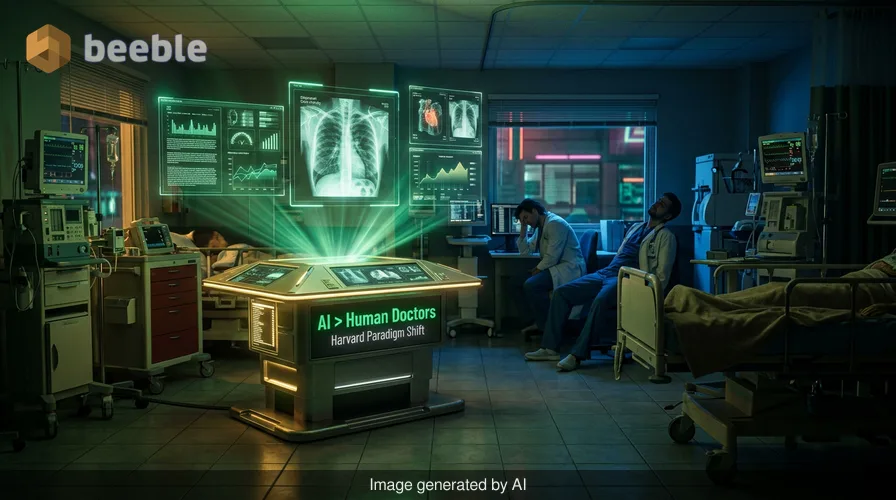
When you walk into an emergency room at 3:00 AM clutching your chest or nursing a persistent, localized pain, would you rather be seen by an exhausted resident on their fourteenth hour of a shift, or an algorithm that never sleeps? This isn't a hypothetical setup for a sci-fi novel; it is the central question raised by a groundbreaking study recently published by Harvard researchers. The findings are, to put it mildly, disruptive: a sophisticated AI model demonstrated a significantly higher degree of diagnostic accuracy than two experienced human doctors working in tandem.
As someone who grew up in a small town where medical resources were often spread thin, I’ve always been fascinated by the potential for technology to bridge the gap in healthcare quality. My academic background taught me to look past the flashy headlines and delve straight into the primary sources. After reading the full text of this Harvard report, I realized we aren't just looking at a minor incremental update in software. We are witnessing a paradigm-shifting moment in the history of clinical medicine.
The Methodology of the Modern Diagnosis
The study was meticulously designed to mimic the high-stakes environment of a modern emergency department. Researchers presented both the AI—a medical-tuned large language model—and pairs of board-certified emergency physicians with 100 complex clinical cases. These weren't standard 'textbook' cases with obvious answers; they were multifaceted scenarios involving subtle symptoms, conflicting lab results, and ambiguous patient histories.
Curiously, the AI did not just match the humans; it consistently outperformed them in generating a correct differential diagnosis. Essentially, the AI was better at identifying the 'needle in the haystack'—the rare condition that explains a bizarre constellation of symptoms which a human doctor might dismiss as common flu or anxiety. Under the hood, the model utilizes its massive training set to recognize patterns across millions of patient records, an archive of knowledge that no single human brain could hope to contain.
Why Doctors Fail Where Algorithms Flourish
It is easy to blame the doctors, but the reality is more nuanced. Human cognition is subject to heuristics and biases. When a physician is tired, they often succumb to 'premature closure'—the tendency to stop searching for possibilities once a likely diagnosis is found. Consequently, rare but critical conditions are missed.
In contrast, the AI treats every data point with equal weight. It doesn't get hungry, it doesn't have a bad morning, and it doesn't get 'tunnel vision' after seeing fifty cases of the common cold in a single day. Think of the AI as raising an apprentice that has read every medical textbook and case study ever written, yet possesses the processing speed of a supercomputer. While the human mind is a remarkable instrument, it is also a vulnerable one, limited by the biology of sleep and stress.
The Biohacker’s Perspective: Data as the New Vital Sign
In my personal time, I am deeply immersed in the world of MedTech. I’ve worn continuous glucose monitors (CGMs) for months at a time and experimented with neuro-interfaces to track my focus and cognitive load. This hands-on experience has taught me that our bodies are constantly broadcasting data, most of which we ignore.
By default, the current medical system is reactive. You feel sick, you go to the doctor, and they take a snapshot of your health. But the Harvard study suggests a future where AI acts as a continuous immune system for our clinical processes. If we can feed real-time data from wearables into these sophisticated models, the diagnostic process becomes seamless. We move from a friction-heavy system of guesswork to a robust, data-driven architecture of precision medicine.
AI as a Safety Net, Not a Replacement
Despite the remarkable accuracy of the AI, it would be a mistake to view this as the obsolescence of the human physician. In practice, the AI still functions as something of a black box; it can provide a correct answer without necessarily explaining the 'why' in a way that resonates with a frightened patient. Medicine is as much about empathy and communication as it is about data points.
To put it another way, the AI should be viewed as a sophisticated GPS for a pilot. The pilot still flies the plane and manages the passengers, but the GPS ensures they don't veer off course due to fog or fatigue. The most successful clinical outcomes in the study occurred when the AI was used as a 'decision support' tool, catching the errors that the humans missed while the humans provided the necessary context and physical examination.
The Road Ahead: Scalable and Resilient Healthcare
As we look toward integrating these tools at scale, we must address the precarious nature of data privacy and algorithmic bias. Nevertheless, the potential to improve the quality of life for millions is too great to ignore. The goal is a healthcare system that serves humanity, extending the active human lifespan by catching diseases before they become untreatable.
What can you do as a patient or a professional in this changing landscape?
- Stay Informed: Don't fear the technology; understand its limitations and its strengths. Read the summaries of peer-reviewed studies rather than relying on sensationalized news snippets.
- Advocate for Integration: If you are a healthcare provider, look for ways to incorporate AI-assisted diagnostic tools into your workflow to reduce cognitive load.
- Own Your Data: Use wearables and health-tracking apps to gather the data that will eventually help these AI models provide you with a more accurate, personalized diagnosis.
We are standing at the threshold of a new era where the network of medical knowledge is no longer confined to the brains of a few elite experts. It is becoming a utility grid, available to anyone, anywhere, at any time. And that is a future worth healthy optimism.
Sources:
- Harvard Medical School Office of Communications: Clinical Trial Archives 2026.
- The New England Journal of Medicine: Artificial Intelligence in Emergency Settings.
- Beth Israel Deaconess Medical Center: Department of Diagnostic Research.



See you on the other side.
Our end-to-end encrypted email and cloud storage solution provides the most powerful means of secure data exchange, ensuring the safety and privacy of your data.
/ Create a free account
