


The trillion dollar AI discount that could break the Silicon Valley business model

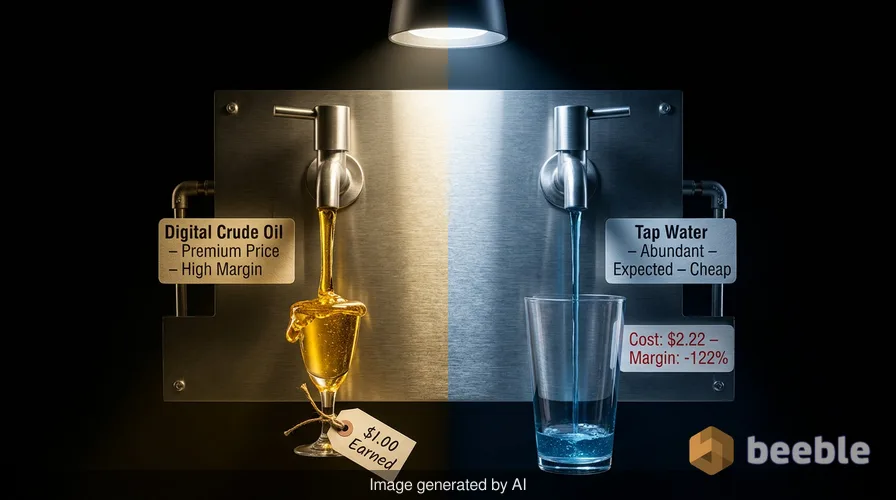
While popular narratives suggest OpenAI and Anthropic are locked in a struggle for absolute dominance, the underlying data indicates they are actually fighting over a shrinking profit margin. For the last two years, these companies operated on the assumption that they could charge a premium for intelligence. They positioned their AI models as the digital crude oil of the modern economy. However, a sudden shift in the market is making that oil look more like tap water: abundant, expected, and increasingly cheap.
OpenAI is currently evaluating significant price cuts for its developer tools to stay competitive with Anthropic. This move comes at a difficult time. According to recent reports, OpenAI is spending far more than it earns. In the first quarter of 2026, the company had an adjusted operating margin of -122%. This means for every dollar a customer paid for a ChatGPT subscription or an API call, OpenAI lost an additional $1.22. This financial gap is sustainable during a period of rapid growth, but the growth is slowing down.
the tokenmaxxing trap and corporate fatigue
Businesses are beginning to experience what industry analysts call tokenmaxxing. This is the practice of integrating AI into every possible corporate workflow without a clear plan for profitability. Companies are burning through their AI budgets at an unsustainable rate. Uber's CTO reportedly exhausted the company's entire 2026 AI budget by April. At JP Morgan, some employees are generating AI bills that exceed their own salaries. This level of spending was acceptable when AI was a shiny new experiment, but CFOs are now demanding a tangible return on investment.
For the average user, this means the era of subsidized AI is ending. Most AI companies originally offered flat-fee subscriptions, like the $20 monthly rate for ChatGPT Plus, to encourage people to try the technology. This price does not cover the actual cost of heavy usage. When a company needs to scale an AI tool for thousands of employees, they move to metered API pricing. They pay for every token or piece of data the model processes. As usage grows, these bills become a systemic risk to corporate balance sheets. This creates a volatile environment where companies are desperate to find cheaper alternatives.
why anthropic is winning the developer war
Anthropic has managed to find a more resilient path than its primary rival. While ChatGPT's share of global generative AI web traffic fell from over 77% in early 2025 to 53% by April 2026, Anthropic saw a massive surge. Its annualized revenue run rate jumped 422% in just five months, reaching $47 billion by May 2026. This growth was driven by Claude Code, a specialized tool that functions as a tireless intern for software engineers.
Anthropic reported its first profitable quarter in Q2 2026. This success suggests that specialized, efficient tools are more valuable to the market than general-purpose chatbots. Developers prefer Claude because it handles complex coding tasks with higher accuracy. However, even this success is under threat from an external force that neither OpenAI nor Anthropic can control. That force is the rapid advancement of open-source models coming out of China.
the deepseek disruption and the zero margin reality
DeepSeek, a Chinese AI lab, has fundamentally changed the math of the AI industry. They released frontier-grade models as open-source software. This allows other companies to host and run the models themselves without paying a middleman like OpenAI. Currently, inference providers serve DeepSeek models at roughly one-thirteenth the price of closed models like Claude Opus.
This creates a structural trap for Silicon Valley. OpenAI and Anthropic have to spend billions of dollars to train their next models. They need high prices to recover those costs. Meanwhile, open-source providers get the model for free and only have to pay for the electricity and hardware to run it. This keeps the price of AI processing near zero. To stay relevant, OpenAI has to cut prices, but every price cut makes their -122% margin even harder to fix.
| Provider | Model Type | Cost Comparison (Relative) | Revenue Status |
|---|---|---|---|
| OpenAI | Closed Source | 13.0x | Loss-Making |
| Anthropic | Closed Source | 10.0x | Profitable |
| DeepSeek | Open Source | 1.0x | Subsidized |
| Local Host | Open Source | 0.8x | Hardware Dependent |
how this impacts your digital life
From a consumer standpoint, this price war is a double-edged sword. On one hand, the apps you use every day will likely remain cheap or free as the underlying cost of AI drops. If your favorite productivity app uses DeepSeek instead of GPT-4, the developer can offer you more features without raising your subscription fee. The democratization of high-level intelligence is happening faster than anyone predicted.
On the other hand, the quality of service might become opaque. As companies switch to cheaper, open-source models to save money, they may not always disclose the change to the user. You might notice a subtle decline in the reasoning or creative capabilities of your tools. We are entering an era of "good enough" AI, where the goal is no longer to be the most intelligent, but to be the most cost-effective.
practical foresight for the ai consumer
As the industry shifts toward this low-margin reality, you should observe your own digital habits. Most users do not need a trillion-parameter model to summarize an email or draft a grocery list. Paying for a premium subscription might soon feel like paying for a fire hose when you only need a glass of water.
Look for tools that allow you to bring your own API key. This setup lets you choose which model you want to use and pay only for what you consume. It protects you from the price hikes that will inevitably come as OpenAI and Anthropic face pressure from their IPO investors to finally show a profit. The era of the all-powerful, centralized AI provider is ending. In its place, we are seeing a decentralized market where intelligence is a commodity rather than a luxury. This transition will be messy for the big tech companies, but it provides a more robust and affordable ecosystem for everyone else.
Sources: Wall Street Journal, Ramp AI Index, JP Morgan Analyst Note, AIPCon Industry Report 2026.



See you on the other side.
Our end-to-end encrypted email and cloud storage solution provides the most powerful means of secure data exchange, ensuring the safety and privacy of your data.
/ Create a free account
