


We have infinite music, yet we are running out of things to hear

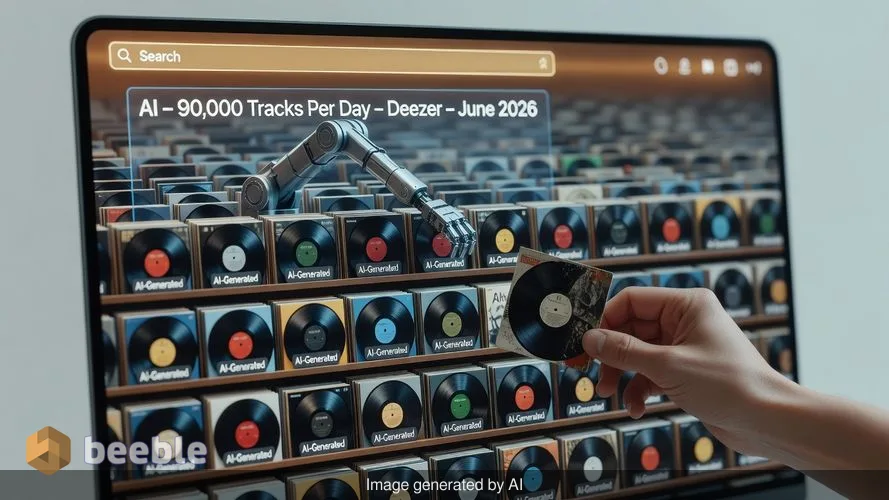
You open a streaming app and the world is at your fingertips, a vast ocean of every sound ever recorded, every genre ever conceptualized, and every mood you might ever feel, until you realize the current is pulling you toward a shore made of synthetic sand. The library feels expansive. The options look endless. The discoverability seems revolutionary. However, the machine guides your hand. The algorithm dictates the terms. The software creates the content.
Behind the scenes, the music industry is grappling with a shift that was purely speculative just three years ago. Deezer, a major player in the global streaming market, reports that over 50% of its daily uploads are now AI-generated tracks. In June 2026, this volume reached a peak of 90,000 tracks per day. This is not a gradual change. It is an industrial displacement of human effort by automated output. In January 2025, AI music was a mere 10% of daily uploads. By mid-2026, the machine outpaces the human songwriter. This rapid expansion creates a digital buffet where half the dishes are plastic replicas of actual food.
The assembly line of background noise
To understand why this matters to the average listener, we must look at how we consume music today. We often use music as a utility rather than an experience. We need "lo-fi beats to study to," "ambient rain for sleep," or "aggressive phonk for the gym." These genres are functional. They are background noise designed to fill a specific emotional or cognitive void. Because these tracks require no lyrical depth or complex narrative structure, they are the perfect candidates for automation.
Startups like Suno and Udio have streamlined the process of creation to a single text prompt. A user types a few keywords, and the model produces a radio-ready track in seconds. This speed allows for a volume of production that no human collective can match. When 90,000 tracks enter a system every 24 hours, the concept of a "new release" loses its meaning. The platform becomes a landfill of derivative sounds that mimic the structures of human art without the intent behind it.
The economics of a fractional cent
Streaming economics are built on a pool of revenue that is divided based on market share. If a platform has one million dollars to pay out and human artists accounts for all streams, they share that million. When AI-generated tracks flood the system, they siphoned off a portion of that pool. This is payment dilution. A fake track that gains 1,000 streams through a bot farm takes money away from a real band that earned 1,000 streams from real fans.
Deezer CEO Alexis Lanternier notes that the company is taking steps to safeguard the rights of artists and songwriters. The streamer plans to remove AI-generated tracks that have not been streamed in the past six months. They are also targeting tracks involved in fraudulent streaming patterns. This strategy aims to protect the financial viability of human creators. The industry is currently a battlefield where platforms try to separate authentic engagement from algorithmic noise.
The fractured response of the gatekeepers
The major streaming platforms are not in agreement on how to handle this influx. This lack of consensus creates a fragmented experience for creators and listeners. Bandcamp took a hard line by banning AI-generated tracks entirely to preserve its reputation as a haven for independent artists. Tidal chose to cut off monetization for such content, effectively making it a hobbyist graveyard.
Apple Music and Spotify have taken a more cautious path. Apple Music uses a voluntary tagging system, relying on the honesty of the uploader. Spotify has developed internal policies that focus on the extent of AI involvement rather than a total ban. Deezer has been the most aggressive in its technical response. It developed detection tools that can identify tracks made by Suno and Udio models. Last month, Deezer even released a tool that allows users to scan their Apple Music and Spotify playlists for AI intruders.
The death of the middle class musician
Historically, a musician could earn a modest living by providing functional music for libraries, commercials, or background playlists. This middle-class tier of the industry is the most vulnerable to the AI surge. If an ad agency can generate a corporate folk track for free using a prompt, they will not hire a session guitarist. If a lo-fi playlist curator can fill their queue with their own AI-generated assets to keep 100% of the royalties, they will stop featuring independent producers.
This shift mimics the architectural foundation of a sprawling city that is built too fast. The skyscrapers look impressive from a distance, but the plumbing is faulty and the walls are thin. We are building a music library that is technically perfect but emotionally hollow. Paradoxically, as the cost of producing a song drops to zero, the value of that song in the cultural consciousness also declines.
The illusion of discovery in a synthetic world
As a cultural critic, I notice the subtle ways this affects our relationship with art. We used to spend hours in record stores, flipping through physical sleeves and judging albums by their cover art and liner notes. Now, we lean back and let the "Auto-play" feature take over. We trust the algorithm to know our taste. But if the algorithm is being fed a diet that is 50% synthetic, our taste is being conditioned by machines.
We are moving toward a reality where the "Discover Weekly" playlist is a feedback loop of AI mimicking the very human artists we liked last month. This is the Content Walled Garden. It feels like exploration, but it is actually a circular path. The detection tools provided by Deezer are a start, but they require the listener to be an active participant in their own curation. Most listeners are passive. They want the music to happen to them, not to work for it.
Reclaiming the intentional ear
The rise of AI music to a 50% upload share is not just a technical milestone. It is a moment for us to reflect on why we listen to music at all. If we only want a specific frequency to help us focus, then the machine is a useful tool. But if we want to hear a human being process their grief, their joy, or their rebellion, we must become more discerning.
We must look for the seams in the sound. We must support platforms that prioritize human attribution. We must recognize that an infinite library is a burden if it obscures the voices that actually have something to say. The technology will not stop. The 90,000 daily tracks will likely grow to 200,000. The responsibility of finding the soul in the noise remains ours.
Sources: Deezer Corporate Statements, Alexis Lanternier Interview Data, Music Business Worldwide, The Verge, Billboard Pro.



See you on the other side.
Our end-to-end encrypted email and cloud storage solution provides the most powerful means of secure data exchange, ensuring the safety and privacy of your data.
/ Create a free account
