


Why did Apple just kick one billion Telegram users off the App Store for a single person's mistake?

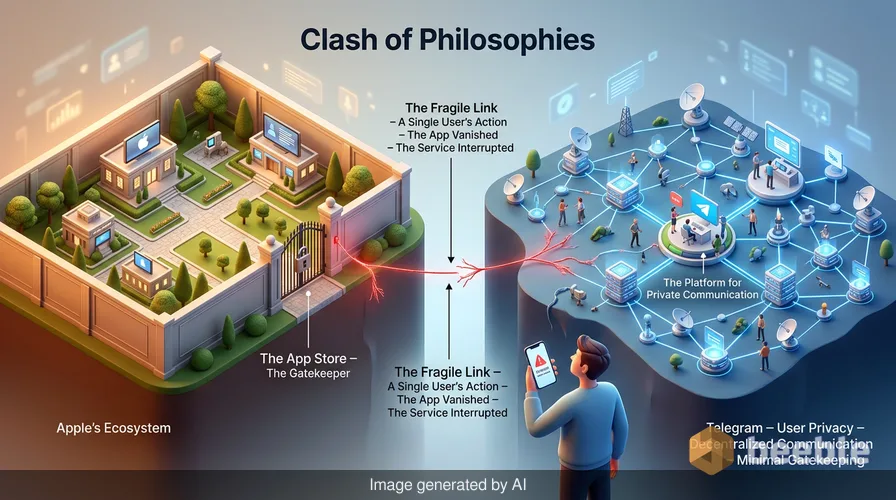
Have you ever considered how much power a single person has over the digital tools you use every day? On Tuesday, Telegram users worldwide discovered that the messaging app had vanished from the Apple App Store. The removal was brief, but the reason behind it is a stark reminder of how fragile the link between a developer and a smartphone user is. Apple pulled the app because one user shared illegal material. While the app is now back in its slot, the event raises serious questions about how tech giants police the platforms that billions of people rely on for private communication.
Looking at the big picture, this is a clash between two very different philosophies of the internet. On one side, you have Apple, the digital landlord that maintains strict rules for what is allowed in its building. On the other side, you have Telegram, a platform that prioritizes user privacy and decentralized communication. When these two collide, the average user is the one who finds their service interrupted. For a few hours, anyone who needed to download Telegram or update their app on an iPhone was out of luck.
The mechanism of a sudden digital eviction
Apple is the gatekeeper of the iOS ecosystem. Its App Store Review Guidelines are a set of laws that every developer must follow to reach the iPhone audience. One of the most strictly enforced rules involves child sexual abuse material. Apple has a zero-tolerance policy for this content. If a review finds such material, Apple has the power to pull the entire app, regardless of how many millions of innocent people use it.
In this specific case, Apple identified a violation tied to a single user. Telegram responded quickly. The developer removed the content and banned the user in question. Once the landlord was satisfied that the rule-breaker was gone, the app returned to the store. This cycle is not new for Telegram. In 2018, the app faced a similar suspension for what Pavel Durov, the founder of Telegram, called inappropriate content. The app was restored only after Telegram updated its safeguards.
Behind the jargon of content moderation, this is a game of whack-a-mole at an astronomical scale. Telegram has more than a billion monthly active users. To put that in perspective, if Telegram were a country, it would be the third most populous in the world. Managing the behavior of a billion people is a task that no human team can handle alone. Telegram relies on detection algorithms to scan public groups and channels. The company claims it has blocked nearly 338,000 groups and channels this year alone.
The debate over fair standards and scale
The brief removal caught the attention of other industry leaders. Tim Sweeney, the CEO of Epic Games, is a frequent critic of Apple's control over the App Store. He pointed out a logical gap in Apple's enforcement strategy. If the presence of one piece of illegal content is the standard for removing an entire app, then almost every communication tool on the market is at risk.
Sweeney asked how any app could operate at scale under these rules. He even mentioned iMessage, which is Apple's own messaging service. The reality is that illegal content exists on every platform where people can share files or messages. If Apple applied this standard to itself, iMessage would also face removal. Practically speaking, this suggests that the rules are applied more strictly to third-party developers than to Apple's own internal services.
From a consumer standpoint, this creates a volatile environment. You might rely on an app for your business or to stay in touch with family in a different country. If that app disappears because of the actions of a person you have never met, your communication is cut off. The systemic risk here is that a few large companies decide which apps are safe enough for the public to access.
A history of regulatory pressure
Telegram is no stranger to scrutiny from governments. In April, Britain's communications regulator, Ofcom, launched an investigation into the app. They cited evidence of illegal content sharing. Telegram denied these accusations and stated that they have nearly eliminated the public spread of such material since 2018. The company argues that its algorithms are effective at catching the vast majority of violations before they reach a wide audience.
In Australia, the online safety regulator fined Telegram in February. The issue was a delay in answering questions about how the app prevents child abuse material and extremist behavior. These regulatory battles show that Telegram is under a microscope. While the app uses encryption to protect user privacy, that same encryption makes it harder for regulators to see what is happening inside private chats.
| Action | Entity | Reason |
|---|---|---|
| Brief Suspension | Apple App Store | Violation of child safety guidelines by one user |
| Investigation | Ofcom (UK) | Evidence of illegal content sharing |
| Financial Fine | eSafety (Australia) | Delay in reporting moderation measures |
| 2018 Removal | Apple App Store | Presence of inappropriate content |
This table shows a pattern of friction. Telegram is a resilient platform, but it is constantly at odds with the entities that govern the digital world. The app has a decentralized structure that makes it popular in countries with strict censorship, but that same structure makes it a target for regulators in the West who want more transparency.
What this means for your digital life
For the average user, the takeaway is simple. Your access to the tools you use is not guaranteed. When you use an iPhone, you are a tenant in Apple's house. If Apple decides that your favorite app is not following the rules, that app can disappear in an instant. This is a foundational reality of the modern smartphone era.
If you rely on a single app for all your communication, you are vulnerable to these sudden changes. Historically, Telegram has been quick to fix these issues, but there is no guarantee that the next fix will be as fast. The bottom line is that the power of the gatekeeper is absolute. Even a platform with a billion users is subject to the whims of the store owner.
Essentially, this incident is a reminder to diversify your digital tools. If you use Telegram for sensitive work or vital family updates, it is a good idea to have a backup plan. This could be a different messaging app or a desktop version of the software that does not rely on the App Store for its existence. The digital world is interconnected, and a problem for one user can quickly become a problem for everyone.
Looking ahead, the tension between privacy and moderation will only grow. As AI tools make it easier for people to generate and share content, the job of the digital landlord will become even harder. You should observe your digital habits and recognize which platforms are most likely to face these types of shutdowns. By understanding the mechanics of how these apps are managed, you can better protect your own ability to stay connected.
Ultimately, the brief disappearance of Telegram was a minor inconvenience that points to a major systemic issue. One billion people lost access to a tool because of the actions of one individual. This is the price of a centralized app ecosystem. It is a trade-off between the convenience of a curated store and the freedom of an open web. As a consumer, being aware of this trade-off is the first step toward a more resilient digital life.
Sources:
- Apple App Store Review Guidelines
- Telegram Official Press Statements
- Ofcom Regulatory Reports
- Australia eSafety Commissioner Public Records
- Epic Games Public Communications



See you on the other side.
Our end-to-end encrypted email and cloud storage solution provides the most powerful means of secure data exchange, ensuring the safety and privacy of your data.
/ Create a free account
