


Why is Google finally pulling the plug on the voice assistant you actually know?

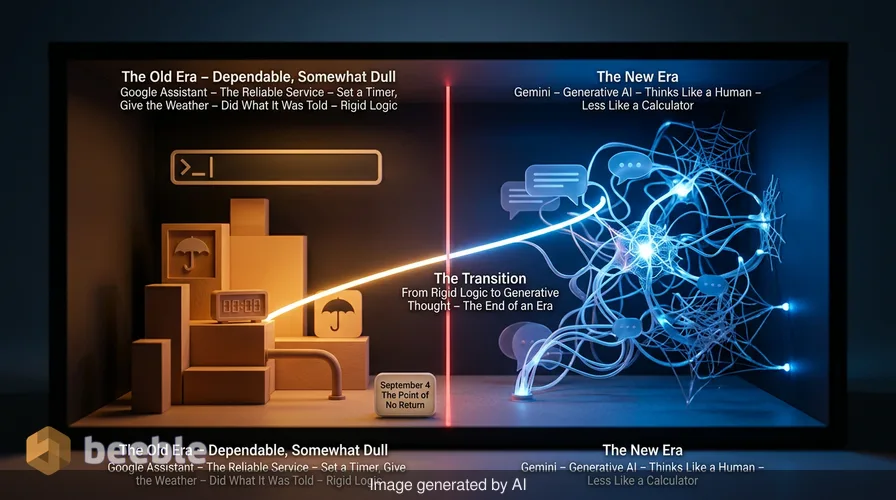
Have you ever wondered why your phone seems to get smarter and more confusing at the same time? For nearly a decade, Google Assistant was the reliable, if somewhat dull, voice in our pockets. It did what it was told. If you asked it to set a timer for ten minutes, it set a timer. If you asked for the weather, it gave you the temperature. It was a system built on rigid logic and predictable outcomes. That era ends on September 4.
Google is officially retiring Assistant on mobile devices. In its place, the company is installing Gemini, a generative AI that thinks more like a human and less like a calculator. For the average user, this is a massive shift in how we interact with our electronics. While the transition has been visible for months, the upcoming deadline marks the point of no return. You will either use the new AI or you will stop using voice commands entirely.
The fundamental shift from logic to language
To understand why this change is happening, we have to look under the hood of how these systems work. Google Assistant is a command-based tool. When you speak to it, the software looks for specific keywords and matches them to a pre-written script. If the script exists, the task happens. If it does not, the Assistant tells you it cannot help. This is why it is so reliable for simple tasks like turning off lights or playing music.
Gemini operates on a different set of rules. It is a large language model, which means it predicts the next most likely word in a sentence based on vast amounts of data. It does not have a library of scripts. Instead, it has a sophisticated understanding of context. Gemini is a tireless intern that can write an email, summarize a long document, or plan a vacation. Because it is generative, it does not just follow a path; it creates a new one every time you speak.
This power comes with a trade-off. Because Gemini is calculating probabilities rather than following a fixed script, it can be unpredictable. Sometimes it forgets it has access to your calendar. Other times, it might try to explain the history of time when you only asked it to turn on the porch light. Google is betting that users will trade the boring reliability of the old system for the creative potential of the new one.
What happens to your other gadgets
Your phone is not the only device affected by this deadline. The move to Gemini is a systemic change that stretches across the entire Google ecosystem. If you use a smartwatch with Wear OS, a pair of Pixel Buds, or a car equipped with Android Auto, the experience is about to change.
Google is forcing these connected devices to move to Gemini because they rely on your phone for their intelligence. When you press the voice button on your steering wheel, your phone does the heavy lifting. Once Assistant is gone from the handset, the car has no choice but to use Gemini. This creates a few practical hurdles for drivers who just want to send a quick text message without the AI getting too wordy.
There are a few exceptions to this rule. If you have an Android TV or a set-top box like a Chromecast, Assistant will stay active for a while longer. Vehicles with Google built-in (where the software is part of the car rather than running through your phone) also have a temporary reprieve. These platforms will eventually move to Gemini, but Google has not set a date for that transition yet.
The hardware and regional gap
Not everyone will make the jump to Gemini on September 4. This transition reveals a widening gap in the mobile market. Gemini requires significant processing power and memory to run effectively. If you have an older Android phone that does not meet the minimum specifications, you will not be able to use the new system.
In these cases, the voice control feature will simply stop working. This leaves owners of budget or legacy hardware in a difficult position. They are losing a core feature of their device without a replacement. Similarly, users in regions where Gemini is not yet supported will lose access to Assistant. These users will have to wait for Google to clear local regulatory or linguistic hurdles before they can talk to their phones again.
| Feature | Google Assistant | Gemini AI |
|---|---|---|
| Technology | Intent-based logic | Generative language model |
| Reliability | High for basic tasks | Variable based on context |
| Conversation | None (single commands) | Fluid and multi-turn |
| Tool Use | Hard-coded integration | Dynamic tool calling |
| Hardware | Low requirements | High requirements |
Why this move is happening now
From a market side, Google is in a race. The tech industry is currently obsessed with generative AI, and Google cannot afford to maintain two separate voice systems. Maintaining Assistant costs money, engineering time, and server space. By consolidating everything under Gemini, Google creates a streamlined experience that is easier to update and monetize.
Historically, Google has been quick to kill off products that no longer fit its overarching strategy. We saw this with Reader, Plus, and Stadia. Assistant is not being killed because it failed, but because it is an old tool in a new world. The silicon inside our phones is now powerful enough to handle complex AI, and Google wants to prove that its software is the best in the business.
Practically speaking, this means the voice assistant is no longer just a utility. It is a product Google wants you to engage with for longer periods. Assistant was designed to get you out of the interface as quickly as possible. Gemini is designed to keep you talking, exploring, and eventually, perhaps, subscribing to premium AI tiers.
The adjustment period for users
If you have been clinging to Assistant, the next few weeks will be a period of friction. You will have to learn how to talk to your phone differently. With Assistant, you were essentially a programmer using voice codes. With Gemini, you are a manager giving directions to a staff member.
One common frustration with Gemini is its tendency to go off on tangents. If you ask it to "message Mom," it might ask which Mom you mean or offer to draft a long, poetic note instead of just opening the text box. This can be annoying when you are in a rush. However, as the system matures, these rough edges usually disappear. The goal is for the AI to learn your habits and eventually anticipate what you need before you even finish your sentence.
How to prepare for the switch
Since the deadline is less than a month away, it is time to check your settings. If you have already opted into Gemini, you likely noticed that the old Assistant logo has already disappeared. If you have stayed on the old system, you should expect a prompt to switch every time you use a voice command.
For the average user, the best approach is to start testing Gemini now. Try your most frequent commands to see how it handles them. If you find it too talkative, you can often go into the settings to set the response length to a shorter mode. If your phone is too old to support the new software, you may need to start looking at an upgrade or get used to typing your requests.
Ultimately, the death of Assistant is a sign that the way we use technology is shifting. We are moving away from simple tools and toward complex partners. It might be frustrating to lose a familiar interface, but this change is foundational to how Google plans to build its ecosystem for the next decade.
Sources: Google Workspace Updates, Android Developers Blog, Reddit Tech Community Reports.



See you on the other side.
Our end-to-end encrypted email and cloud storage solution provides the most powerful means of secure data exchange, ensuring the safety and privacy of your data.
/ Create a free account
