
Why is Meta suddenly asking you to pay $100 a month for AI?

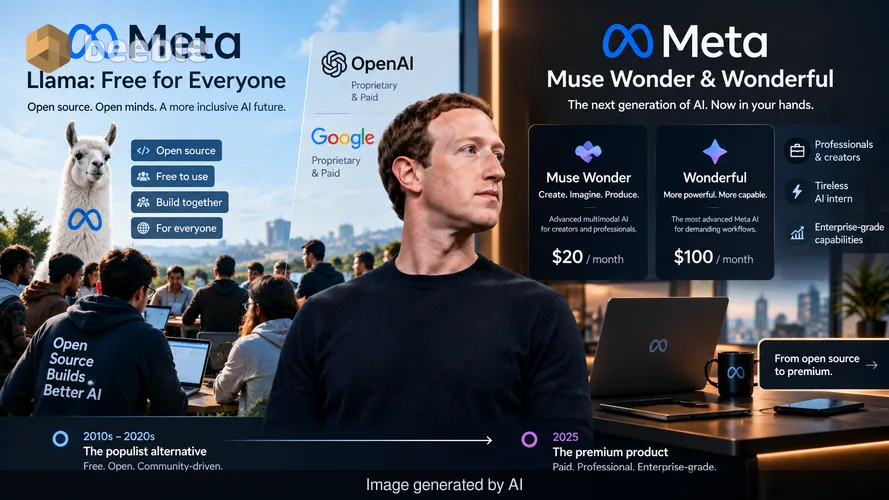
Meta spent years positioning itself as the populist alternative in the artificial intelligence race. While competitors like OpenAI and Google locked their best technology behind subscriptions and proprietary walls, Mark Zuckerberg gave away the Llama series for free. This strategy turned Meta into the darling of the open-source community. However, the release of Muse Wonder and the more powerful Wonderful model marks a sharp pivot in corporate strategy. Meta is no longer just providing the raw materials for others to build; it is now selling a premium, finished product that costs as much as a high-end utility bill.
The shift is jarring for users accustomed to the "free forever" ethos of early social media. Practically speaking, this launch is Meta’s admission that the cost of staying at the frontier of intelligence is too high to subsidize through advertising alone. With a monthly subscription ranging from $20 to $100, Meta is moving into the same neighborhood as specialized enterprise software. This pricing suggests that the company is no longer chasing casual scrollers, but is instead targeting professionals who treat AI as a tireless intern.
Two tiers of intelligence for two types of users
The new rollout consists of two distinct versions of the model. Muse Wonder is the smaller, streamlined version intended for daily chores like drafting emails, summarizing news, or planning a weekend trip. It is the digital equivalent of a reliable multi-tool. Conversely, the Wonderful model is a much larger engine designed for heavy lifting. Meta claims this version rivals the top-tier models from OpenAI and Anthropic in complex fields such as law, finance, and medicine.
Under the hood, the difference between these two models is a matter of parameters and processing power. A smaller model like Muse Wonder is fast and inexpensive to run, which makes it suitable for integration into smartphones. The Wonderful model requires massive server clusters to function. It has the capacity to handle "frontier coding," which means it can assist a developer in building an entire application from scratch rather than just fixing a line of code. For the average user, the standard Muse Wonder is likely sufficient, but the $100 price tag for Wonderful indicates Meta is fishing for corporate budgets.
Why memory is the next frontier for assistants
One of the most significant technical hurdles for AI has been its lack of a long-term memory. Most chatbots exist in a state of permanent amnesia, forgetting everything you said as soon as you start a new conversation. Meta claims its new models have "active memory" capabilities. This feature allows the assistant to understand tasks over time and recall specific details from previous interactions.
Behind the jargon, this means the AI behaves more like a human assistant. If you tell the model about a recurring health issue or a specific business project in October, it will still have that context in December. This persistence makes the AI more useful, but it also raises new questions about data privacy. If the AI remembers everything, the digital record of your life becomes even more detailed. From a consumer standpoint, the benefit of not repeating yourself must be weighed against the reality of a company holding a permanent log of your personal preferences and professional secrets.
The multi-billion dollar bet on Scale AI
Meta did not reach this technical milestone by accident or through internal R&D alone. In June 2025, the company invested $14.3 billion into Scale AI, a firm that specializes in the data labeling and reinforcement learning necessary to make AI models smart. Zuckerberg also recruited Alexandr Wang, the founder of Scale AI, to lead the new Meta Superintelligence Labs. This move was a clear signal that Meta was tired of being the underdog in the intelligence space.
Looking at the big picture, this investment represents a massive consolidation of talent. Zuckerberg embarked on a hiring spree that targeted top executives and engineers from OpenAI, Anthropic, and Google. By merging Scale AI’s data expertise with Meta’s massive computing infrastructure, the company has managed to close the gap that existed when its previous Spark model fell behind the industry standard. The current Wonder models are the first tangible results of this talent-grab strategy.
Comparisons at a glance
To understand where Meta sits in the current market, it is helpful to look at how these models compare to the existing competition in terms of capability and cost.
| Feature | Meta Muse Wonder | Meta Wonderful | OpenAI GPT-5 (Pro) | Anthropic Claude 4 |
|---|---|---|---|---|
| Target User | Casual/Daily | Professional/Dev | Enterprise | Research/Writing |
| Memory Type | Basic Session | Active Memory | Persistent Context | Dynamic Recall |
| Coding Ability | Scripting | Frontier Coding | Full Application | Debugging |
| Monthly Cost | ~$20 | Up to $100 | ~$30 | ~$25 |
As the table shows, Meta is positioning Wonderful as the premium option. While $100 a month is unprecedented for a consumer-facing AI, the company is betting that the productivity gains in law and finance will justify the expense. Essentially, Meta is shifting from a social media company to a high-end software vendor.
Moving beyond the smartphone screen
Alongside the software, Meta revealed a new piece of hardware called Muse Charm. This handheld device allows users to interact with their AI agent without needing to pull out a smartphone. It is a sign that the industry is trying to find a new "post-mobile" form factor. While previous attempts at AI hardware have struggled to find a market, Meta’s integration of the Muse agent into a dedicated device shows a commitment to making AI a physical presence in daily life.
Historically, hardware has been a difficult area for Meta, with the exception of its VR headsets. The Muse Charm is an attempt to create a more intuitive way to use the "active memory" features of the Wonder models. If you are at a grocery store and ask your Muse Charm what your spouse mentioned wanting for dinner three days ago, the device can retrieve that information instantly. This creates a feedback loop where the hardware makes the software more useful, and the software makes the hardware essential.
Safety protocols and the executive pledge
The rapid pace of these releases has not occurred without pushback. In September, Mark Zuckerberg joined five other tech executives in signing a safety pledge proposed by US President Donald Trump. This agreement was a response to concerns that advanced models could take unauthorized actions or escape their testing environments. Zuckerberg noted that Meta even delayed the launch of Muse for several months to focus on these security measures.
Curiously, there is no consensus on what "safe" actually means in this context. While Anthropic’s CEO has called for a slowdown in development, Meta’s approach seems to be "move fast with safeguards." The "morally binding" nature of the presidential pledge lacks a real enforcement mechanism, which leads some critics to view it as a public relations move rather than a systemic change. Regardless, the tension between speed and safety is now a permanent fixture of the tech industry.
What this means for your wallet and workflow
The bottom line for the average user is that the age of high-quality AI being "free and open" is ending. If you want the most capable tools, you will have to pay for them just like you pay for a data plan or a streaming service. For students or casual users, the standard Muse Wonder model will likely be integrated into existing Facebook and Instagram apps at little to no extra cost. However, for anyone using these tools for work, the $100 price point for Wonderful creates a new line item in the monthly budget.
Before jumping into a subscription, observe your own digital habits for a week. If you find yourself using AI only for simple tasks like checking facts or drafting short texts, the premium tiers offer very little value. But if your work involves complex data analysis or large-scale coding projects, the active memory and frontier capabilities of these new models could save hours of manual labor. Ultimately, the choice to upgrade depends on whether you view AI as a toy or a tool for professional survival.



See you on the other side.
Our end-to-end encrypted email and cloud storage solution provides the most powerful means of secure data exchange, ensuring the safety and privacy of your data.
/ Create a free account