


Why OpenAI is Winning the AI Race by Abandoning its Original Finish Line

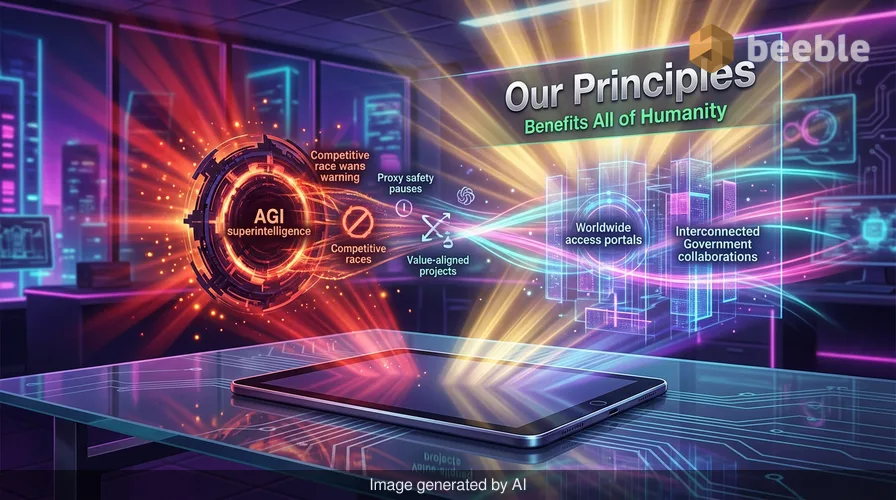
For nearly a decade, the tech world has operated under a singular, almost religious assumption: that OpenAI existed to birth a digital god. This hypothetical entity, known as Artificial General Intelligence (AGI), was supposed to be the ultimate finish line— a point where machines would surpass human cognitive abilities across the board. The narrative was simple. OpenAI would build it, ensure it didn't accidentally wipe us out, and then, presumably, the world would change forever.
Looking at the big picture, that narrative has officially collapsed. On Sunday, OpenAI published an update to its core operating principles that signals a systemic shift in how the most influential AI company on the planet views its own future. Instead of a singular focus on a world-changing superintelligence, the company is pivoting toward becoming a robust, foundational utility provider. It is no longer trying to build the finish line; it is trying to own the track, the stadium, and the broadcast rights.
Challenging the AGI Obsession
While it seems true that AGI remains a distant goal in the company’s marketing, the reality of these new principles is far more pragmatic. In 2018, OpenAI’s mission was almost monastic. It was a research-first organization with a staunch, singular focus on safe AGI development. The 2018 document explicitly mentioned a fiduciary duty to humanity and a commitment to minimizing conflicts of interest.
Fast forward to April 2026, and the tone has shifted from philosophical to industrial. Behind the jargon of democratizing AI, OpenAI is essentially admitting that the concept of a singular AGI event is a distraction. Sam Altman recently described AGI as having a ring of power that makes people do crazy things. To counter this, OpenAI is no longer waiting for a magical breakthrough. Instead, they are integrating AI into the world’s plumbing right now.
Practically speaking, this means OpenAI has moved from being a visionary lab to an emerging infrastructure giant. They aren't just looking for the ghost in the machine; they are looking for the machine that runs the government, the hospital, and the power grid. By de-emphasizing the AGI finish line, they have cleared the way to behave like any other massive tech conglomerate, prioritizing scale and integration over the purity of their original research goals.
The Death of the Step-Aside Clause
One of the most striking changes in the 2026 document is what is missing. In the early days, OpenAI had a remarkably altruistic policy: if another value-aligned, safety-conscious project was close to achieving AGI, OpenAI would stop its own development and help them instead. It was the ultimate safety net, a promise that the race for intelligence wouldn't become a reckless sprint to the edge of a cliff.
That clause is gone. In its place is an acknowledgment that OpenAI is now a much larger force in the world. Historically, this is a classic pivot point for disruptive companies. As a startup, you can afford to be a cooperative researcher; as an $800 billion entity, you have stakeholders, massive infrastructure costs, and a competitive rivalry with peers like Anthropic that makes stepping aside a financial impossibility.
This shift suggests that OpenAI has moved from a collaborative model to a competitive one. The company now sees itself as too big to stop. Instead of stepping aside for safety, they are doubling down on the idea that they are the only ones capable of managing the risks. Under the hood, this looks less like a safety precaution and more like a move to consolidate influence before the technology becomes truly decentralized.
From Research Lab to Defense Contractor
To understand the practical impact of these shifting principles, we have to look at how they are being applied in the real world. Earlier this year, a significant rift opened between the top AI labs and the federal government. When Anthropic refused to grant the Trump administration unfettered access to its Claude models for military use, the company was promptly labeled a supply chain risk.
Conversely, OpenAI saw an opportunity where others saw an ethical dilemma. By signing a massive deal with the Department of War in late February, OpenAI cemented its role as the digital crude oil of modern statecraft. This move would have been unthinkable under the 2018 principles, which were designed to avoid the consolidation of power. In 2026, however, OpenAI views this as a necessary step to ensure that cyber-resilient models are integrated into critical infrastructure.
On the market side, this is a brilliant tactical maneuver. While some users have boycotted ChatGPT in favor of Claude, the sheer scale of government contracts provides OpenAI with a level of financial stability and systemic integration that no consumer-facing chatbot ever could. They are effectively making themselves a foundational part of the national interest. If the government relies on your models to defend against pathogens or secure the grid, you are no longer just a tech company—you are a public utility.
The Economics of Universal Prosperity
OpenAI’s new principles also include a somewhat opaque call for new economic models. They are asking governments to rethink how wealth is distributed as AI drives down the cost of labor and increases the demand for infrastructure. At first glance, this sounds like a generous vision for a post-scarcity world. However, an analytical translator might see it differently.
OpenAI is currently spending unprecedented amounts of money on compute power and data centers, far outstripping their current revenue. They describe this as a fundamental belief in a future of universal prosperity, but it is also a massive financial gamble. By calling for new economic models and government-funded infrastructure, OpenAI is essentially asking for a taxpayer-backed safety net for their own expansion.
In everyday life, this translates to a future where the cost of AI might be hidden in our taxes or our utility bills rather than a $20 monthly subscription. They are pushing for a world where AI is as ubiquitous and invisible as electricity. While this could lead to widespread flourishing, it also places a transparently high amount of control in the hands of the company that provides the underlying tech.
What This Means for You
For the average user, these changes in OpenAI’s charter might feel like a distant corporate shuffle, but the effects will be tangible sooner than you think.
- Tool Reliability vs. Innovation: Expect ChatGPT and its successors to become more predictable and integrated into your work life, but perhaps less experimental. OpenAI is focusing on being a streamlined tool for business and government, not a playground for sci-fi fantasies.
- Privacy and Sovereignty: As OpenAI aligns more closely with government agencies, the line between private tech and state infrastructure blurs. Users should be more mindful than ever about what data they feed into these systems, as the principles of safety now include national security interests.
- Cost and Access: OpenAI’s push for decentralization sounds good, but their reliance on massive infrastructure suggests that the power to run high-level AI will remain in the hands of those who can afford the electricity and the chips.
Ultimately, OpenAI has traded its role as a cautious observer for that of an active architect. They are no longer waiting to see what AGI looks like; they are building the world they want it to inhabit. For us, the challenge is to stop looking for the grand arrival of a super-intelligent machine and start paying attention to the ways this tireless intern is already rewriting the rules of our economy, our defense, and our daily digital habits.
Zooming out, the most important takeaway is that the AI revolution has moved out of the lab and into the lobby. The focus has shifted from whether a machine can think to how many parts of our lives a machine can manage. OpenAI is no longer trying to reach the finish line of human intelligence—they are busy building the new world that begins right where they currently stand.
Sources:
- OpenAI Official Documentation: "Our Principles" (2018 and 2026 versions)
- Sam Altman’s Personal Blog: "The Ring of Power" (April 2026)
- Market Reports: AI Lab Valuations and Series G Funding Data (April 2026)
- Department of War Press Release: Strategic Partnership for Cyber-Resilience (February 2026)
- Anthropic Public Statement: Response to Federal Supply Chain Directives (March 2026)



See you on the other side.
Our end-to-end encrypted email and cloud storage solution provides the most powerful means of secure data exchange, ensuring the safety and privacy of your data.
/ Create a free account
