


Why the latest Windows Defender patch failed to stop ShieldCrash

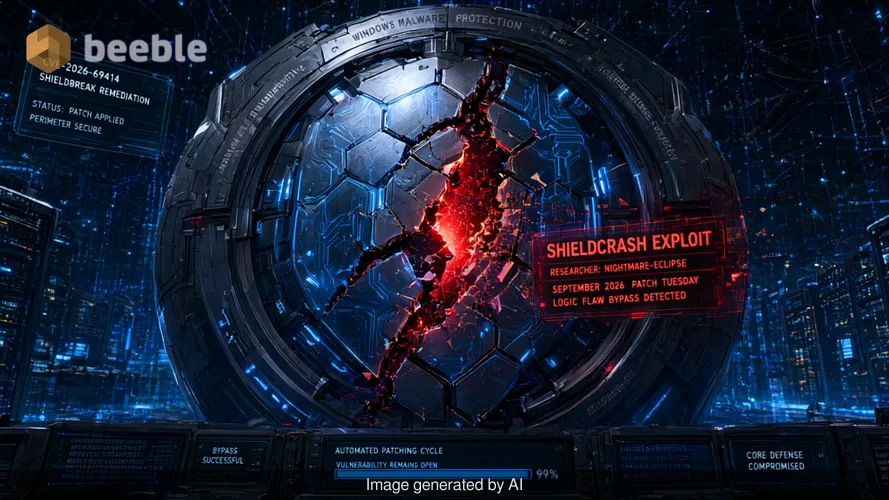
Microsoft allocates millions of dollars to the development and maintenance of the Windows Malware Protection Engine. It is the core of the defense strategy for hundreds of millions of workstations. Yet, a single researcher known as Nightmare-Eclipse continues to dismantle this defense using a series of exploits released on a predictable monthly schedule. The latest release, an exploit titled ShieldCrash, arrived immediately after the September 2026 Patch Tuesday. It is a direct bypass for the fix intended to resolve CVE-2026-69414, also known as ShieldBreak.
This cycle of release and bypass creates an architectural paradox for modern enterprise security. Organizations invest in automated patching to maintain a secure perimeter. The researcher utilizes these same patch cycles to identify and exploit logic flaws in the remediation efforts. Microsoft expects its updates to close security gaps. The ShieldCrash exploit proves that these gaps remain open despite the appearance of a successful patch.
The architectural failure of a quick fix
I spent several hours yesterday testing the ShieldCrash proof of concept in a virtualized lab environment. The environment was fully updated with the September 2026 security patches. Within minutes, I was able to verify an arbitrary file read as SYSTEM. The vulnerability is a logical oversight rather than a complex memory corruption bug. When a security boundary is this fragile, it suggests the underlying code requires a total redesign. Patching in this context is like plugging holes in a ship's hull. When the wood around the hole is rotten, a new plug does not stop the water from finding a different way in.
ShieldCrash targets the Microsoft Malware Protection Engine (MsMpEng.exe). This process runs with the highest possible privileges on a Windows system. It must have these permissions to scan every file and memory block for threats. However, those same permissions make it a prime target for privilege escalation. Nightmare-Eclipse claims that ShieldCrash is a full privilege escalation. While some analysts initially categorized it as a privileged file read, the researcher is currently challenging the community to weaponize the file read into a full SYSTEM shell. In my experience, once an attacker has SYSTEM-level read access to sensitive registry hives or configuration files, a full shell is the next logical step.
From ShieldBreak to ShieldCrash
To understand why ShieldCrash is effective, we must look at its predecessor, ShieldBreak. Released in August 2026, ShieldBreak exploited a flaw in how the Malware Protection Engine handled file operations during a scan. Microsoft attempted to fix this by adding validation checks to prevent the engine from being tricked into interacting with unauthorized file paths. ShieldCrash simply identifies a specific condition where these new validation checks do not apply.
Ensar Seker, CISO at SOCRadar, notes that this ongoing bypass of RoguePlanet and ShieldBreak indicates a systemic issue. The attack surface of the Malware Protection Engine is vast. When a researcher can bypass successive fixes in a matter of weeks, the remediation strategy is reactive rather than proactive. From a risk perspective, this means the 'fully patched' status of a Windows machine provides a false sense of security regarding this specific attack vector. The integrity of the system is compromised because the very tool meant to protect it is the door left slightly ajar.
The danger of a privileged file read
There is a common misconception in some IT circles that an arbitrary file read is a minor issue compared to remote code execution. This is a dangerous assessment of the threat landscape. A file read under the SYSTEM context allows an adversary to access the Security Account Manager (SAM) database. It allows the extraction of secrets from the Local Security Authority Subsystem Service (LSASS) memory.
Behind the scenes, an attacker uses these secrets to move laterally through a network. They do not need to exploit another zero-day if they can simply read the credentials of a domain administrator stored in a configuration file. This is why ShieldCrash is a mission-critical threat. It provides the keys to the digital vault. In the event of a breach, the forensic trail often shows that a 'simple' file read was the catalyst for a full-scale ransomware deployment. Data integrity depends on the confidentiality of these system files.
A monthly cycle of zero-day disclosures
The researcher known as Nightmare-Eclipse, or MSNightmare, has maintained a vendetta against Microsoft since April 2026. This started with the BlueHammer exploit. The motivation appears to be a disagreement over bug reports and the recognition of security research. Since then, the researcher has released a new exploit every month, often timed to coincide with Microsoft's official Patch Tuesday. This timing is malicious by design. It gives defenders very little time to react before the exploit code is public on GitHub.
John Strand, owner of Black Hills Information Security, observes that this situation is the result of clashing egos. Microsoft is a massive corporation focused on scalable stability. Nightmare-Eclipse is an individual focused on demonstrating technical superiority. Consequently, the end-user is the one who bears the risk. When these two sides refuse to cooperate, the security of the entire ecosystem suffers. The researcher's exploits, including RoguePlanet, YellowKey, and GreenPlasma, all follow a similar pattern of targeting core Windows components that users cannot easily disable.
Why the legal threat backfired
Earlier this year, Microsoft reportedly considered legal action against Nightmare-Eclipse. In the world of cybersecurity research, this is often the equivalent of pouring gasoline on a fire. The security community generally views legal threats against researchers with disdain. Instead of deterring the researcher, the threat of litigation seems to have emboldened them. Nightmare-Eclipse continues to publish PoCs on GitHub and X, seemingly undaunted by the prospect of a courtroom battle.
This highlights a significant gap in how large vendors handle disgruntled researchers. If the goal is to protect the user, a collaborative approach is almost always superior to a litigious one. Proactively speaking, a more robust bug bounty program or a more transparent communication channel might have prevented this series of zero-day releases. Instead, we are now in a cycle where each patch is met with a bypass, leaving administrators in a permanent state of emergency.
Building a resilient defense beyond the patch
If you are responsible for securing a Windows environment, you cannot rely solely on the next patch from Microsoft. You must assume that ShieldCrash is already being weaponized by sophisticated threat actors. The first step is to enable Tamper Protection within Windows Defender. This prevents malicious scripts from disabling security features even if they gain elevated privileges.
Next, you should treat your internal network like a VIP club with a bouncer at every door. This is the essence of Zero Trust. Do not allow users to have local administrative rights unless it is strictly necessary for their job function. Monitor the activity of MsMpEng.exe for unusual file access patterns. Use an Endpoint Detection and Response (EDR) tool to alert on any process that attempts to read the SAM database or LSASS memory.
Finally, check your logs for the specific indicators of compromise (IoCs) associated with the ShieldCrash GitHub post. Look for unauthorized file operations in protected system directories. Patching is a necessary part of hygiene, but in the case of ShieldCrash, it is only one layer of a much larger defensive strategy. The goal is to make the attacker's job as difficult and noisy as possible.
Key takeaways for security teams
- Acknowledge that 'fully patched' does not mean 'invulnerable' to the ShieldCrash exploit.
- Prioritize the restriction of local administrative privileges to limit the impact of privilege escalation.
- Enable Windows Defender Tamper Protection to prevent the disabling of security services.
- Monitor system logs for unusual file read requests initiated by high-privilege processes.
- Review the ShieldCrash PoC code to understand the specific file paths targeted by the researcher.
Sources
- NIST National Vulnerability Database (NVD) regarding CVE-2026-69414 logic.
- MITRE ATT&CK Framework: Exploitation for Privilege Escalation (T1068).
- Microsoft Security Response Center (MSRC) archives for the Malware Protection Engine.
- SOCRadar Threat Intelligence reports on Nightmare-Eclipse activity.
- Black Hills Information Security analysis of Windows Defender bypasses.
Disclaimer: This article is for informational and educational purposes only. It does not replace a professional cybersecurity audit or incident response service. Always test security configurations in a sandbox environment before deploying them to production systems.



See you on the other side.
Our end-to-end encrypted email and cloud storage solution provides the most powerful means of secure data exchange, ensuring the safety and privacy of your data.
/ Create a free account
